How long do cigarette cravings really last? The 4‑minute rule
July 29, 2026·4 min read
Cigarette cravings peak fast and fade in about 3–5 minutes. Why they come in waves, what makes them pass, and how to get through those 4 minutes.
When a craving hits, the biggest trap is this thought: the urge will keep getting worse.
Your mind says: this feeling is going to grow, become unbearable, and in the end you’ll smoke. So lighting up now feels like “cutting short” a long torture.
That prediction is wrong. And knowing it’s wrong is often stronger than the craving itself.
How long does a cigarette craving last?
On average, 3–5 minutes — roughly four minutes. In this article, “four minutes” means that range; it can move by a minute or two depending on you and the trigger.
For scale: boiling an egg takes about the same time. A craving doesn’t last longer than a soft‑boiled egg.
A craving isn’t a straight line, it’s a wave. It rises, hits a peak, then falls. Even if you do nothing, it falls — because the signal that triggered the urge naturally fades out.
The most intense moment is usually around the end of the first minute. So the point when you’re thinking “I can’t take this” is actually the top of the wave. After that, it’s downhill.
Why do cravings come in waves?
Because most cravings aren’t pure chemistry; they’re driven by triggers.
Coffee cup, steering wheel, phone screen, leaving work, alcohol, an argument. Your brain has paired these cues with cigarettes for years. When the cue appears, the brain asks for the reward it’s expecting.
When the reward doesn’t show up, that signal keeps ringing for a short while, then cuts off. That cut‑off time is the 3–5 minutes.
⚠️ Key difference: every wave you ride out weakens the link to that trigger. So waiting doesn’t just get you through this craving; it also makes the next one smaller. When you give in, the link is refreshed.
Are cravings different in the first 72 hours?
Yes. In the first days, the waves are more frequent and more intense. That’s because on top of the triggers, you also have nicotine withdrawal.
Measurable nicotine leaves the body in about 72 hours. After that, it’s all about triggers — and triggers fade with repetition. We’ve covered the full first 72 hours and the symptom timeline separately.
What helps you get through those four minutes?
People report that these all help — and they all take less than four minutes:
Breathing. Inhale for four seconds, hold for seven, exhale for eight. Three rounds. This slows your heart rate and pulls your body out of high‑alert mode.
Changing location. Step out of the room you’re in, go outside, stand up. The trigger is often tied to the place; when the place changes, the signal weakens.
Water. One glass, slowly. Having something in your mouth satisfies part of the urge.
Five senses. Name five things you can see, four sounds you can hear, three sensations you can feel. It turns your attention from the inside to the outside.
Keeping your hands busy. Pen, keychain, your phone case. Smoking isn’t just about the mouth; it’s also a habit in your hands.
Timing it. Set a four‑minute timer on your phone. That turns a vague discomfort into something with a clear end. Watching the timer can feel boring — but “being bored” is the most harmless version of a craving.
“But my cravings last much longer”
There are two options.
First: the wave passed, but the thoughts stayed. The physical urge ended, but you’re still thinking about a cigarette. That’s no longer a craving, it’s a mental loop — and it cuts off when your attention fully shifts somewhere else.
Second: you’re staying inside the trigger. Sitting at a table full of people who are smoking and waiting for the urge to pass means the wave keeps getting retriggered. It’s like standing in front of a bakery window and hoping your hunger will go away.
What happens if you smoke one?
The wave doesn’t disappear — it gets postponed.
As soon as nicotine arrives, your brain gets its reward and the link to that trigger is renewed. The next wave comes back with the same strength, sometimes even a bit earlier.
That’s why “I’ll just have one to calm down” feels true in the short term but backfires over time. We’ve also written about why one cigarette doesn’t erase your progress; the two ideas don’t contradict each other: one cigarette isn’t the end of everything, but it isn’t free either.
When does it stop completely?
Both frequency and intensity keep dropping. In the first weeks you might get several waves a day; after a few months it’s down to once or twice a week, then once a month.
A random, brief urge months later is still considered normal — and by then the wave usually lasts only a few seconds.
Seeing what you gain in return makes the trade easier: your body’s repair timeline moves forward with every one of those four‑minute wins.
The craving lasts four minutes. The decision lasts a lifetime. Not a bad swap.
Next time a wave hits, start the timer. The first climb goes like this — wave by wave, four minutes at a time.
If you’re right in the middle of a craving and want something guided in your hand: the Tar2Star app opens a three‑round breathing exercise and a simple distraction task with one tap — built exactly for these minutes.
This page is a photo. The app is the film.
These numbers show today. Tar2Star shows you a new one every morning — and stays with you when a craving hits.
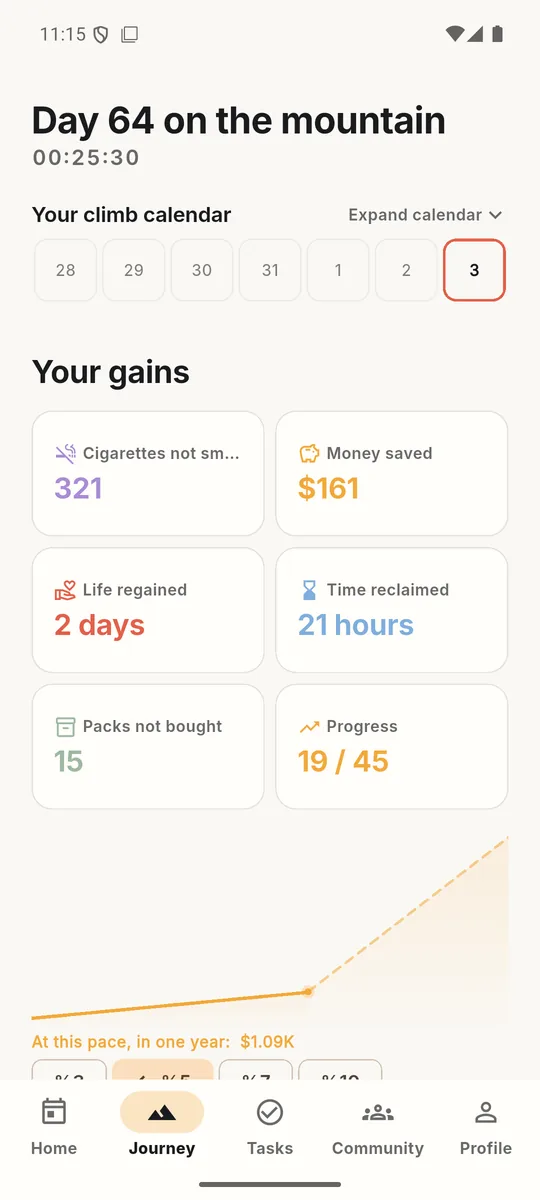
Your gains day by day: cigarettes not smoked, money saved, life reclaimed.
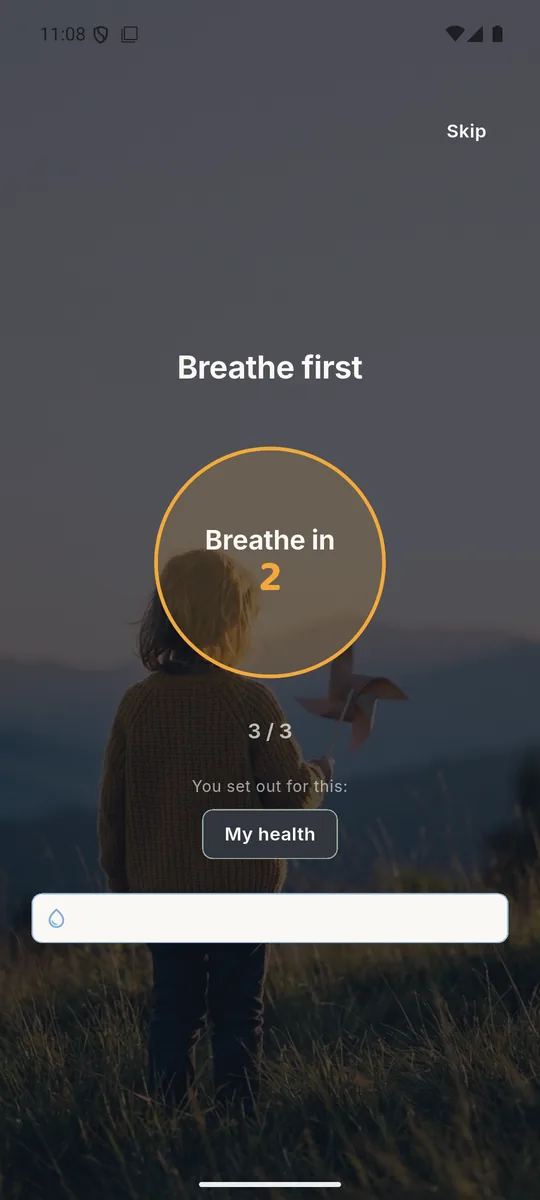
One tap when a craving hits: breathe first. A three-round guided breathing exercise.
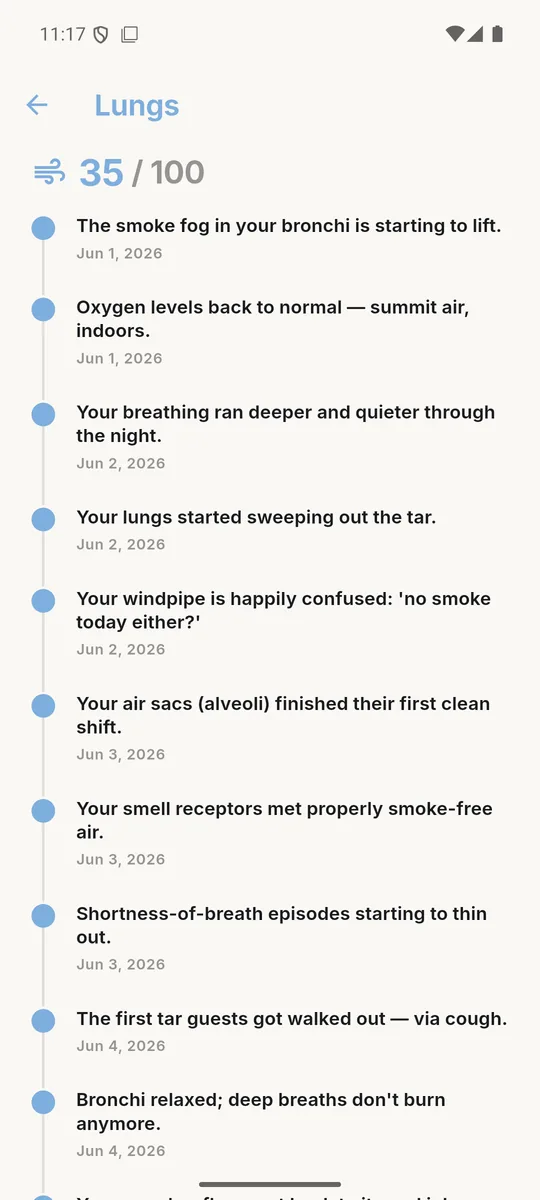
Six routes, 600 stops. Whatever is repairing in your body, you read it there.

You choose the view you are climbing — summit, forest, sea, or your own photo.
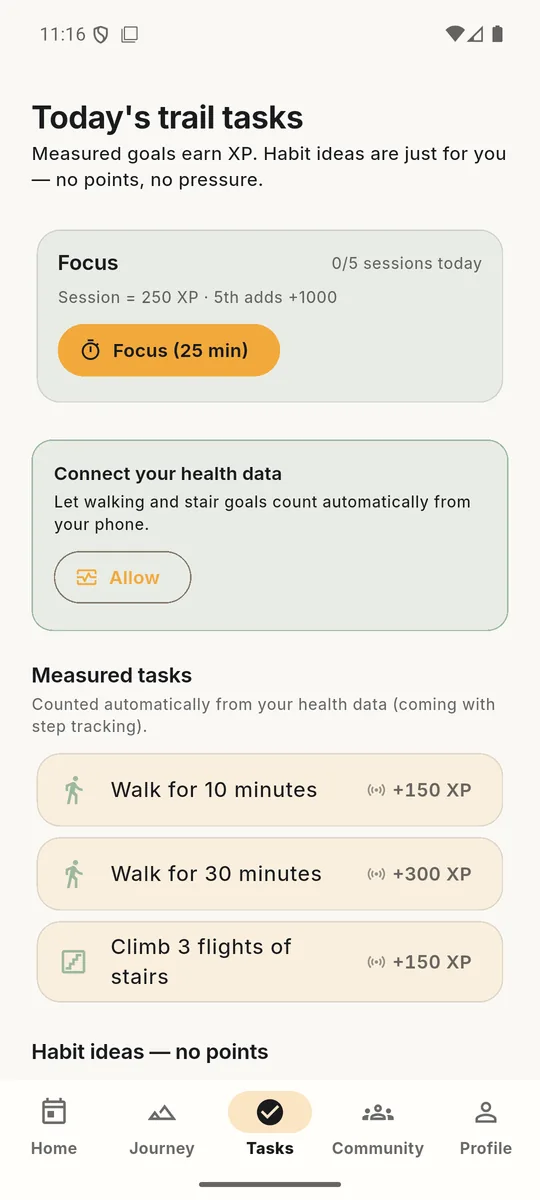
Small tasks every day. You are building a habit, not willpower.
Real screens from the app.
- Hear your own voice when a craving hits — the reason you quit, in your own words. You can add the voices of people you love, too.
- One tap for guided breathing and a distracting task — enough to fill those four minutes.
- 600 stops across six routes: read exactly what is repairing in your body today.
- Your numbers live on your device and keep counting offline — even on a plane.
- You pick the view you are climbing: summit, forest, sea, or your own photo.
- Interface, content and notifications in 14 languages.
You start free. The first day of the journey and the last are both yours.