Smoking in the car: the smallest, worst indoor space
July 30, 2026·7 min read
A car is one of the worst places to smoke: tiny air volume, stubborn residue, and kids stuck in the back seat. Why windows don’t fix it—and what to do instead.
Most people who decide not to smoke at home don’t put the car on that list. But in terms of exposure, a car is actually worse than any room in your house.
The reason comes down to one word: volume.
Why is a car so bad?
Your living room has many times the air volume of a car. The same cigarette is now filling a much smaller space — so the concentration in the air goes way up.
On top of that you get three things:
Ventilation is limited. The AC mostly recirculates the same air. Even on “fresh air” mode, the exchange rate is lower than in a typical room.
Surfaces are close and absorbent. Seat fabric, headliner, floor mats, seat belts. The places where residue sticks are right under your nose.
No escape. At home a child can go to a different room. In the car they’re strapped into the seat.
Each of these would matter on its own; together they turn the car into an even more closed box than the worst room in the house. If you’ve read why opening a window at home isn’t enough, every point there plays out again here — just in a smaller space.
Is opening the window enough?
No — and the way it fails is a bit counterintuitive.
When you open a window in a moving car, you create turbulence inside. The smoke doesn’t just go straight out; it swirls around the cabin and a chunk of it gets dragged toward the back seat.
Measurements show that in a car where someone smokes with the window open, particle levels inside still end up clearly above what’s considered acceptable for indoor spaces. We covered why opening a window at home isn’t enough in a separate piece; in a car, it’s the same problem squeezed into a smaller volume.
⚠️ One of the worst setups for a passenger in the back is when the driver cracks their own window and smokes: the air current carries the smoke straight to the rear.
Why do kids in the back seat get more of it?
Three things combine:
Airflow moves backward. That turbulence effect above.
They breathe faster for their body size. They pull more particles out of the same air.
They touch more surfaces. Seats, belts, toys — all of them collect residue.
We wrote separately about exposure in homes with kids; in that picture, the car is the single most intense line item.
Why is residue so stubborn in cars?
A car is small, closed, and often hot. When it’s been sitting in the sun and the inside warms up, residue on surfaces gets kicked back into the air.
That means even if nobody smokes inside today, stepping into a car where people have smoked before still exposes you. The same is true for used cars — if someone has smoked in it, it can smell for months because the residue is still there.
Here the smell is actually a useful signal: if you can smell it, the residue is there. “I got used to it, I don’t notice it anymore” doesn’t mean the smell is gone; it means your nose adapted. When someone else gets into your car and notices it in the first second, that’s your proof.
We talk about cleaning in our home decontamination guide; for a car there are four specific steps: empty and wipe the ashtray, wash the floor mats, wipe the headliner with a damp cloth, and change the cabin air filter.
⚠️ That last one is the most often skipped and the most helpful: the filter traps residue and every time you turn the AC on, it blows some of it right back into the cabin. If you’ve cleaned and the smell is still hanging around, this is usually why.
Buying a used car
This is something even people who never smoke run into — usually after the deal is done.
Checking for it is simple: let the car sit closed up in the sun for a while, then open the door. A cool car can hide the smell; heat brings it out. Also look closely at the headliner and the seat belts — residue builds up there the most and is the hardest to remove.
If the seller says “it smells a little, it’ll fade,” that’s often not accurate: once residue is deep in absorbent materials, it doesn’t just vanish; getting rid of it can mean replacing the upholstery.
It’s rough on you, too
Most of this article is about protecting other people, but there’s also this: smoking in the car raises your own exposure as well.
It also tends to become one of the most automatic cigarettes of the day. Ignition, seatbelt, cigarette — for a lot of people that’s a single sequence now. So a big chunk of car cigarettes aren’t about craving; they’re about the habit loop.
Making your car smoke‑free: an easy first win
Even if you’re not ready to quit yet, this is something you can do on its own — and it has a big impact.
It’s three minutes of work:
Take the lighter out of the car. Including the plug‑in adapter in the dash.
Empty and clean the ashtray; refill it with gum or nuts.
Set one simple rule: “We don’t smoke in this car.” No exceptions — one exception is enough to kill the rule.
⚠️ This rule also doubles as a quitting tool: it puts space between the urge and the action. If the car is off‑limits, you have to stop for a break on long drives, and that break turns an automatic cigarette into a conscious choice.
A nice side effect: it doesn’t require convincing anyone. Like the “no smoking on the balcony” rule, it’s a one‑time decision that keeps running in the background. Even someone who isn’t ready to quit can do this today and usually sees a drop in their daily count within a week.
Then there are your passengers. When someone gets in and reaches for a cigarette, it’s easy to say “it’s fine, go ahead,” but once the rule is broken, it’s hard to put back. The shortest answer is enough: “We don’t smoke in the car, we’ll pull over if you need a break.” People don’t expect a long explanation.
Long drives: what then?
This is the practical question that comes up the most, because for many people most car cigarettes pile up on long trips.
Things that help: gum or sunflower seeds, a break every two hours (which is recommended anyway), water, switching up music or podcasts, and cracking the window for fresh air, not for smoke.
A craving wave lasts about four minutes on average — by the time you reach the next rest stop, it will likely have passed.
On long drives, the main trigger often isn’t nicotine itself but trying to stay awake: the cigarette becomes a fake “break.” Knowing that makes it easier to swap in the real thing — an actual stop. Pulling over and stepping outside for three minutes wakes you up more than a cigarette at the wheel, and you keep your rule intact.
⚠️ “I’ll just have one to stay awake” is often the most expensive sentence on a road trip: once the rule is broken, you don’t need a new reason for cigarette number two on the same journey.
When you’re alone in the car
We’ve mostly talked about protecting others; but most people who smoke in the car do it when they’re alone, and that’s when the “it’s not hurting anyone” line shows up.
Two replies to that. First, the residue problem: everyone who gets into that car later — your child, a friend, the next owner — ends up sitting in what you’re putting on those surfaces today. Second, and more important: the cigarettes you smoke in the car often make up a big and barely noticed chunk of your daily total. Almost nobody says “today I had six just in the car.”
That’s why tracking every cigarette for one day is especially eye‑opening if you smoke while driving: the number usually comes out clearly higher than you expect. Six cigarettes a day in the car alone adds up to about 2,200 cigarettes a year — roughly 110 packs — just behind the wheel.
The car is the smallest, most intense indoor space you use. Opening the window doesn’t fix that — sometimes it makes it worse.
One thing you can do today: take the lighter out of the car. Three minutes to change the place where exposure is highest.
If you want to see how your daily number drops after this rule, plug it into the counter on the right. And for those “white‑knuckle” minutes on the road, the Tar2Star app is built exactly for those moments.
This page is a photo. The app is the film.
These numbers show today. Tar2Star shows you a new one every morning — and stays with you when a craving hits.
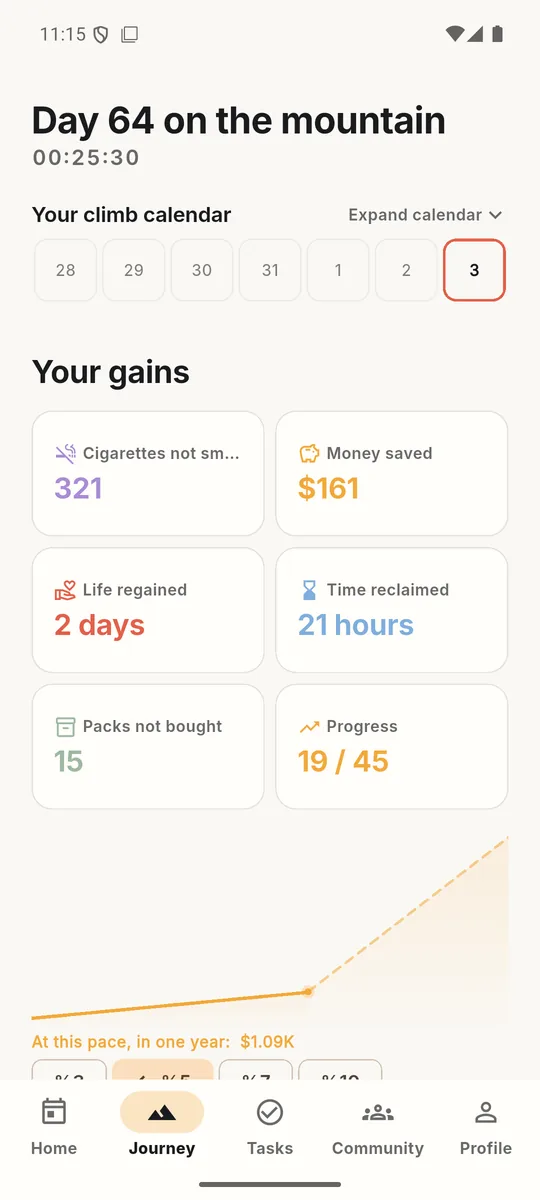
Your gains day by day: cigarettes not smoked, money saved, life reclaimed.
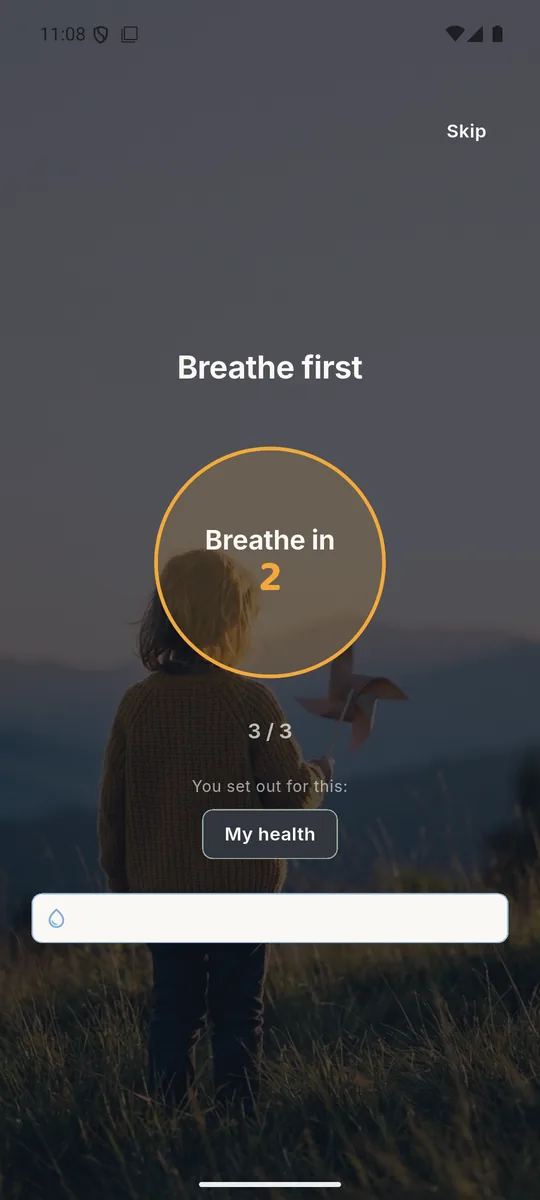
One tap when a craving hits: breathe first. A three-round guided breathing exercise.
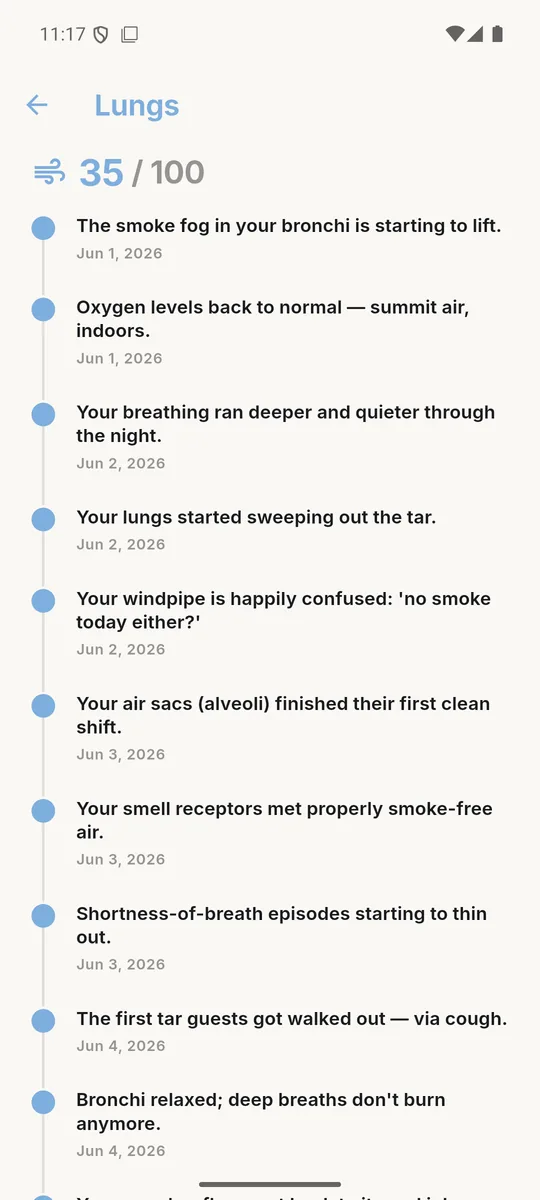
Six routes, 600 stops. Whatever is repairing in your body, you read it there.

You choose the view you are climbing — summit, forest, sea, or your own photo.
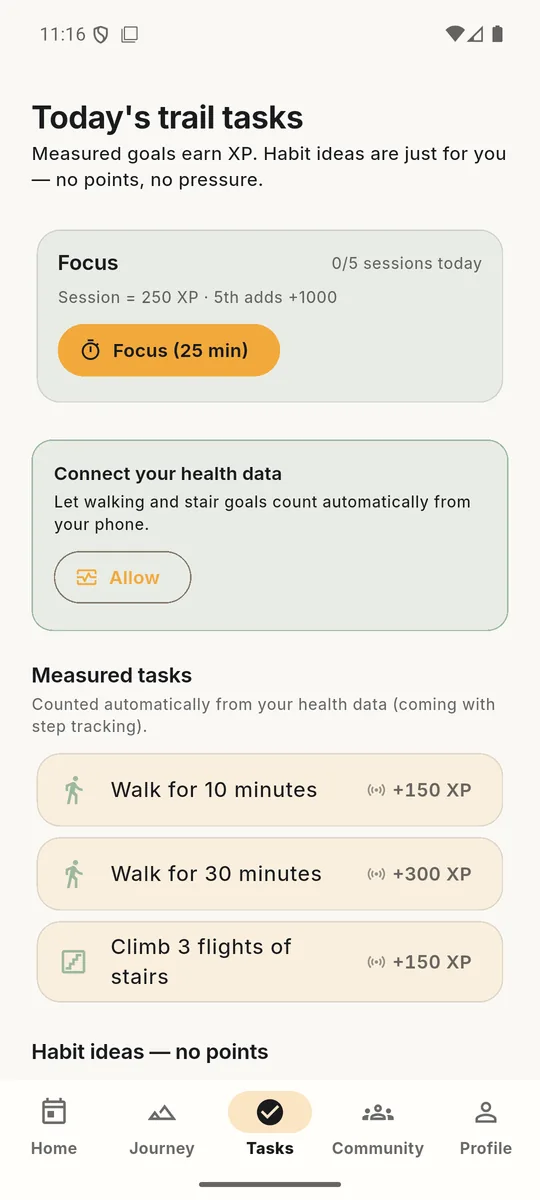
Small tasks every day. You are building a habit, not willpower.
Real screens from the app.
- Hear your own voice when a craving hits — the reason you quit, in your own words. You can add the voices of people you love, too.
- One tap for guided breathing and a distracting task — enough to fill those four minutes.
- 600 stops across six routes: read exactly what is repairing in your body today.
- Your numbers live on your device and keep counting offline — even on a plane.
- You pick the view you are climbing: summit, forest, sea, or your own photo.
- Interface, content and notifications in 14 languages.
You start free. The first day of the journey and the last are both yours.