Why your surgeon keeps saying “quit smoking before surgery”
July 30, 2026·7 min read
Surgeons don’t say “quit smoking” before surgery as a lecture. It’s physics: oxygen, healing, infection, lungs. Here’s what changes and how fast.
When your surgery date gets scheduled, one of the first things your surgeon says is: “You need to quit smoking.”
That’s not a moral lecture. It’s a surgical requirement. And the reasons are very concrete.
Three main mechanisms
1. Less oxygen reaches your tissues. Carbon monoxide lowers your blood’s ability to carry oxygen; nicotine makes your blood vessels tighten. Surgical wounds are among the body parts that need the most oxygen. Result: the incision heals more slowly and the newly healed tissue is weaker.
2. Higher infection risk. Surgical site infections are more common in people who smoke. Part of that is the oxygen problem above, part of it is changes in how the immune system responds.
3. Breathing complications. Anesthesia already suppresses your breathing. In someone who smokes, the airways are more irritable and there’s more mucus. After surgery, that means more coughing, higher risk of atelectasis (a part of the lung collapsing) and pneumonia.
These points show up in surgical and anesthesia guidelines; for broader overviews you can check the World Health Organization’s tobacco page and the CDC. Your own risk picture, though, needs to be assessed by your surgeon and your anesthesiologist.
How long before surgery should you quit?
General rule: the earlier, the better — but two time points really stand out.
12–24 hours: Carbon monoxide levels in your blood drop. So even if you quit the day before, you go into surgery with better oxygen‑carrying capacity. That’s the factual answer to “there’s only one day left, it’s pointless now.”
4 weeks and beyond: This is the time frame where studies report meaningful improvements in wound healing and breathing complications. That’s why many surgeons say “at least a month before.”
The days in between aren’t wasted; the benefits build gradually between those two points.
If you’re curious what happens on those in‑between days, the timeline from the moment you quit works the same way for someone quitting because of surgery: at 12 hours carbon monoxide drops; over days, your airways relax; over weeks, your circulation improves. Wherever your surgery date lands on that calendar, you go into the operating room with the benefits you’ve already built.
“Two weeks to surgery — is it too late?”
No.
Many people who ask this are really saying a sunk‑cost sentence: “If I can’t make it to four weeks, I might as well not bother.”
That logical trap is something we unpack in the article on quitting later in life. For surgery specifically, this is true: two weeks is better than one; one week is better than a single day; one day is better than nothing.
The benefits don’t arrive in one jump; they build in steps.
⚠️ The risky part of that “might as well not bother” line is that it pretends to be a calculation. “It won’t be enough anyway” is not a measurement, it’s permission — and it’s exactly what makes doing nothing feel reasonable. For someone with three days left before surgery, the useful question isn’t “is it enough,” it’s “am I using the three days I do have?”
What happens after surgery?
This half barely gets talked about, but it’s where a lot of the plan actually lives.
Pain and coughing. After surgery, taking deep breaths and coughing are part of the treatment — they help keep your lungs from collapsing. In someone who smokes, there’s more mucus, so those breathing exercises are both more necessary and more uncomfortable.
Withdrawal, in the hospital. The first days after quitting are already the steepest part; on top of that you add the stress of surgery. Knowing this ahead of time helps: some of the restlessness you feel in the hospital may be from surgery, and some may be from nicotine withdrawal — and the two can blur together. Telling your nurse and doctor that you’ve quit smoking helps them separate those and plan care accordingly.
Movement and healing. Wound healing is fastest in the first weeks. That means the first two weeks after surgery are the two weeks when your “I quit” benefits are working their hardest.
Turning this into an opportunity
A surgery date gives you one rare advantage when you’re quitting: there’s a real, fixed date on the calendar.
For a lot of people, the hardest part of quitting is picking a date; with surgery, that date is already set. On top of that, you usually won’t be able to smoke in the hospital anyway — so those first 48–72 hours, the steepest stretch, will already be spent in a smoke‑free environment.
That’s why the period after surgery is statistically a good window for turning “I had to quit” into “I stayed quit.” With one caution:
⚠️ The two weeks after you go home are the highest‑risk time. A lot of people who were forced to stop in the hospital go straight back to smoking at home — because the decision felt like the hospital’s decision, not theirs. Whose reason you’re using matters a lot here.
There’s one simple piece of prep you can do before you’re admitted that takes about ten minutes: get your home ready for discharge day. Ashtrays, lighters, the pack in the car. After surgery, you won’t be in any shape to deal with that stuff; that’s why it helps to clear it all out while you’re still up and about. We talk more about why throwing away the ashtrays isn’t just symbolic in a separate article.
A second bit of prep is just a sentence: you already know roughly how many days you’ll be in the hospital. That means you also know what your “days since I quit” counter will show when you get home. “It’s been five days; I don’t want to reset that to zero” is often the most concrete thing someone has in their hand when they walk back through the door.
What should you ask your doctor?
This conversation often never happens, even though it’s one of the most practical steps you can take. Three questions to ask:
“By when do you want me to quit?” It depends on the type of surgery.
“Can I use nicotine patches or gum?” In the pre‑surgery period this needs its own plan — sometimes it’s recommended, sometimes the timing is different. That decision needs to come from your doctor.
“Do any of my medications need adjusting?” Smoking changes how some medicines work in the body; when you quit, doses sometimes need to be recalibrated. We unpack that in more detail in the article on quitting at 60.
Can surgery be canceled because of smoking?
In some hospitals, certain operations (especially ones that rely heavily on good healing, like joint replacements, grafts, or reconstructive procedures) are postponed if the person keeps smoking.
That’s not a punishment; it’s a result‑focused decision. The success of those operations depends directly on how well the tissue heals.
The call belongs to your surgeon, so bringing it up early works in your favor.
⚠️ Hiding it is the worst option. If your surgical team doesn’t know you smoke, they set up your breathing monitoring and pain plan based on incomplete information. Instead of saying “I quit,” saying “I quit three days ago, before that I was at about a pack a day” lets them plan around what’s actually going on in your body.
What if the surgery is an emergency?
Not every operation comes with weeks of notice.
With emergency surgery, there may not be a real window to quit beforehand — but that 12–24 hour benefit point still exists whenever you can use it. And not smoking after surgery is entirely in your hands, and those are the days when healing is most critical.
So in an emergency, the question shifts. It isn’t “how much can I gain before surgery,” it becomes “how much can I protect after surgery?” That second window is longer and matters more.
Your surgeon’s insistence isn’t moral, it’s mechanical: oxygen, healing, infection.
One thing you can do today: note how many days you have until surgery, and circle today as your quit date — whatever that number is, that’s how much benefit you can still build.
If you want to see those hours adding up from today, you can plug your date into the counter on the right; even the first 12 hours make a measurable difference. For in‑hospital “I need something right now” moments, the Tar2Star app can sit in your pocket as backup.
This page is a photo. The app is the film.
These numbers show today. Tar2Star shows you a new one every morning — and stays with you when a craving hits.
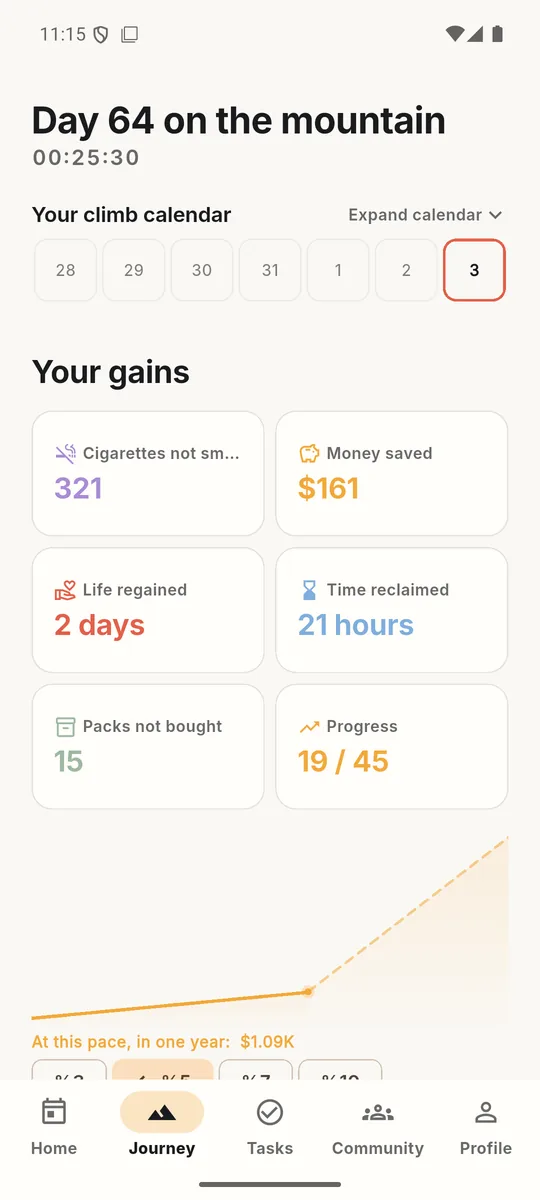
Your gains day by day: cigarettes not smoked, money saved, life reclaimed.
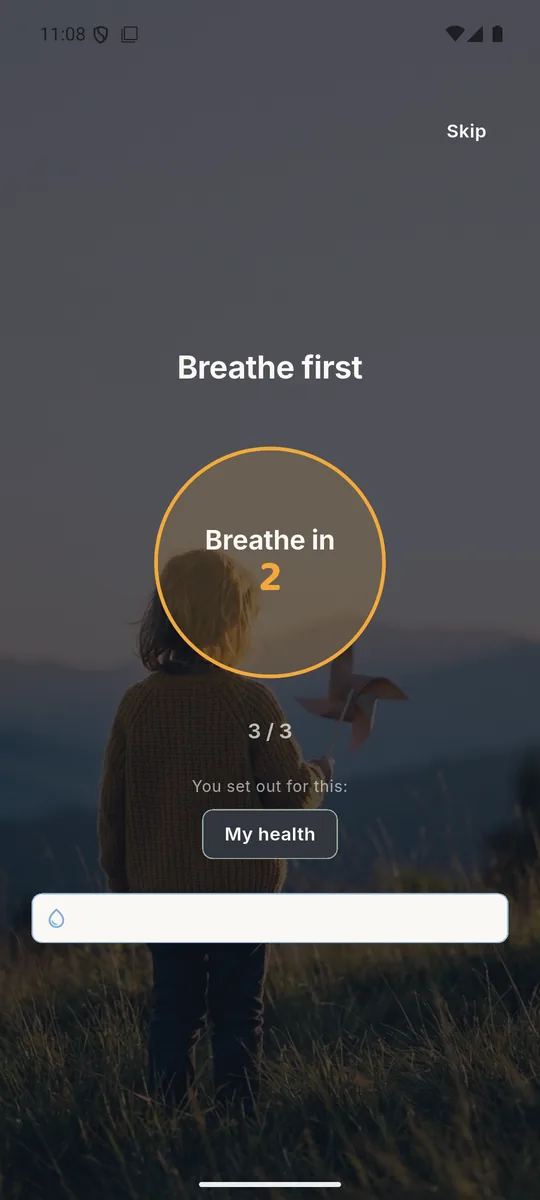
One tap when a craving hits: breathe first. A three-round guided breathing exercise.
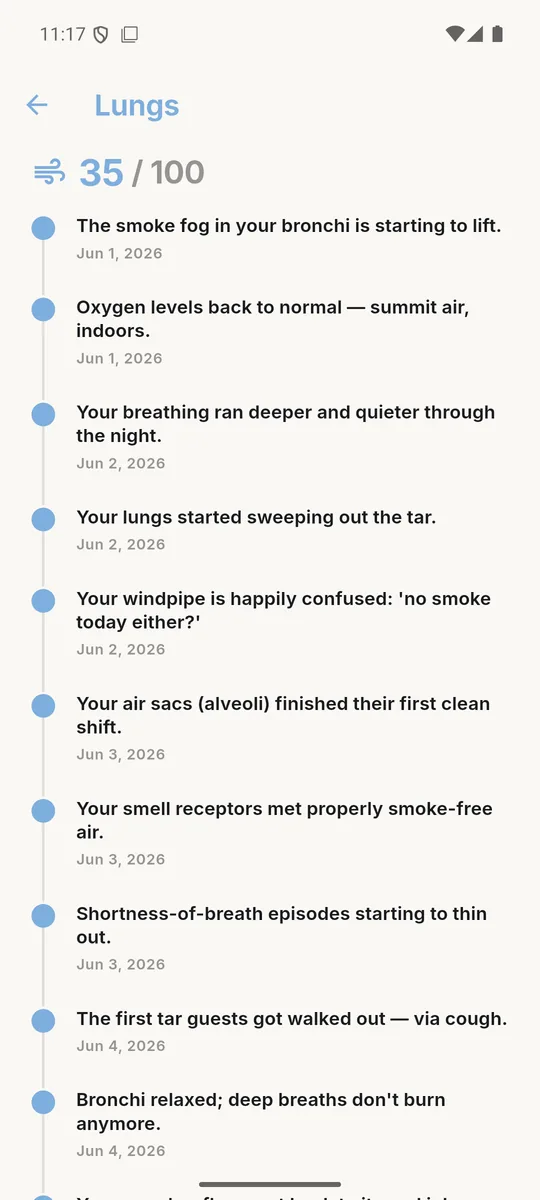
Six routes, 600 stops. Whatever is repairing in your body, you read it there.

You choose the view you are climbing — summit, forest, sea, or your own photo.
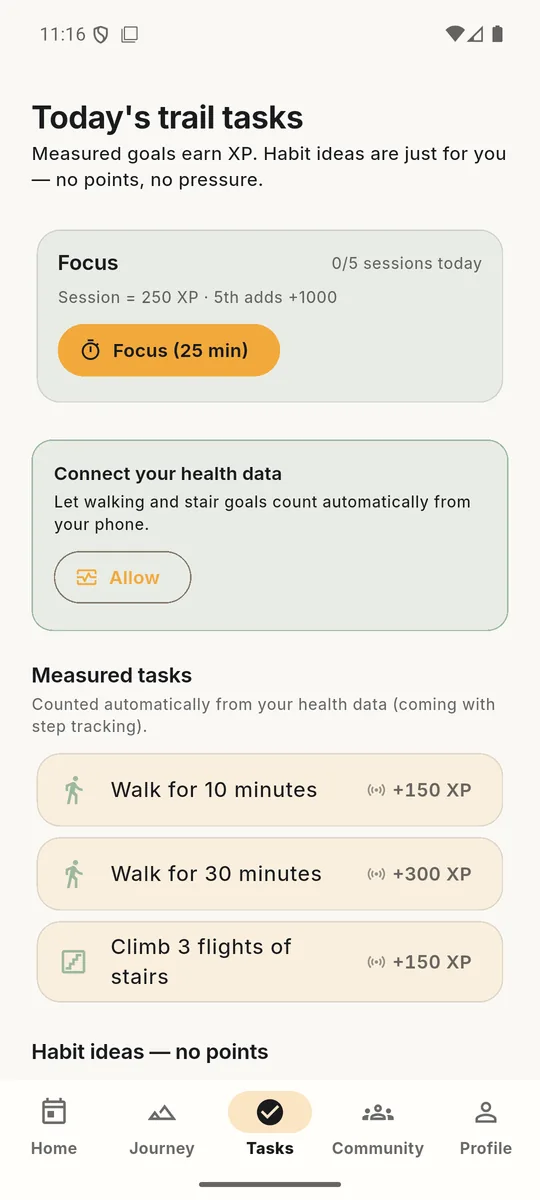
Small tasks every day. You are building a habit, not willpower.
Real screens from the app.
- Hear your own voice when a craving hits — the reason you quit, in your own words. You can add the voices of people you love, too.
- One tap for guided breathing and a distracting task — enough to fill those four minutes.
- 600 stops across six routes: read exactly what is repairing in your body today.
- Your numbers live on your device and keep counting offline — even on a plane.
- You pick the view you are climbing: summit, forest, sea, or your own photo.
- Interface, content and notifications in 14 languages.
You start free. The first day of the journey and the last are both yours.