Your smoke‑free journey: what brought you here?
July 29, 2026·7 min read
Most quit‑smoking advice tries to scare or shame you. This guide does something else: shows you, step by step, what actually happens when you quit.
There are millions of articles about quitting smoking. Most of them hit the same three notes: scare you, blame you, then tell you to "use your willpower" and walk away.
None of those three really work. You know that, because you’re still here, still searching.
Why most quit‑smoking content doesn’t help
There’s a fourth way almost nobody spends enough time on: showing what actually happens.
Fear is abstract. "You’ll get cancer" hasn’t made many people quit, because the brain isn’t great at caring about something distant and fuzzy. A risk 20 years from now doesn’t weigh much against a cigarette you can light in three minutes.
That’s not a character flaw. It’s how we’re wired — and nicotine is built to fit into that wiring. (The Face of Nicotine route breaks down the mechanics step by step.)
But this is not abstract:
Within 20 minutes of your last cigarette, your heart rate and blood pressure start to return to normal. After 12 hours, the carbon monoxide level in your blood drops back to normal and your cells get more oxygen. After 72 hours, your bronchial tubes relax and breathing gets easier.
And that’s just the first three days.
Between 2–12 weeks, circulation and lung function improve. Over 1–9 months, coughing and shortness of breath go down. After 1 year, your risk of coronary heart disease is about half that of someone who kept smoking.
These numbers aren’t ours; they match the World Health Organization’s timeline for health benefits after quitting and U.S. CDC data. Every number you see on this blog has a source like that behind it.
These aren’t threats. They’re gains. And they’re all measurable.
Notice what’s going on: two sentences can describe the same situation and make you feel completely different. This entire blog lives in that space between those two sentences.
Why quitting isn’t a ban — it’s a climb
If you frame quitting as a ban, you’re stuck from the start. A ban feels like something has been taken away from you. The mind then fixates on the thing that’s gone.
Every time you tell yourself "I’m not allowed to smoke," you’ve already brought cigarettes back to center stage.
We talk about it as a climb instead. From tar to star — Tar2Star.
Here’s the difference: on a ban, every day feels like a loss; on a climb, every day is an ascent. Same day, two stories. On day seven you can say "I’ve been depriving myself for seven days" or "I’ve climbed seven days up." Same seven days. Which story you choose has a lot to do with whether you see day eight.
And on a climb, the summit isn’t one magical date. The "summit" is what you pick up along the way: breath that comes back, your sense of smell that comes back, the money that comes back, the mornings that come back.
That’s why there’s no single "Quit Day" celebration here. Instead, there are 600 milestones — and you don’t need weeks to hit the first one; you need minutes.
What you won’t find here: fear, blame, sermons
There is no fear‑mongering on this blog. No graphic pack photos, no illness close‑ups, no "you’re dying" headlines. You’ve seen those already. If they worked, you wouldn’t be reading this.
There is no blame, either. How many times you’ve tried, how many times you’ve gone back — that’s not something we hold against you. For most people, making a quit stick takes more than one attempt (CDC) — that’s not failure, that’s the process. A year down the road, there’s no difference between someone who quit on their seventh attempt and someone who quit on their first.
And there are no sermons. We’re not here to tell you what to do. We’re here to show what’s going on so you can decide. Mark Twain nailed it over a century ago:
"Nothing so needs reforming as other people's habits." — Mark Twain, Following the Equator, 1897
Everyone seems eager to reform your habit. We’re not. We just want to show you what that habit is doing to you — and what changes when you stop. The rest is yours.
So what’s left, then? That’s the real question here.
What you will find here while you quit
Three things.
Numbers. You’ll see what happens after how many minutes, how much money is stacking up, how many cigarettes you haven’t smoked. Every figure is sourced; if it doesn’t have a source, it doesn’t go on this blog. Instead of vague phrases like "very harmful," we’ll use sentences you can pin down, like "after 12 hours, carbon monoxide returns to normal."
Time. Quitting isn’t a featureless desert; it has a timeline. We can tell you when the hardest parts tend to hit, how long they usually last, and when they ease off. Most fears grow in the dark; when you know the duration, they shrink.
Order. We put together a map of 730 posts, and each one is also a video episode. You’ll always know where you are and what the next step is. You can move through from the first post in order, or jump straight to the question that’s bothering you right now.
There’s also a fourth thing — but technically it doesn’t live "on the blog." It lives in your browser. We’ll get there in a minute.
The nine stages of your quit‑smoking journey
This blog is a journey split into nine routes. Each one matches a phase of the quitting process:
**Setting Out** — the decision moment, prep, day one
**First Ascent** — the first 72 hours and the toughest week
**The Body Repairs** — what heals hour by hour, day by day
**The Face of Nicotine** — what’s actually in a cigarette, how dependence works
**The Mind's Voice** — triggers, excuses, identity
**The Backpack** — practical tools that help in rough moments
**The View** — money, time, and breath you’re getting back
**The Campfire** — stories and the people around you
**The Summit and After** — long term, slips, staying quit
You can read in order: each post ends by pointing you to the next stop. Or you can jump straight to the question on your mind — the map on the left is there for that.
If you’re not sure where to begin, two ideas: getting clear on why you want to quit, or going straight to what happens in the first 72 hours. One is preparation; the other is exploration.
How to track what’s happening in your body when you quit
On the right‑hand side, plug your quit date into the counter — right now. From that moment on, the timeline above becomes your timeline.
The counter shows how many days have passed, how many cigarettes you haven’t smoked, how much money you’ve saved, and what’s happening in your body right now. It doesn’t ask for an account, doesn’t want your email, doesn’t send anything anywhere — the data lives only in your browser.
Here’s the key: the timeline above is the same for everyone, but the counter is just for you. "After 20 minutes, heart rate returns to normal" is information. "Your heart rate hasn’t been a smoker’s heart rate for 6 days and 4 hours" feels like ownership.
If you haven’t quit yet, put in tomorrow’s date. Seeing what you stand to gain in a week can be enough to get you started. There’s nothing to lose: entering a date doesn’t lock you into anything.
For someone who smokes a pack a day, this is what the counter says in the first week: 140 cigarettes not smoked, roughly 25 hours back, and seven times your pack price still in your pocket. These aren’t guesses; they’re just math from the two numbers you gave it. When you stretch the same calculation out over a year, the total is usually way above what people think they "spend on cigarettes."
The counter on this page is a small snapshot of your climb. The full route — all 600 milestones, crisis‑time support, daily tracking — lives in the Tar2Star app.
The journey starts here. First stop: a question almost nobody answers honestly — why do you want to quit, and is the reason you say out loud really your reason?
This page is a photo. The app is the film.
These numbers show today. Tar2Star shows you a new one every morning — and stays with you when a craving hits.
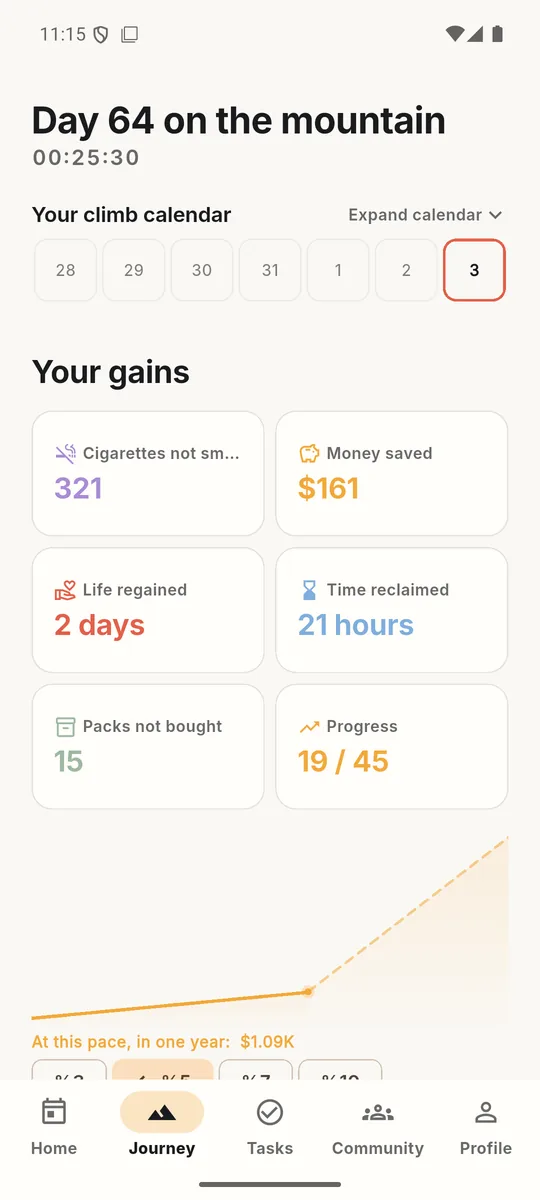
Your gains day by day: cigarettes not smoked, money saved, life reclaimed.
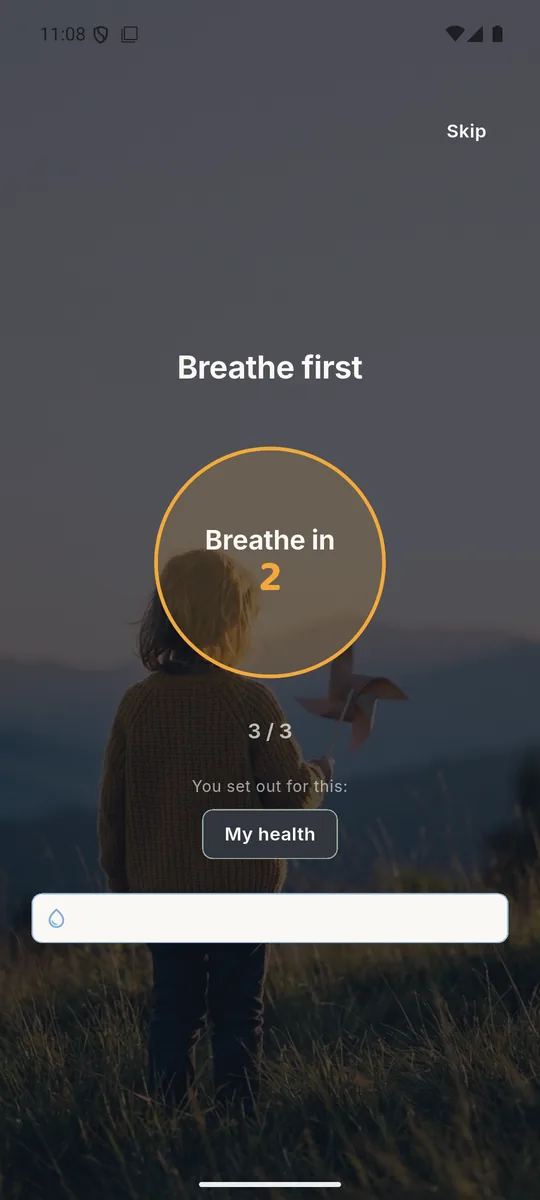
One tap when a craving hits: breathe first. A three-round guided breathing exercise.
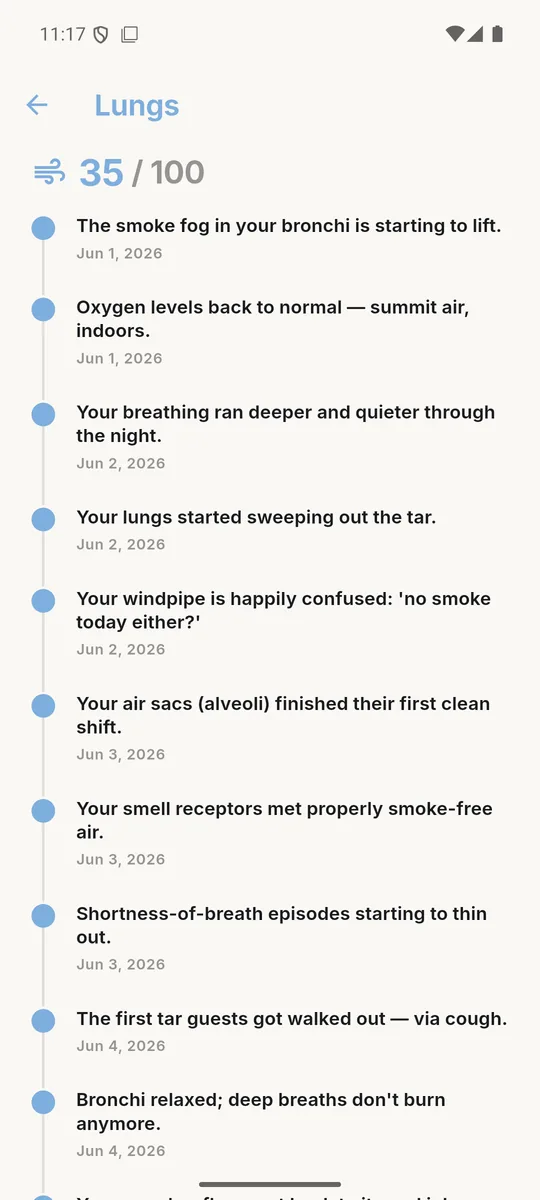
Six routes, 600 stops. Whatever is repairing in your body, you read it there.

You choose the view you are climbing — summit, forest, sea, or your own photo.
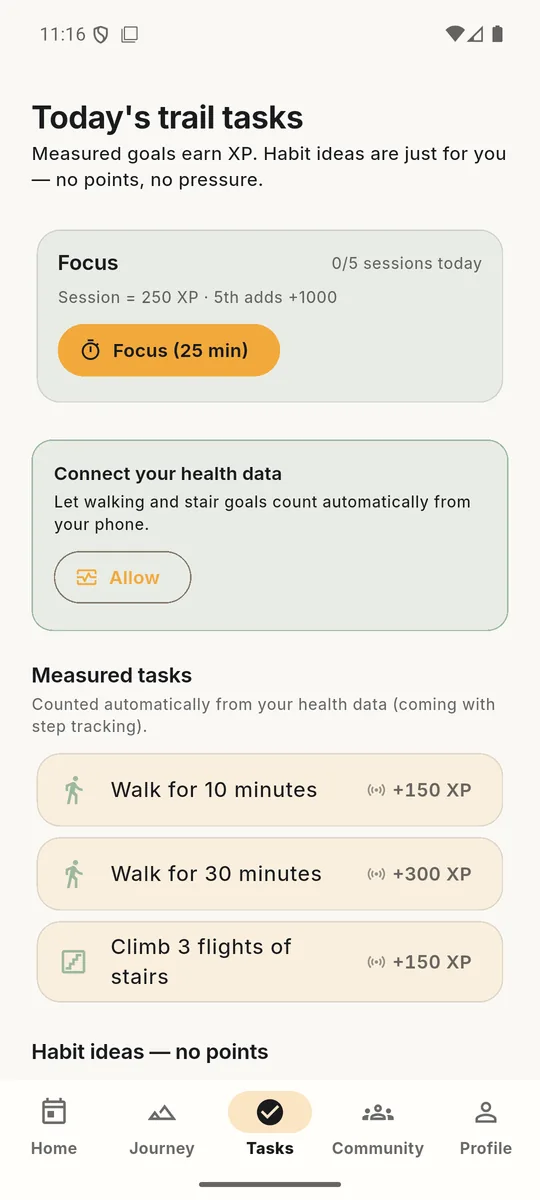
Small tasks every day. You are building a habit, not willpower.
Real screens from the app.
- Hear your own voice when a craving hits — the reason you quit, in your own words. You can add the voices of people you love, too.
- One tap for guided breathing and a distracting task — enough to fill those four minutes.
- 600 stops across six routes: read exactly what is repairing in your body today.
- Your numbers live on your device and keep counting offline — even on a plane.
- You pick the view you are climbing: summit, forest, sea, or your own photo.
- Interface, content and notifications in 14 languages.
You start free. The first day of the journey and the last are both yours.