What Does a Smoke‑Free Day Actually Look Like? Mental Rehearsal
July 30, 2026·7 min read
“Life without cigarettes” sounds abstract. Walk through a real smoke‑free day, step by step, and rehearse it so the first day feels less foreign.
--- Up to this point, most quit prep has been about loss: what you’ll give up, what you’ll let go of, ne what you’ll lean on instead.
This one flips it. One question: What does an ordinary day without cigarettes actually look like?
This isn’t a pep talk; it’s a dry run. When you’ve already walked through a day in your head, the real thing feels a lot less alien.
Why rehearse?
Because anything unknown looks bigger than it is.
As long as “life without cigarettes” is just a vague phrase, it feels like a hole — something missing. Once you turn it into a specific day, it stops being a hole and becomes… just a different kind of day.
Most of the fear comes from not knowing; this piece is about closing off that particular chunk of uncertainty.
Scene 1: Morning
Right now: You wake up, stay in bed for a bit, get up, light the first cigarette. Usually with coffee. There’s a taste in your mouth, a slight burn in your throat.
Smoke‑free: You wake up and you don’t have to get up — not for a cigarette, anyway. If you get up, it’s for you, not for nicotine. Your mouth tastes different. Coffee tastes different too — in the first weeks, sometimes surprisingly different, because your sense of taste starts to sharpen within 48 hours.
Most noticeable change: No morning cough. People who quit mention this more than almost anything else in the first weeks.
Scene 2: The workday
Right now: Your day is chopped up by cigarette breaks. Meeting ends: cigarette. Hit send on an email: cigarette. In between, there’s the constant math of “how many are left,” and the mental note to stop and buy more later.
Smoke‑free: Breaks are still there, but what you do in them changes — stairs, water, window. We broke down how to set this up at work in a separate guide.
Most noticeable change: No background calculations. How many are in the pack, will that last until tonight, do I need to go out. That little counting app in your head has been running nonstop; when it shuts off, there’s a strange quiet.
There’s also the time piece: twenty cigarettes a day is roughly 100 minutes. Most of those minutes come out of your workday, and when you get them back, the first thing many people feel is, “My day got longer.”
Scene 3: Evenings and social time
Right now: Cigarette after dinner, cigarette on the balcony, a few at the table with friends. Before you go out, you check the pack.
Smoke‑free: For most people, this is the hardest stretch in the first weeks — there’s no point pretending otherwise. Expect about three weeks of “this feels weird.”
But after three weeks: You sit at the table and don’t have to get up. You don’t step outside in the middle of a good conversation. In winter, you’re not standing outside in the cold.
Most noticeable change: Walking into a home that doesn’t smell like smoke. Clothes, car, pillow — no stale smell following you around.
Scene 4: One week in, one month in
This is the scene almost nobody pictures while they’re still in planning mode — and it’s one of the most important.
One week: Seven days on the counter. Breathing is noticeably different — stairs and hills feel different. Sleep is starting to settle. Roughly 140 cigarettes not smoked.
One month: The waves are less frequent, often down to once or twice a day. Your circulation is improving, walking distance increases. Your first money milestone is within reach.
And something else: After a month, you’re no longer the person reading this; you’re the person saying something to someone else who’s trying to quit. A lot of people describe this as one of the most unexpected wins of the first month.
How to do the rehearsal
Five minutes. One sheet of paper:
Write out tomorrow morning. From waking up to leaving for work, without cigarettes. Be specific: which room you’re in, what you’re drinking, what you’re doing.
Write down the hardest moment. What time of day is it? What exactly will you do there instead?
Write one sentence about a week from now. Just one line: “In a week, ___ will be different.”
That third line helps the most, because it turns your “reason” into something that builds over time.
One warning
⚠️ Rehearsal is not about imagining a perfect, glossy life without cigarettes. There will be rough days, urges, evenings when you’re just fed up.
If you picture perfection, the first bad day turns into “I guess this isn’t working.” The job of rehearsal is to script a realistic day: some hard moments, lots of ordinary ones, and a few that are noticeably better.
Scene 5: Six months from now
This one usually doesn’t make it into rehearsal because it feels too far away — but it’s what most people are secretly curious about.
At six months, cigarettes are not a daily topic anymore. For many people, the urge waves are completely gone. For others, they show up maybe once or twice a month, very faintly. The counter stops being something you check all the time.
The weirdest part is this: you no longer need a “reason.” Nobody stands in the bathroom every morning thinking, “Why am I brushing my teeth today?” A reason is more like an anchor than a fuel tank — it really helps at the start, and then it quietly stops being necessary.
By the numbers: six months, at twenty cigarettes a day, adds up to about 3,600 cigarettes not smoked, or 180 packs.
The most common rehearsal mistake
Most people who try this exercise write out a good day: nice weather, calm day at work, mood on point.
But the real value of rehearsal is scripting the bad day. Because going back to smoking rarely happens on a great day.
A simple fix: add a fourth step to the list above — write the scene, “I’ve had a terrible day, it’s 10:00 p.m., I’m home alone.” What do you do right then? Answer in one concrete sentence: “I’ll go for a walk,” “I’ll text Serkan,” “I’ll take a shower and go to bed.”
⚠️ That single scene often does more for you than the rest of the rehearsal. The evening block in the first‑24‑hours emergency plan is built around the same moment.
Rehearsal is not daydreaming
This distinction matters, because they look similar — but only one of them changes anything.
Daydreaming stares at the finish line: a year from now, smoke‑free, healthy, happy. It feels nice — and doesn’t change what you do tomorrow.
Rehearsal zooms in on the moment: tomorrow, 7:15 a.m., in the kitchen, coffee in your hand, no cigarette. What exactly do you do?
The difference: daydreaming builds a destination; rehearsal scripts a movement. And in a crisis, what you need is not a destination — it’s one simple action you can take right now.
⚠️ Easy test: does your rehearsal include a verb? “I’ll feel better” is not a verb, it’s an outcome. “I’ll drink some water and step out onto the balcony” is a verb. Rehearsal is built out of verbs.
A smoke‑free life isn’t an empty space; it’s just a different sort of day. Walking through that day in your head first makes the real thing feel less strange.
Today’s one task: write out tomorrow morning without cigarettes, in three lines.
If you want to see “one week from now” as a number, plug your date into the counter on the right. And if you want to keep your rehearsal and crisis tools in your pocket, the Tar2Star app was built exactly for that. ---
This page is a photo. The app is the film.
These numbers show today. Tar2Star shows you a new one every morning — and stays with you when a craving hits.
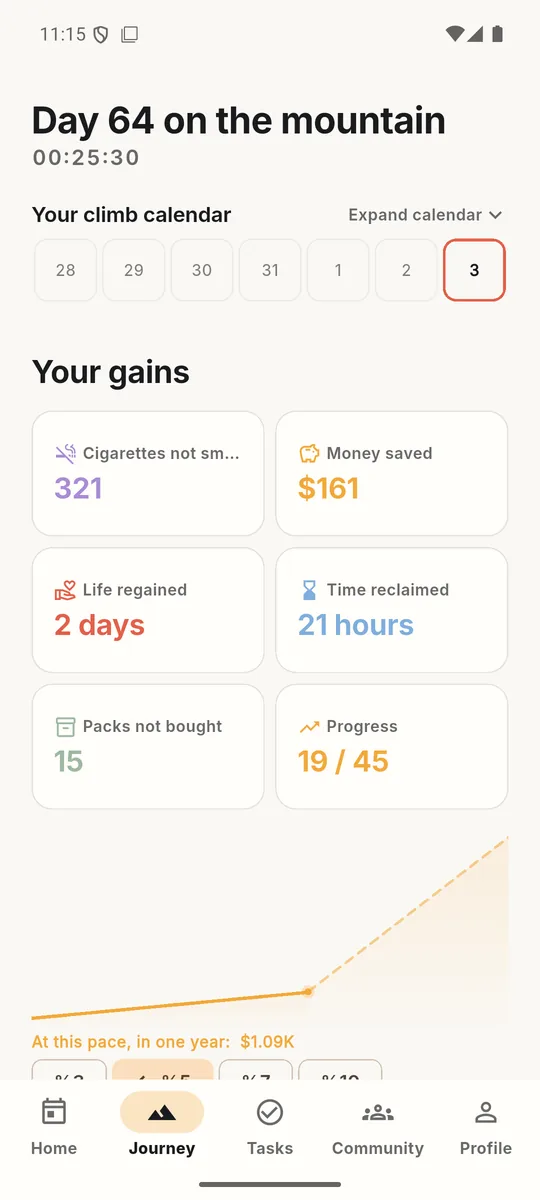
Your gains day by day: cigarettes not smoked, money saved, life reclaimed.
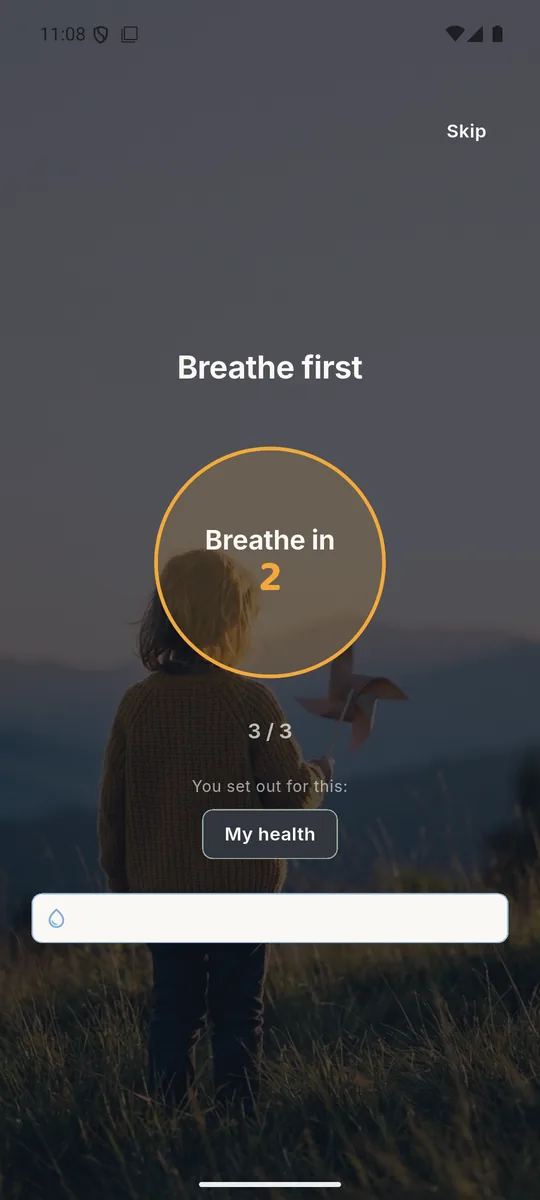
One tap when a craving hits: breathe first. A three-round guided breathing exercise.
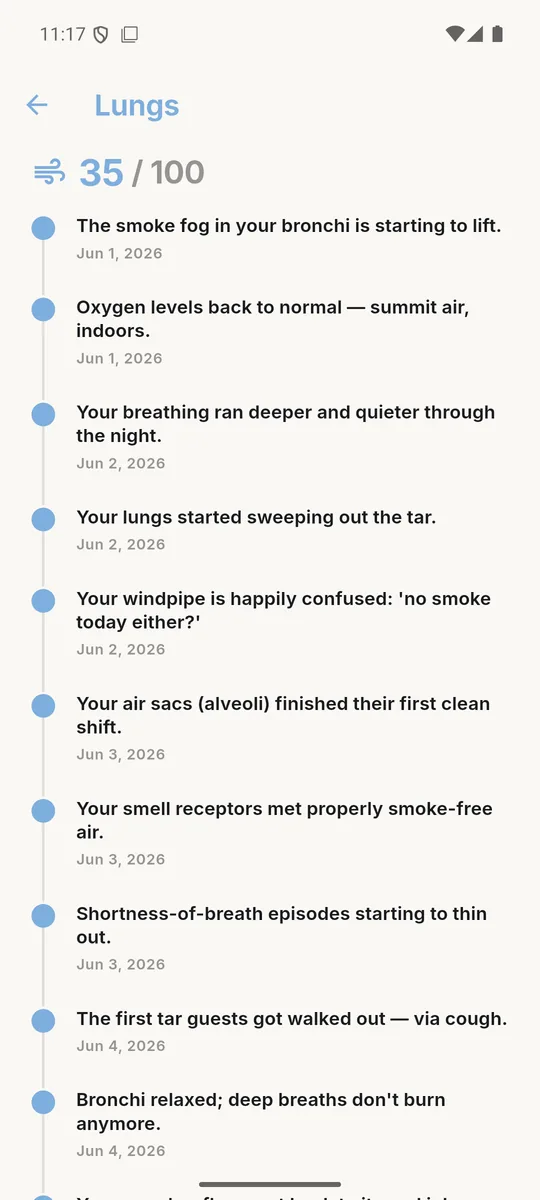
Six routes, 600 stops. Whatever is repairing in your body, you read it there.

You choose the view you are climbing — summit, forest, sea, or your own photo.
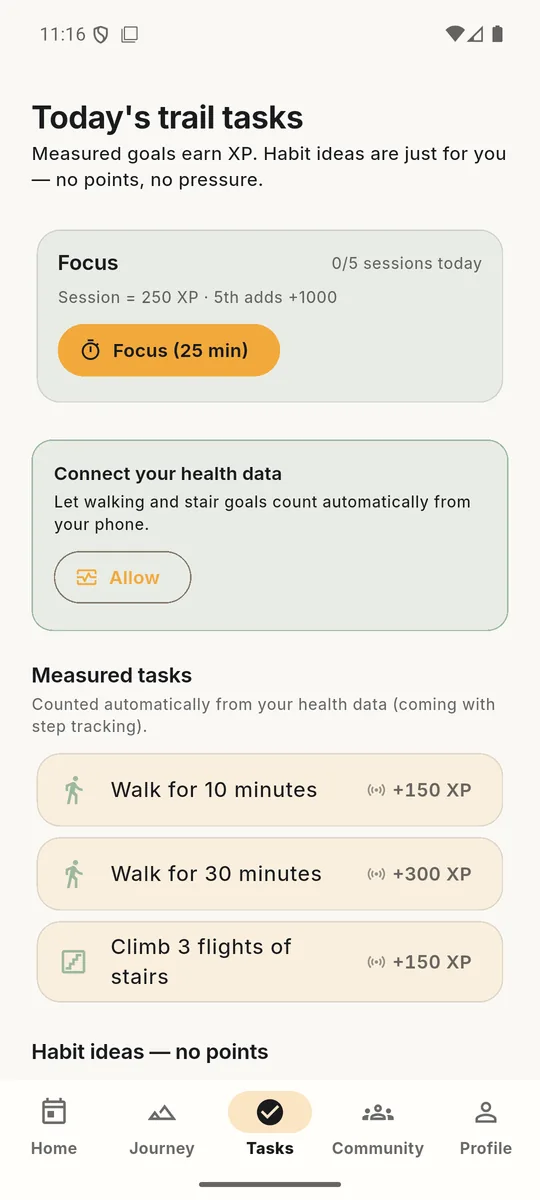
Small tasks every day. You are building a habit, not willpower.
Real screens from the app.
- Hear your own voice when a craving hits — the reason you quit, in your own words. You can add the voices of people you love, too.
- One tap for guided breathing and a distracting task — enough to fill those four minutes.
- 600 stops across six routes: read exactly what is repairing in your body today.
- Your numbers live on your device and keep counting offline — even on a plane.
- You pick the view you are climbing: summit, forest, sea, or your own photo.
- Interface, content and notifications in 14 languages.
You start free. The first day of the journey and the last are both yours.