Are You Really Addicted If You Only Smoke on Weekends?
July 30, 2026·7 min read
You don’t smoke all week, then have a few on Saturday. Is that addiction or just a habit? How to tell the difference and what to do with it.
You don’t touch a cigarette from Monday to Friday. Then Saturday night shows up, and seven of them disappear.
That pattern is confusing, because it seems to prove two opposite things at once:
You’re not addicted (you go five days without any), and
Something is going on (because it happens again every single week).
Both can be true. They’re just talking about different things.
(If you’ve seen the eight‑step checklist, the “first cigarette of the day” question is probably “never” for you — and that changes the whole game plan.)
Addiction or just a habit?
The line between them is not how many you smoke. It’s withdrawal.
If on Monday and Wednesday you: - don’t think about cigarettes, - don’t feel extra irritable, - don’t wake up “needing one”,
…then there isn’t a strong physical addiction in the classic sense. Nicotine isn’t sitting in your system all week, so your body isn’t going through a full withdrawal cycle.
But there is a behavior that keeps repeating every Saturday, and it’s tied to a specific trigger.
That’s conditioning: > certain place + certain time + certain drink → cigarette.
Why does this difference matter? Because it changes what actually helps.
With physical addiction, nicotine replacement can be useful.
With conditioning, it doesn’t do much — there, you have to change the setting and the chain.
Why “I can control it” feels so convincing
Because you keep re‑proving it every week.
Going five days without smoking looks like hard evidence that you’re in charge. And there is some control there — nobody is denying that.
The catch is: that control doesn’t end the behavior, it keeps it alive.
An on‑off pattern like that is one of the most stubborn behavior loops:
Skipping a week doesn’t really break it.
It actually confirms the pattern in your head: “See? I’m not addicted.”
We talked about why “on and off” rewards are so sticky in the piece on cutting down. Weekend smoking is that mechanism in its purest form:
cigarettes are rare, so
each one feels more valuable.
Seven in one night: the dose problem
“Seven a week” sounds like “around one a day”. But your body doesn’t see it that way.
Packing seven cigarettes into a few hours pushes your nicotine and carbon monoxide levels, for that evening, towards what a pack‑a‑day smoker sees.
So yes, the weekly total is low. But that one night’s exposure really isn’t.
And it usually comes with a package deal: - alcohol, - late hours, - poor sleep.
Each of those is already a load on your body — the cigarettes just pile on top.
On the heart and circulation side, there’s no clear “safe” lower limit — even low doses are not considered harmless. We unpacked that in detail in the piece on smoking only 3 cigarettes a day.
The real test: three questions
We’ve seen that “Am I addicted?” can’t be answered by a simple number. These three questions work better:
Have you ever ended up smoking on a night you’d decided not to?
(Does your behavior break away from your plan?)
Does not smoking in that usual setting feel uncomfortable?
(Does the absence feel like something’s “missing”?)
How many years has it been the same pattern?
(Is it really steady, or slowly creeping up?)
If your answers are basically “no/short” to all three, you’re looking at a genuinely light habit.
If even one of them is a clear “yes”, then whatever name you give it, there’s a bond there that will need to be undone.
The direction test
The key question isn’t your current health snapshot. It’s which way this is heading.
⚠️ Weekend‑only smoking can stay stable for a long time — but it often slips into weekdays during stressful periods.
Once a cigarette shows up mid‑week, the old rule (“I only smoke on weekends”) loses its authority. A new “normal” starts forming.
Ask yourself:
Five years ago, was your pattern exactly what it is now?
If the honest answer is “No, it was less”, then the curve is pointing up.
The morning after Saturday
The quiet part of weekend smoking is Sunday morning.
Seven cigarettes in a few hours leave measurable traces the next day: - sore or scratchy throat, - poorer sleep quality, - that heavy, tired feeling in the morning.
Most people blame all of that on the alcohol and never factor in the cigarettes.
There’s a simple way to separate them:
Do one weekend with alcohol but no cigarettes.
The difference you feel the next morning is the cigarette’s share, all by itself.
That little experiment is also the first step of the plan in this article — so you’re not “losing” anything by trying it.
A three‑weekend plan
For this group, the heavy lifting fits into three weekends. Each weekend has its own challenge:
Weekend 1 — the hardest one. Same setting, fresh habit, everyone else offering you a smoke.
Make the decision at home before you go out.
Skip alcohol that night.
Leaving early isn’t weakness; it’s strategy.
Weekend 2 — where the surprise comes. It usually goes easier than the first. That ease is exactly what tricks people:
“So I guess there wasn’t really a problem,”
…and then they loosen up on weekend three.
Weekend 3 — where the conditioning breaks. Sitting at the same table, in the same place, without a cigarette tells your brain:
“This setting no longer automatically means smoking.”
From there on, it gets noticeably easier.
⚠️ It matters that all three weekends happen in the same kind of setting you usually smoke in.
Spending three weekends at home doesn’t really break the link. It just pauses it.
What does “quitting” look like here?
For weekend‑only smokers, the prep work is actually the shortest, because there’s basically one main bond to loosen:
The first three weekends have to be intentional.
You’re not dealing with strong physical withdrawal, so the work is almost entirely about the environment.
Once you’re past those three weekends, the conditioning is already much weaker.
In practice, that looks like:
Make your first two or three weekends alcohol‑free.
In this group, that’s usually the single biggest lever.
Keep your hands busy, leave earlier if you need to, shut down offers from the start.
Decide at home — the decision you “make at the table” is the easiest one to flip at the table.
We covered social circles and smoking in a separate piece; if you’re a weekend smoker, that one might actually be more useful than this article. There’s also a separate post for people who only smoke in social settings — those two often overlap in the same person.
“I smoke so little, is it even worth quitting?”
Let’s flip that question.
Seven cigarettes a week is roughly 360 cigarettes a year. In ten years, that’s about 3,600.
Now look from the other side:
For you, quitting is about as easy as it ever gets:
No brutal morning cravings.
No dramatic 72‑hour withdrawal saga.
No long symptom list.
The actual job is basically three weekends.
The only reason to keep putting it off is that it doesn’t look like a problem.
And something that doesn’t look like a problem is the textbook definition of the most expensive kind of delay.
Weekend smoking is less about winning the argument “addiction or not” and more about one thing:
Which direction is it moving?
Today’s homework is simple:
Compare your pattern now to the last five years.
Is it flat, or quietly climbing?
Drop your “7 per week” into the calculator on the right and see what that adds up to over a year.
If you want something in your hand in those weekend moments, the Tar2Star app was built exactly for those hours.
This page is a photo. The app is the film.
These numbers show today. Tar2Star shows you a new one every morning — and stays with you when a craving hits.
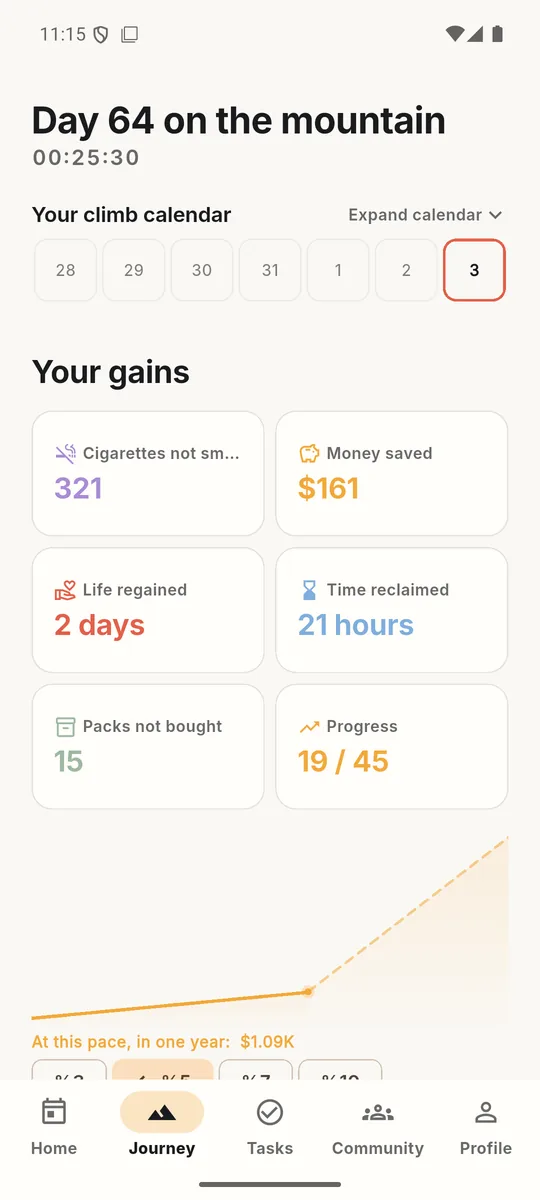
Your gains day by day: cigarettes not smoked, money saved, life reclaimed.
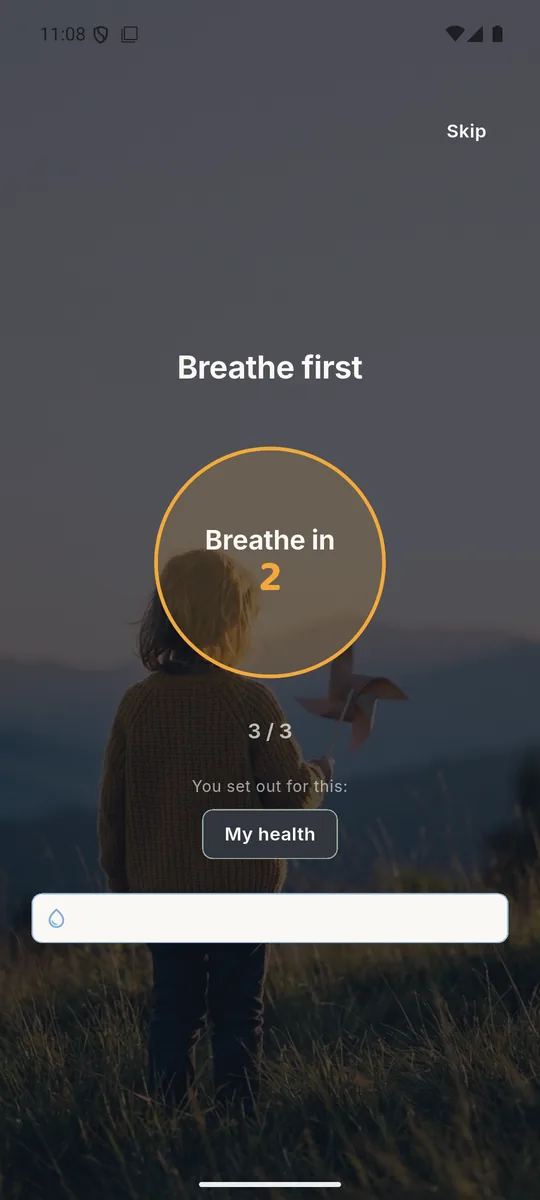
One tap when a craving hits: breathe first. A three-round guided breathing exercise.
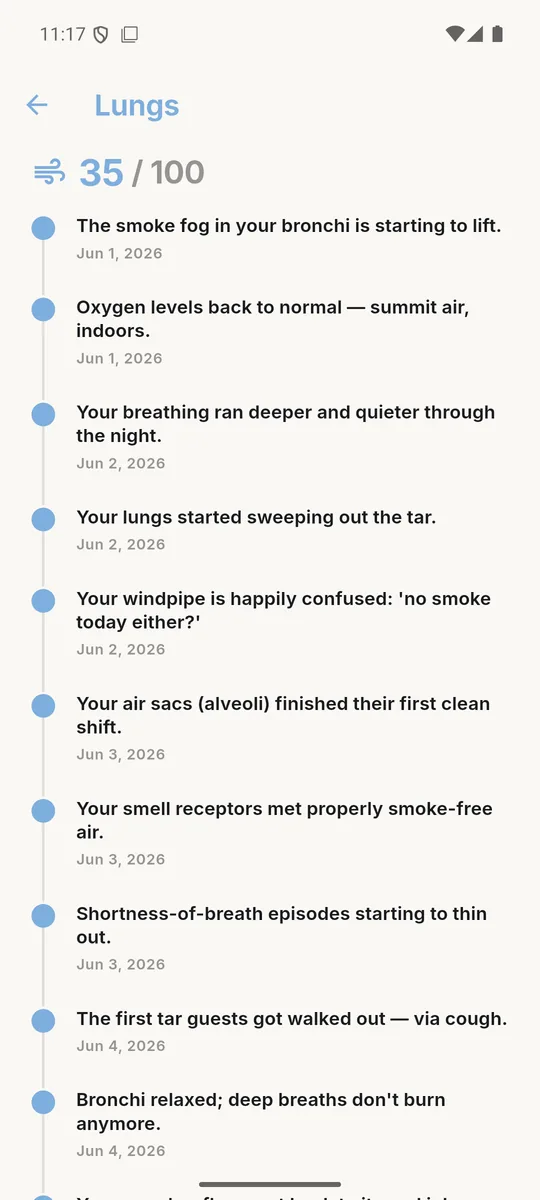
Six routes, 600 stops. Whatever is repairing in your body, you read it there.

You choose the view you are climbing — summit, forest, sea, or your own photo.
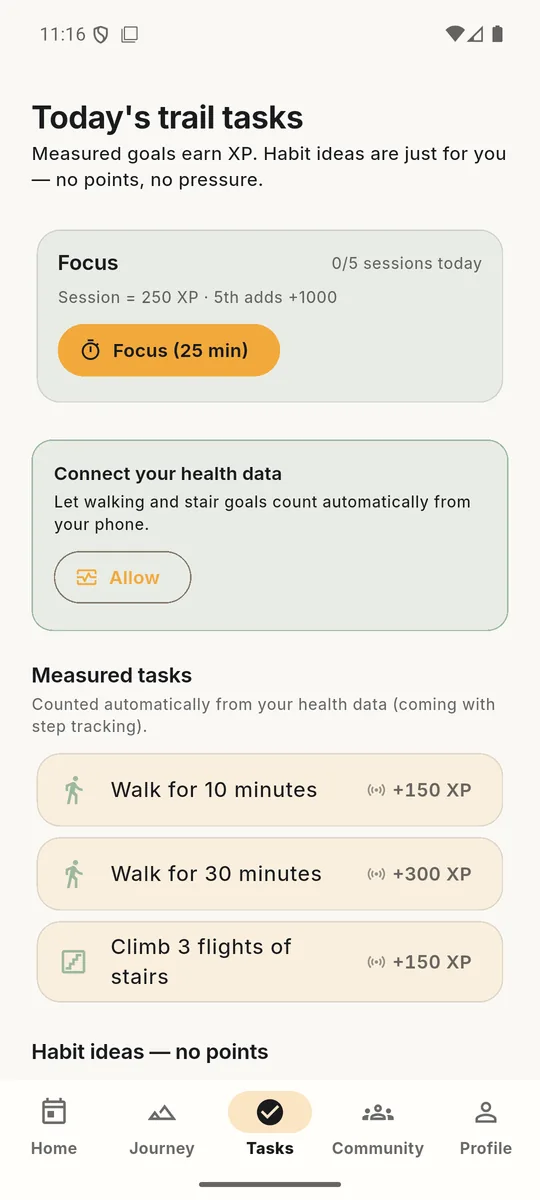
Small tasks every day. You are building a habit, not willpower.
Real screens from the app.
- Hear your own voice when a craving hits — the reason you quit, in your own words. You can add the voices of people you love, too.
- One tap for guided breathing and a distracting task — enough to fill those four minutes.
- 600 stops across six routes: read exactly what is repairing in your body today.
- Your numbers live on your device and keep counting offline — even on a plane.
- You pick the view you are climbing: summit, forest, sea, or your own photo.
- Interface, content and notifications in 14 languages.
You start free. The first day of the journey and the last are both yours.