Quitting smoking after a diagnosis: is it still worth it?
July 30, 2026·8 min read
A diagnosis closes the “prevention” door, not the “what happens next” door. How quitting after a diagnosis changes treatment, risks, and everyday life.
The sentence people say most often after a diagnosis:
“The damage is done. What’s the point of quitting now?”
It sounds logical if you see quitting as something that only prevents illness. But quitting has a second job that becomes even more important after a diagnosis: changing the course of what happens next.
What does quitting after a diagnosis actually change?
It helps to separate two things:
Prevention: stopping a disease from appearing in the first place. After a diagnosis, that door is closed — that’s true.
Course: how the disease behaves — how fast it progresses, how you respond to treatment, whether complications show up, what your quality of life is like. This door is still open, and quitting directly affects it.
For someone who’s already been diagnosed, that second door is the real story. And the impact isn’t small.
Where does quitting after a diagnosis make a difference?
Some concrete areas:
Surgery outcomes. If you need an operation, quitting directly affects wound healing and infection risk. We walked through the mechanism in the pre‑surgery quitting guide.
Response to treatment. In oncology, continuing to smoke has been reported to worsen how well some treatments work and the overall course of disease. In people receiving cancer treatment, quitting is linked in recent reviews with better survival and better tolerance of treatment. Part of the mechanism is the same as above: carbon monoxide lowers the blood’s oxygen‑carrying capacity, nicotine narrows blood vessels — and oxygen delivery to tissue is a shared input for both healing and many treatments.
Risk of a second event. For someone who has had a heart attack or arterial blockage, quitting is counted as one of the single most effective ways to cut the risk of it happening again. According to the World Health Organization’s recovery timeline, coronary heart disease risk drops by half within 1 year in people who stay quit, compared with those who continue to smoke; lung cancer risk falls to about half after 10 years. Those numbers also matter for someone who already has a diagnosis: the future risk is still moving, not fixed.
Speed of progression. In conditions like COPD, lost lung function doesn’t come back; but quitting slows the rate of loss. Lung capacity goes down with age in everyone; smoking makes that decline steeper; when you quit, the curve returns to the normal age‑related slope. In the piece on smoking for years we unpack this in detail — in everyday terms it means: if right now you have to stop twice on one flight of stairs, quitting lets you stay at that level instead of sliding to three, four, five stops.
Quality of life. Shortness of breath, cough, fatigue, sleep. These can shift within weeks — and for someone living with a condition, they’re often what shapes day‑to‑day life the most.
There’s a timetable for this last part too: carbon monoxide in the blood drops back to normal in about 12 hours, taste and smell improve in about 48 hours, airways begin to relax around 72 hours, circulation improves over the following weeks. We laid out the hour‑by‑hour timeline separately — and it runs in the same order for someone with a diagnosis.
Medication effects. Smoking speeds up certain liver enzymes, and that can change the levels of medicines in your body. In other words, smoking doesn’t just interact with the disease — it also interacts with the treatment itself.
For broader summaries, see World Health Organization and CDC. For your specific situation, ask your own clinician — everything here is general information, not personal medical advice.
What “the damage is done” is really doing for you
That sentence sounds like a calculation, but most of the time it’s doing a different job: it’s giving permission.
The moment you get a diagnosis is heavy, and smoking is a familiar comfort in the middle of that. “The damage is done” is the thought that lets that comfort stay.
This isn’t about judging it; it’s about seeing what the sentence really does so you can put a real answer across from it.
That answer is: from here on, things are still variable. How variable depends on your situation — that’s something the clinician who knows your case can tell you.
Guilt and quitting
One of the hardest parts after a diagnosis is guilt: “I did this to myself.”
For quitting, guilt doesn’t work like fuel; it works like a brake. It pushes stress up, stress calls for a cigarette, and the loop feeds itself. We talked through the same loop in the pregnancy piece.
The practical way out is the same: there’s nothing left to do to yesterday; there’s a lot you can still do about tomorrow. And after a diagnosis that’s not just a comforting phrase — it’s a medical reality, because the course of the disease is still open to change.
Why support matters so much after a diagnosis
One of the most misleading ideas about this period is that the decision to quit will just “happen” by itself. Many people think, “After this diagnosis, I’ll definitely stop,” and the motivation really does spike in the first days.
But a diagnosis doesn’t hand you a method — just like a doctor’s warning doesn’t give you a plan.
⚠️ And at the same time, this is one of the toughest possible moments to quit: sleep is disrupted, anxiety is higher, appointments and tests scramble your daily routine. When motivation and difficulty both peak at once, trying to get through it on willpower alone becomes much harder.
Three things to talk through with your clinician:
Support matched to your level of dependence — patch/gum or prescription options. What’s suitable depends on your current health picture.
Medication adjustment — since smoking changes how some medicines work, doses may need to be reviewed when you quit.
Quit‑smoking clinic / support line — behavioral support makes a clear difference to your chances of success.
We broke these three questions down in more detail in the piece on what to do when your doctor says “you need to quit”.
⚠️ A very common mistake in this period is to think of quitting as separate from “the real treatment.” For your clinician, they sit in the same file: smoking changes how your medicines work and how your procedures turn out. So the answer to “is this worth mentioning to my doctor?” is always yes.
What do you tell family?
After a diagnosis, people around you often swing to one of two extremes: they either don’t mention it at all, or they hover and check constantly.
Both can make quitting harder. The most practical move is to say exactly what you want: “I’m quitting. Please don’t offer me cigarettes, if I struggle I’ll tell you, you don’t have to ask me every day.” We shared a longer script in a separate piece.
If someone else at home smokes, the conversation needs one extra step. Being exposed to smoke at home makes quitting tougher both medically and practically. We explained why smoking indoors and just opening a window isn’t enough; in this period, the minimum clear ask is: no smoking inside the home.
Where do you start?
For the first week after a diagnosis, three steps are enough to begin:
Pick a date — ideally today, within no more than 7 days. Long lead‑times don’t work well now, because tests and appointments tend to cut in.
Ask about support — those three points above can be covered even in a quick phone call. It’s a five‑minute conversation.
Get your home ready — ashtrays, lighters, packs. It’s about a ten‑minute job, but the first hard night is when you really notice the difference.
All three together take less than an hour. In the weeks after a diagnosis, that’s one of the highest‑return hours you can spend.
How do you track your own change?
After a diagnosis, one of the most useful things you can do is to stop guessing about what’s changing in your body and start writing it down. Four simple measures are enough, and you can do all of them at home:
Stairs. On which floor do you need to stop and catch your breath right now? One number, written down once a week.
Morning cough. How many times in the first hour after you wake up? It can actually increase in the first weeks — that’s often tiny airway hairs starting to work again, and it usually settles down after a few weeks.
Sleep. How many times do you wake up at night?
Shortness of breath. At what point in the day does it show up?
Then there are the numbers from your checkups: blood pressure, pulse, spirometry results. Write those down too; when you repeat the tests three months from now, you’ll have a baseline to compare with.
These four areas also answer the most slippery question in this whole period: “Has quitting really changed anything?” If it has, it shows up on paper; it doesn’t always show up clearly in memory.
Knowing in advance what the first three days are likely to feel like also takes some weight off your shoulders: we explained why those first 72 hours are the steepest part in a separate piece — and that same timetable applies if you’ve had a diagnosis.
A diagnosis shuts the prevention door; it does not shut the door on how the story unfolds.
The one action for today: book an appointment or call your clinician and say, “I want to quit. What support is right for me?”
If you want to see how many days you’ve put behind you, enter your quit date in the counter on the right. And for in‑the‑moment tools when cravings spike, the Tar2Star app is there to back you up.
This page is a photo. The app is the film.
These numbers show today. Tar2Star shows you a new one every morning — and stays with you when a craving hits.
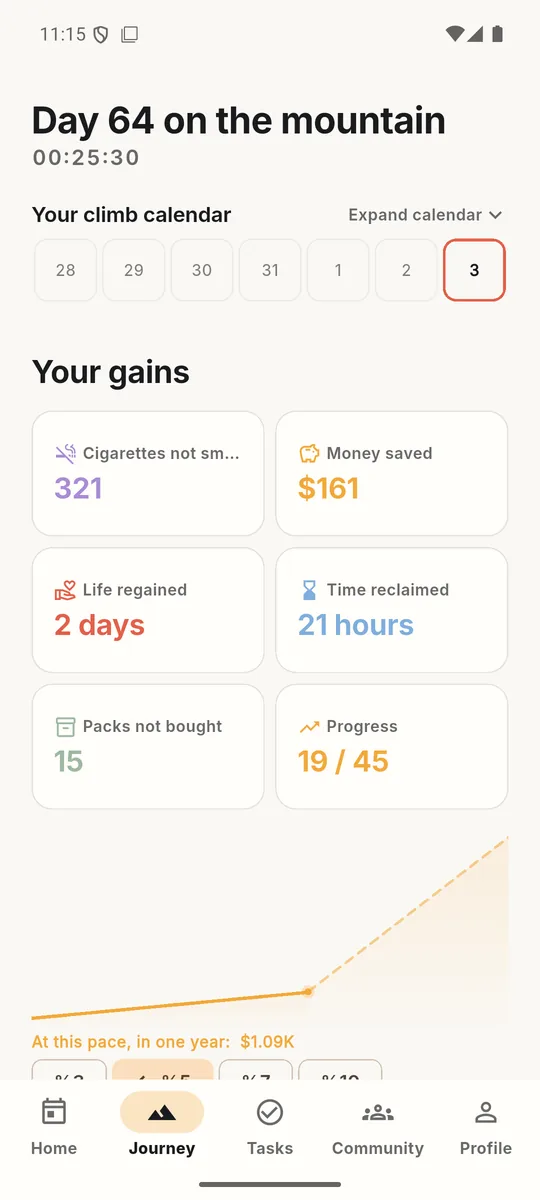
Your gains day by day: cigarettes not smoked, money saved, life reclaimed.
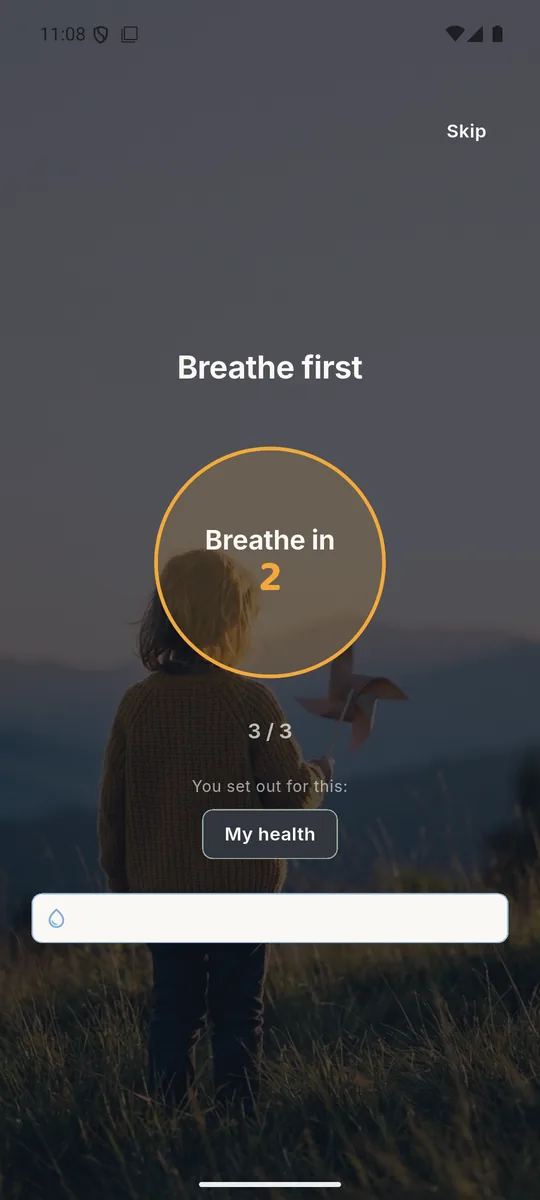
One tap when a craving hits: breathe first. A three-round guided breathing exercise.
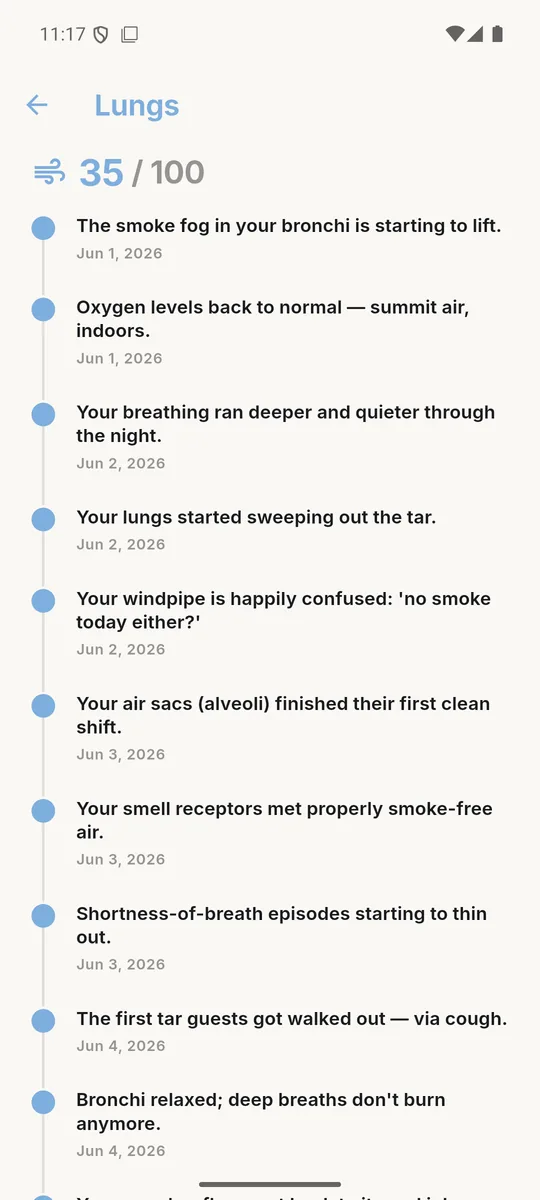
Six routes, 600 stops. Whatever is repairing in your body, you read it there.

You choose the view you are climbing — summit, forest, sea, or your own photo.
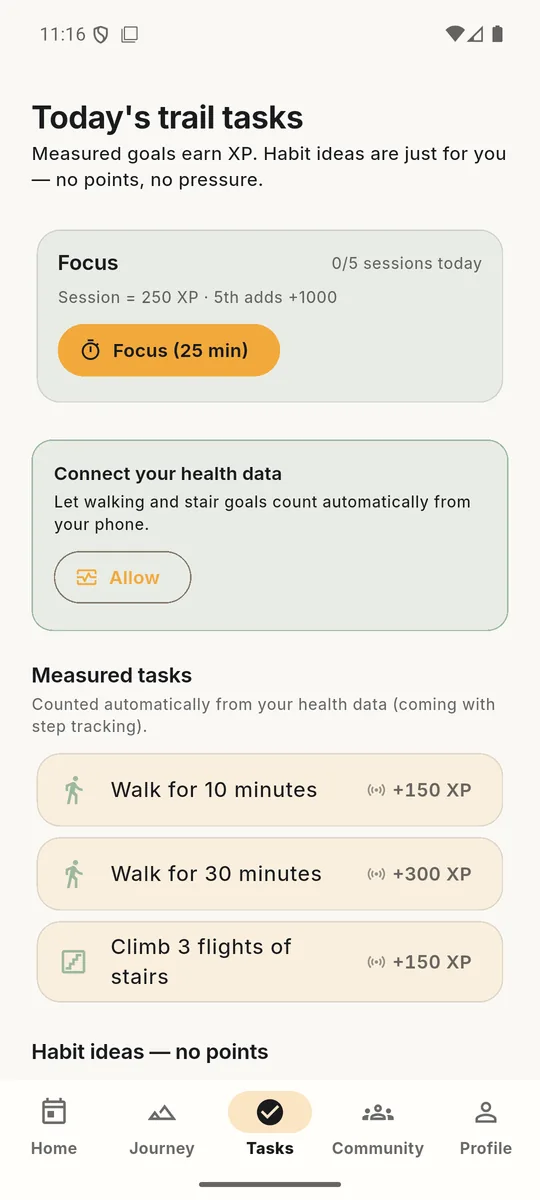
Small tasks every day. You are building a habit, not willpower.
Real screens from the app.
- Hear your own voice when a craving hits — the reason you quit, in your own words. You can add the voices of people you love, too.
- One tap for guided breathing and a distracting task — enough to fill those four minutes.
- 600 stops across six routes: read exactly what is repairing in your body today.
- Your numbers live on your device and keep counting offline — even on a plane.
- You pick the view you are climbing: summit, forest, sea, or your own photo.
- Interface, content and notifications in 14 languages.
You start free. The first day of the journey and the last are both yours.