Deciding to Quit Smoking: Why “I Should Quit” Never Works
July 29, 2026·7 min read
“I should quit” feels right yet changes nothing. See how switching one verb tense to “I’m quitting” turns a vague intention into a real decision you can act on today.
"I should quit."
How many times have you said that? A hundred? A thousand? And how many times after that sentence… did nothing actually change?
The problem isn’t you. The problem is the sentence — and that’s the part of the quitting decision almost nobody talks about.
Changing a single word sounds like a cheap trick. But that word decides when the sentence happens — and that tense decides whether it can be postponed.
How do you decide to quit smoking? Start by changing one sentence
Put these two side by side:
I should quit. I’m quitting.
The first one is a judgment. You’re looking at yourself from the outside and passing a verdict: this isn’t good, I really ought to stop. Same family as “I should drink more water” or “I should go to bed earlier.” Those sentences are true — and they don’t move anything in real life.
The second one is an action. It describes something that’s happening now.
The difference isn’t just a word, it’s the time frame. “I should quit” lives in the future, and the future is endlessly reschedulable. “I’m quitting” is present tense — and the present can’t be pushed to next week.
“I can’t decide to quit”: why it’s so easy to stay stuck for years
Because that in‑between zone is comfortable.
Saying “I should quit” lets you keep smoking and still feel like a responsible person. You see yourself as someone who intends to quit — someone who “gets it.” You’ve admitted the problem. But you don’t actually have to do anything yet.
Your mind loves this position. Your conscience relaxes, your habit stays intact. You get the best of both worlds.
There’s also a social bonus. “I should quit” shuts down the whole table: nobody tells you to quit because you’ve already said it yourself. It sounds like a plan, but it mostly works as armor — and as long as it works as armor, it doesn’t have to produce any change.
⚠️ That’s exactly why it’s risky: “I should quit” isn’t a warm‑up phase, it’s a comfort zone. You can sit there for years and nothing will push you out of it.
Does a dramatic “decision moment” to quit smoking really exist?
It does — just not the way movies frame it.
You may be waiting for a scene: one morning you’ll wake up, feel a surge of willpower, dump the pack in the trash. That scene does happen for some people. But for most, the decision is much quieter.
It usually looks like this: an ordinary Tuesday, an ordinary cigarette, and suddenly the thought, “I don’t want this anymore.” No drama. So small that you might forget it happened.
When people who’ve quit are asked later, most don’t remember that exact moment. They remember day one, the first week, the first big craving. The decision itself doesn’t leave a big memory trace because it’s tiny; what sticks is the first action that follows it.
What actually makes the difference isn’t how big that moment feels — it’s what you do right after. And that “what you do” can be much smaller than you think: writing down a date, throwing away a pack, telling one person.
You don’t have to “feel ready” to say “I’m quitting”
This is the part many people miss.
We wait to feel ready. But feeling ready is a result, not a starting condition. You don’t feel ready before you begin; you feel more ready because you began.
Someone who can’t swim doesn’t stand on the shore waiting to feel ready to swim. Without getting in the water, that feeling never arrives. Nobody feels truly ready on day one. The “readiness” is built inside that first day.
Seneca wrote the same idea, in reverse, almost two thousand years ago:
“It is not because things are difficult that we do not dare; it is because we do not dare that they are difficult.” (Non quia difficilia sunt non audemus, sed quia non audemus difficilia sunt. — Seneca, Letters to Lucilius, 104)
What that line translates to in this context is simple: the difficulty is not the reason you delay; the delay is what makes it feel more difficult.
Every week you postpone makes the next attempt look a little bigger.
That’s why waiting for the perfect moment isn’t a strategy; it’s just a subtler way of putting it off.
You don’t decide once — you decide once a day
This is the most relieving part for many people.
“I’m quitting” is not a single, lifelong oath. If you treat it like a sacred lifetime vow, it becomes heavy: a week later the same promise is still on your shoulders, and every craving feels like it’s attacking your entire future.
In reality, the decision gets made again every morning — and here’s the good news: a decision you make every morning is a decision you can win back every morning. If yesterday went badly, today’s decision is still yours.
Practically, that means setting your goal not as “never again,” but as “not today.” The first one is impossible to measure and never feels finished. The second one is done every night when you go to bed.
And one day of “not today,” repeated, means that six months from now you can look back and count 180 days you’ve already won.
3 ways to make your quitting decision more solid
Three concrete steps. All can be done today in ten minutes:
1. Say the sentence out loud. Say “I’m quitting.” Let your own ears hear it. It may feel silly, but speaking a sentence turns it from a thought into a statement.
2. Write down a date. Not in your head — write it down somewhere. There’s a specific way to pick a quit date; randomly pointing at a day usually doesn’t work well.
3. Tell one person. Not everyone, just one human being. A sentence you’ve said out loud to someone is much harder to take back than one that never left your mouth.
If you’ve decided before and it didn’t stick
Then you’ve said “I’m quitting” before and it didn’t hold. Let’s talk about what that actually means.
On average, people make more than one attempt before they quit for good (CDC). Everyone who works in this field knows this; it’s not a failure, it’s how the process works. Each attempt leaves you with data for the next one: where you got stuck, which day was hardest, what excuse convinced you.
So someone who has tried before isn’t “worse” than someone who never tried. They’re actually ahead. They’ve got a map.
There’s a concrete way to use that map. Think back to your last attempt and answer three questions:
On which day did you cave? Third day, second week, third month? The answer tells you where to put extra support this time.
Exactly where were you at that moment? At the coffee table, in the car, on the balcony? Cravings pick locations more than they pick clock times.
What did you tell yourself? “Today’s special,” “just one,” “I’m already stressed.” Write that line down now — because the same line will show up next time, and if it catches you unprepared it will sound persuasive.
When you put those three answers together, you end up with something powerful: your personal risk map. It’s something nobody else can hand you; only someone who’s tried before can have it.
What happens after you change the sentence?
Your body starts changing in ways you can actually measure — much faster than most people expect.
Within 20 minutes of your last cigarette, your heart rate and blood pressure drop toward normal. After 12 hours, the carbon monoxide level in your blood falls and the oxygen reaching your cells increases. These numbers line up with the World Health Organization’s recovery timeline after quitting and CDC data.
We broke down what happens hour by hour in a separate article.
Your one job for today: change the sentence.
Drop “I should quit.” Say “I’m quitting.” The rest lives in your first climb.
If you want to see what changes from the moment you say it, enter your date in the counter on the right. And if you’d like to keep that counter in your pocket, the Tar2Star app is built for that — it tracks every gain, day by day, from the very first one.
This page is a photo. The app is the film.
These numbers show today. Tar2Star shows you a new one every morning — and stays with you when a craving hits.
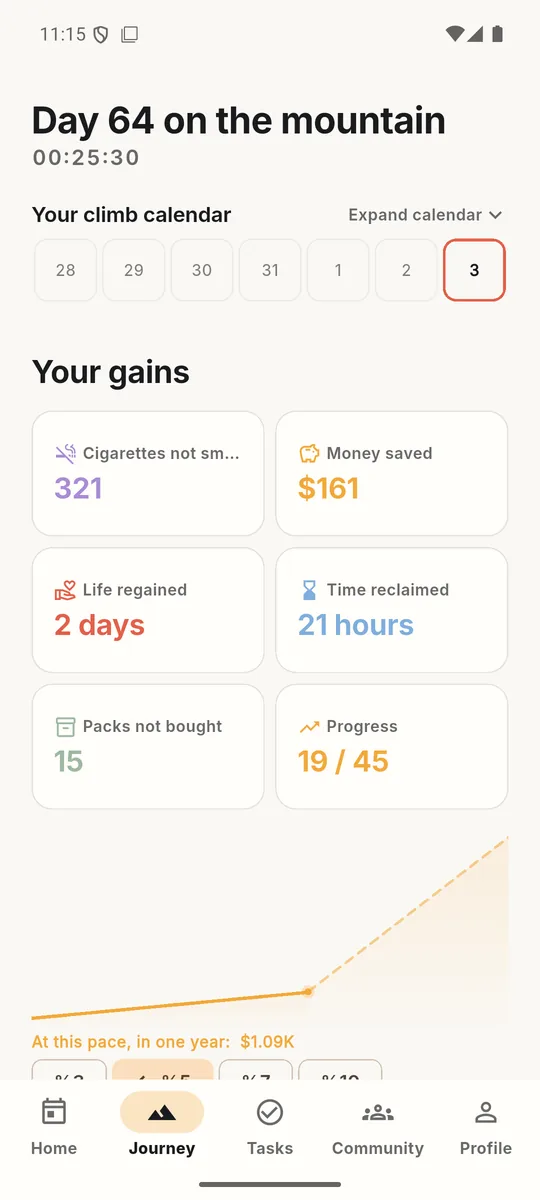
Your gains day by day: cigarettes not smoked, money saved, life reclaimed.
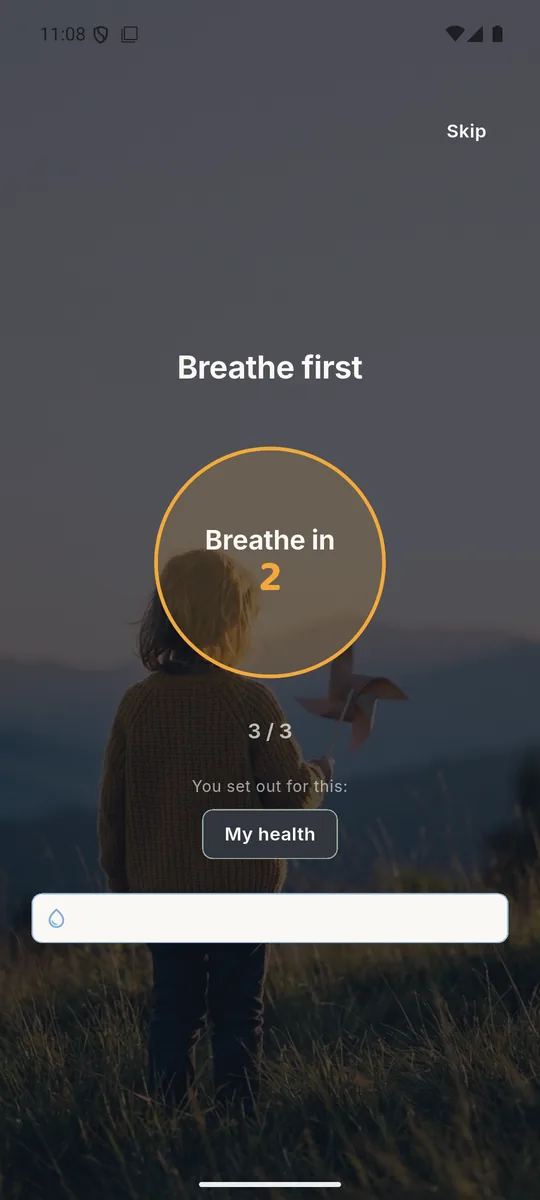
One tap when a craving hits: breathe first. A three-round guided breathing exercise.
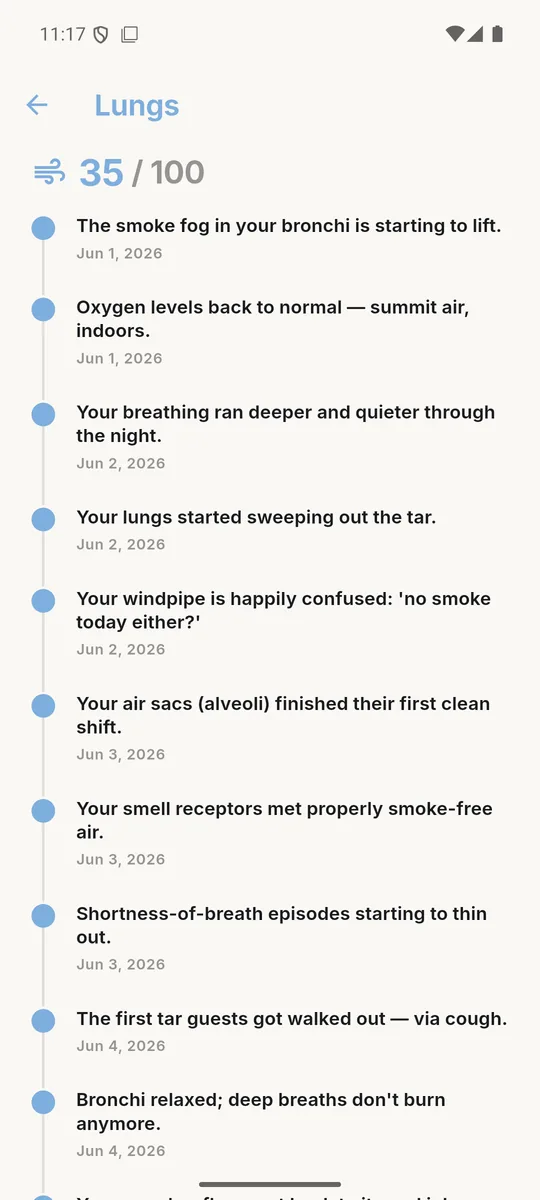
Six routes, 600 stops. Whatever is repairing in your body, you read it there.

You choose the view you are climbing — summit, forest, sea, or your own photo.
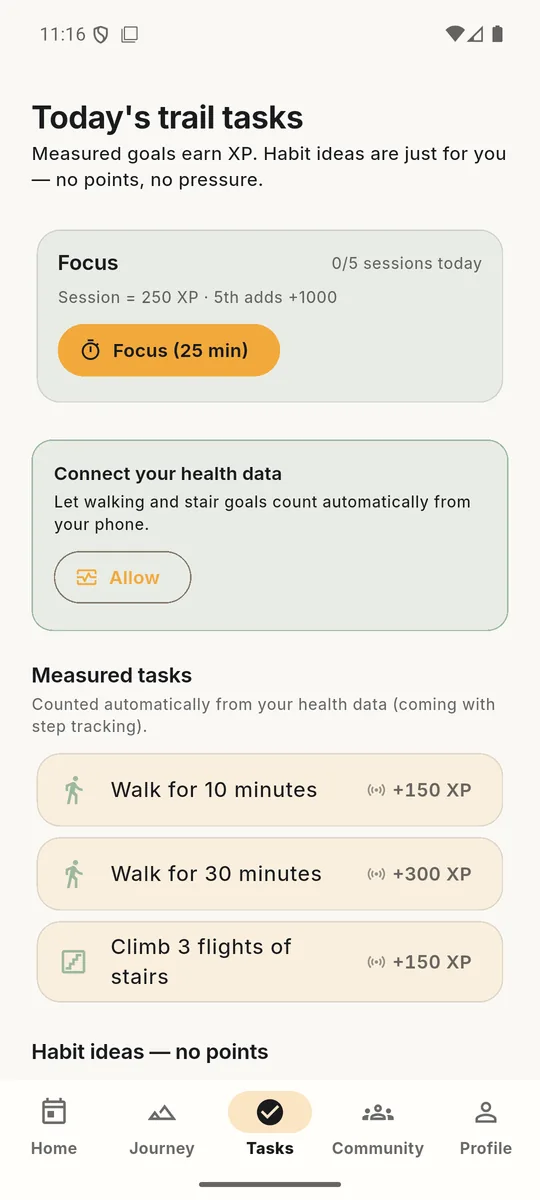
Small tasks every day. You are building a habit, not willpower.
Real screens from the app.
- Hear your own voice when a craving hits — the reason you quit, in your own words. You can add the voices of people you love, too.
- One tap for guided breathing and a distracting task — enough to fill those four minutes.
- 600 stops across six routes: read exactly what is repairing in your body today.
- Your numbers live on your device and keep counting offline — even on a plane.
- You pick the view you are climbing: summit, forest, sea, or your own photo.
- Interface, content and notifications in 14 languages.
You start free. The first day of the journey and the last are both yours.