Who Are You Really Quitting Smoking For?
July 30, 2026·8 min read
Quitting “for someone else” can get you started — but it rarely keeps you smoke‑free. Here’s how to find a reason that actually holds on bad days.
If you’ve found your reason for quitting, there’s a second question almost nobody asks: whose reason is it?
The same sentence can work completely differently in two people’s lives. (Step one in the prep list was saying your reason in one sentence; this piece is about who actually owns that sentence.) Two people say, “I’m quitting for my kid.” One is still smoke‑free in month three, the other is back to smoking in week two.
The sentence is the same. The ownership isn’t.
This is the often‑skipped second half of the “find your reason” exercise.
Why does it matter who your reason belongs to?
Because the engine that kicks in when things get hard is different.
An internal reason feels like a choice. When you’re struggling, you’re telling yourself, “I want this.” The decision sits on your side of the table.
An external reason feels like an obligation. When you’re struggling, you’re telling yourself, “I have to do this.” And obligations tend to create pushback the tougher things get.
In that second case, something odd shows up: smoking turns into a way of taking your space back. Nobody thinks about it that way consciously, but that’s how the behavior works. If you feel like you owe the decision to someone else, breaking that “debt” can feel like a tiny act of freedom.
Is “for someone else” always bad?
No — and that difference matters.
Quitting “for someone else” can be a great launch button. Your partner insisting, your kid asking, a doctor warning you — these are real sparks that get people moving.
The problem isn’t starting there. The problem is staying there. If a quit that started with an external reason doesn’t turn into your own reason by week two or three, it usually loses its fuel.
A healthy version looks like this: “I started because my partner wanted me to. Now I can walk up the stairs without gasping, and I don’t want to give that up.” The spark is external. The fuel is internal.
How do you tell if a reason is really yours?
There’s a simple test. Write your reason as one sentence, then ask:
If nobody ever knew this, would it still be true?
“I don’t want my partner to be upset.” → Loses strength if nobody knows. External. That path has its own trap.
“I don’t want to wake up coughing every morning.” → Doesn’t depend on anyone else. Internal.
“I don’t want to be a bad example for my kid.” → Interesting middle ground: it’s about someone else, but it’s your value. Usually holds up well.
The test isn’t perfect, but it clarifies one thing: does this sentence need someone else to confirm it?
The three‑question exercise was built exactly for this split; the second question (0–10 scale and “why not lower”) pulls ownership to the surface.
Mixed reasons are the norm
In real life, reasons don’t show up nice and pure. Most people have three–four reasons at once, and some of them are external.
That’s not a problem. What matters is that your list has at least one reason that doesn’t depend on anybody else.
A practical check: write your list, and next to each line add “mine” or “someone else’s.” If you don’t have a single “mine,” go back to the exercise. That’s not a failure — it just means your prep isn’t finished yet.
What if all your reasons are about other people?
If your list has no “mine,” the solution isn’t to throw your reasons out. It’s to add at least one internal one next to them. Three approaches tend to work:
1. Flip the same reason toward yourself. Under a sentence like “I don’t want my partner to be upset,” there’s usually something you want: fewer arguments at home, not having to hide cigarettes, being able to hug someone without worrying about the smell. One of those is your sentence.
2. Add something you can measure. Stairs, morning cough, smell, money. These don’t depend on anyone else and can be confirmed within about three weeks. A reason you’ve verified is stronger than a reason someone promised.
3. Look at “who you’d like to be.” A sentence like “I want to be someone who doesn’t have to check whether there are enough cigarettes left” doesn’t owe anything to anyone. And it doesn’t turn into rebellion on a rough night.
⚠️ All three are ten‑minute jobs. But if you skip them, you usually notice in week three — and that is the worst time to be fixing foundations.
Which sentence will actually hold on a hard night?
This is the one practical question in this piece.
It’s 11 p.m., your day has been awful, there are no cigarettes at home but the corner store is open. What sentence will be in your head right then?
“I promised my partner.” → Sometimes works, sometimes leads straight into “I’m tired of doing this for everyone else.”
“I want this for me.” → More durable — as long as it’s genuinely true for you.
“It’s been four days, I don’t want to reset to zero.” → This one works the most often, because it’s both yours and measurable.
Look at the numbers in that third one: four days means about 80 cigarettes not smoked, and for someone who smokes a pack a day, roughly four packs’ worth of money not spent. For someone who’s made it past the first 72 hours, what you stand to lose is no longer abstract.
That’s what makes the third sentence interesting: over time, your reason turns into accumulation. In the beginning, why you quit matters. By week three, not losing what you’ve already built matters even more.
⚠️ That’s why having a visible counter isn’t just a fun gadget — it’s a working tool. A number you don’t want to lose usually beats a sentence you’re trying to talk yourself into.
Your reason will change — and it needs to
Most people write their reason once and never look back.
In reality, your reason shifts — and that’s a good sign:
Week one. The reason is often defensive: “I don’t want to feel awful,” “I gave my word.” In this phase, your reason is mainly a brake.
Month one. It tends to move toward something you can see: “Stairs don’t wipe me out anymore,” “I don’t wake up coughing.” Now it’s evidence.
Month six. For many people the reason disappears — because there’s nothing left that needs a reason. Nobody stands in the bathroom asking, “Why am I brushing my teeth today?”
So your reason is less a fuel tank and more an anchor. You need it at the start; later it quietly stops being necessary. That’s why it helps to redo the exercise at the end of month one: some of your original sentences will no longer fit, and the new ones you write will usually be more solid.
Is saying “I’m quitting for myself” selfish?
This comes up a lot, especially for people quitting “for their family,” and the answer is short.
People with their own internal reasons tend to stay smoke‑free longer. So even if your top priority is your kid, the most useful reason for them is still the one you feel you own. Saying “for myself” doesn’t push anyone out — it just changes who’s carrying the decision. And when you’re the one carrying it, it usually gets carried further.
In practice: let your list say both “my kid” and “my morning cough.” The first gets you to start. The second keeps you going.
What if you’re not quitting for anyone at all?
Sometimes the honest answer is “no one”: not for yourself, not for others — just a vague sense of “I guess it’s time.”
That’s still a start, but it’s the most fragile version. At the first real bump in the road, there’s nothing to lean on.
If that’s where you are, the next step isn’t to postpone quitting. It’s to spend ten minutes today looking for your reason. People do quit without a clear reason — but quitting with one is noticeably easier.
Who your reason belongs to matters as much as what it is.
One thing you can do today: write your reason down and mark whether it’s “mine” or “someone else’s.” If you don’t have a single “mine,” your list isn’t wrong — it’s just not finished.
And keep that third sentence in your back pocket: “It’s been four days, I don’t want to reset to zero.” For that sentence to work, you need a number you can actually see. That’s the whole point of putting your quit date into the counter on the right.
If you’d like to have that same number in your pocket on a rough night, the Tar2Star app is built for exactly those minutes: days smoke‑free, cigarettes not smoked, and something to keep your hands busy when a craving hits. ---
This page is a photo. The app is the film.
These numbers show today. Tar2Star shows you a new one every morning — and stays with you when a craving hits.
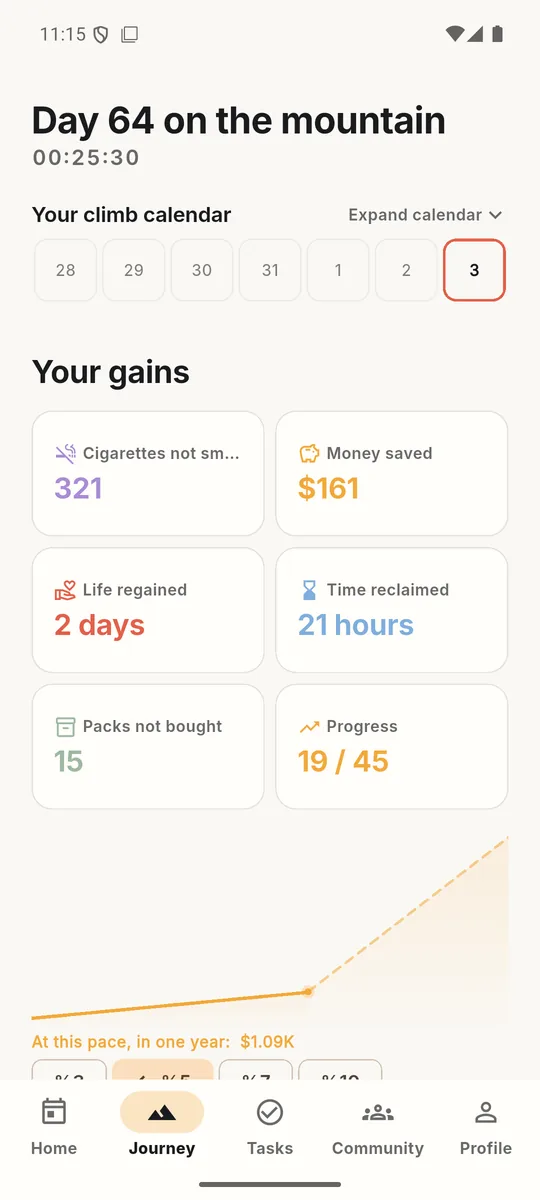
Your gains day by day: cigarettes not smoked, money saved, life reclaimed.
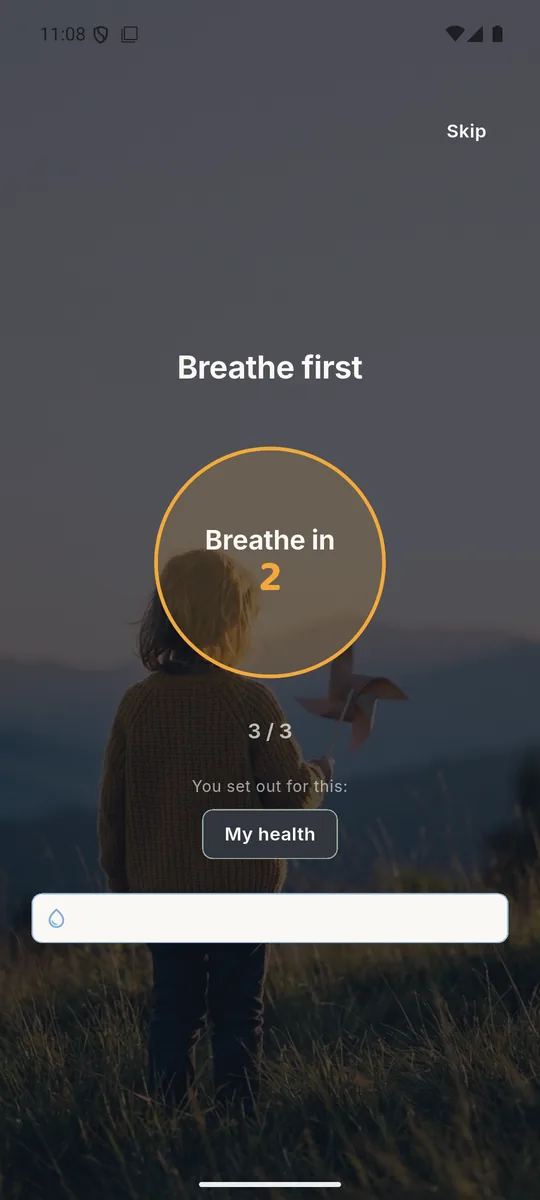
One tap when a craving hits: breathe first. A three-round guided breathing exercise.
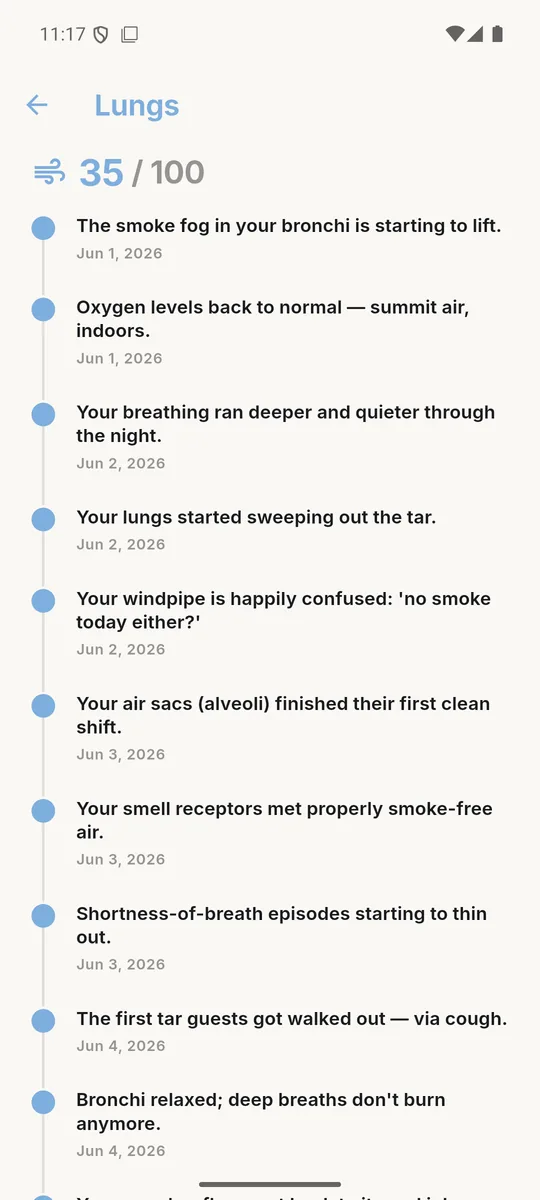
Six routes, 600 stops. Whatever is repairing in your body, you read it there.

You choose the view you are climbing — summit, forest, sea, or your own photo.
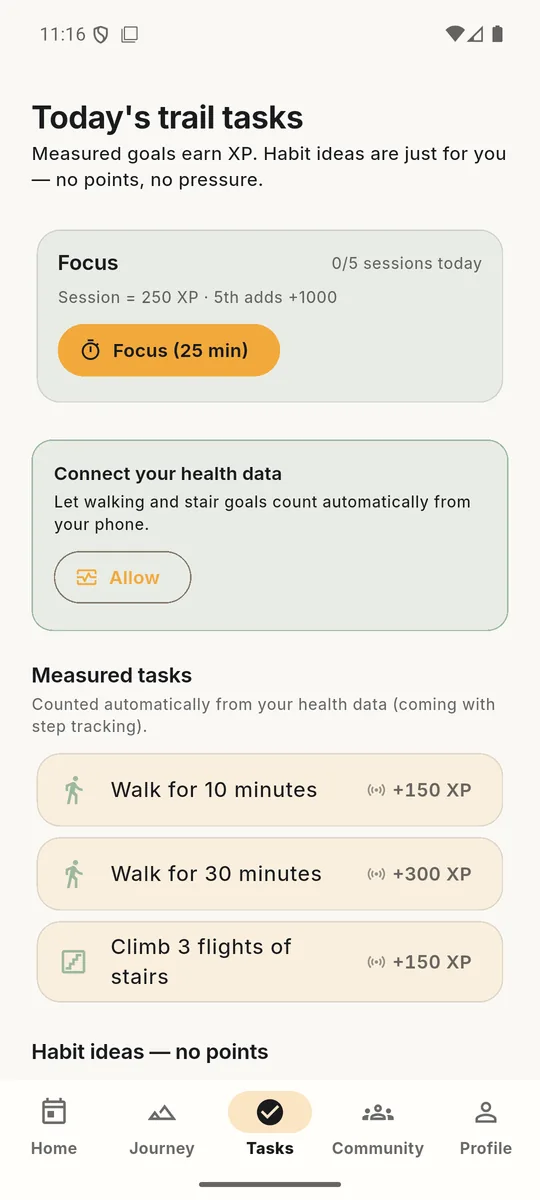
Small tasks every day. You are building a habit, not willpower.
Real screens from the app.
- Hear your own voice when a craving hits — the reason you quit, in your own words. You can add the voices of people you love, too.
- One tap for guided breathing and a distracting task — enough to fill those four minutes.
- 600 stops across six routes: read exactly what is repairing in your body today.
- Your numbers live on your device and keep counting offline — even on a plane.
- You pick the view you are climbing: summit, forest, sea, or your own photo.
- Interface, content and notifications in 14 languages.
You start free. The first day of the journey and the last are both yours.