Is There a Right Time to Quit Smoking? Why the Answer Is “Today”
July 29, 2026·7 min read
Waiting for the perfect time to quit smoking just extends the habit. See why “today” beats “someday” and what you actually gain by not postponing it.
Vacation first, then I’ll quit.
Let this project be over, then I’ll quit.
Once I get through winter. After New Year’s. On my birthday. At the start of the month.
How many years has that list been running in your head?
Every item on it sounds reasonable on its own. Added together, they become one year, then five, then ten. A pile of “good reasons” that, summed up, stops making sense — this article is about that exact math.
Why the “right time” to quit never seems to arrive
Because “the right time” isn’t really about a date on a calendar — it’s about how stressed you feel. And you’ve silently defined it like this: a stretch of life when my stress is low.
The problem: that stretch basically doesn’t exist. One project ends, another starts. Vacation ends, work piles up. Winter is over, summer plans roll in.
Life doesn’t hand out long, empty, peaceful slots with nothing going on. Waiting for that slot is itself a decision: choosing to wait is also a choice.
Voltaire’s 250‑year‑old line fits this perfectly:
“The best is the enemy of the good.” (Le mieux est l’ennemi du bien. — Voltaire, La Bégueule, 1772)
Chasing a perfect moment blocks a perfectly good one. And with quitting, the bar for a “good moment” is very modest: any moment that starts today.
Why postponing feeds on itself
Because every delay makes the next delay easier.
The first time you say “next month,” that’s a decision. The fifth time you say “next month,” it’s no longer a decision, it’s a habit — and habits don’t get questioned, they just repeat.
Postponing is sneaky because it never presents itself as a real “no.” It always sounds like: “yes, but not now.” On paper you’re always saying yes.
That’s why those sentences don’t trigger much guilt. If they did, you probably wouldn’t stand them for long — you’d quit. They survive precisely because they feel comfortable.
Is “you shouldn’t quit when you’re stressed” actually true?
Partly. Quitting in the middle of intense stress is harder; that’s real.
But there’s a twist in the logic. Smoking gives the feeling that it lowers stress — what it mostly does is silence, for a few minutes, the withdrawal tension that the last cigarette created. You light up, remove the discomfort of not having nicotine, feel the contrast, and call that “relief.”
So the calm period you’re waiting for… never really shows up while you stay in the cycle. Because that cycle is generating a chunk of the tension itself.
⚠️ To be clear: this is not “stress isn’t real.” Real life stress is real. What’s questionable is the idea that cigarettes are genuinely solving it. That idea is one of nicotine’s oldest tricks.
Are there actually bad times to quit?
Yes. To be honest, there are a few situations where pausing makes sense:
If you’re in the middle of a major upheaval — moving, changing jobs, a recent loss — it can be reasonable to wait a few weeks.
For situations like surgery or pregnancy, it’s usually a reason to quit sooner, not later; talk it through with your doctor.
Outside of that, everything else — a busy week, a tough project, a packed social calendar — is just… normal life. And if you wait for normal life to calm down, you’ll notice it doesn’t.
What does “starting today” actually change?
Let’s put real numbers on what you lose by pushing the date forward.
Someone who smokes a pack a day goes through about 7,300 cigarettes a year. Pushing quitting back by one month means about 600 extra cigarettes. One more week means about 140 extra cigarettes.
These aren’t “future” cigarettes. They’re this week’s smoke, going into this week’s lungs.
Then there’s money. You already know that number better than anyone. Take what you pay for a pack and multiply it by seven: that’s one week of delay. Multiply by thirty: that’s one month. That total is the price tag of postponing — and it renews itself every month.
There’s a third cost almost no one talks about: time. One cigarette takes around five minutes. Twenty cigarettes a day adds up to about 100 minutes — roughly 600 hours a year, the same as thirty‑eight full days awake.
Every month you delay is about three more days of your year cut out and burned.
The gain side starts just as fast: about 20 minutes after your last cigarette, heart rate and blood pressure begin to drop to normal; after 12 hours, carbon monoxide in your blood falls; after 48 hours, your sense of taste and smell start to noticeably improve. This timeline lines up with World Health Organization and CDC data; we’ve broken down what happens hour by hour in a separate article.
Is age just another excuse?
One of the most common postponing lines is: “At my age, what difference does it make?”
It does make a difference — and the difference has actually been measured. A famous 50‑year cohort study of British doctors looked at extra life expectancy based on the age they quit: those who quit around 60 gained about 3 years, those who quit around 50 gained about 6 years, and those who quit around 40 gained about 9 years.
How you read that chart matters. Many people look at it and think, “I’m 55, I missed the train.” The chart is saying the opposite: there’s a gain at every age, and the longer you wait, the smaller that gain becomes. The gap between quitting at 55 and quitting at 60 is actually one of the biggest gaps on it.
And there’s another side: extra years of life are the most abstract part of the story. The concrete benefits show up in the first months — stairs, sleep, morning cough, taste and smell. Someone who quits at 60 experiences those in their first three months, just like someone who quits at 30.
Even a “late” quit has measurable wins. We dig into whether years of smoking damage can be reversed in another piece.
What exactly do we mean by “today”?
You’ve got two perfectly valid options:
Right now. Toss the pack you’re holding, call today your quit date. No elaborate build‑up, but very real.
A near‑term date. Pick a day within the next two weeks. Use the time in between to get ready: clear out smoking stuff, tell your circle, set up your “crisis plan.”
The difference between those two is minor. What matters is that both live on an actual date in a calendar. “Soon” is not a date.
The two‑week limit isn’t random. When people set a date further out, two things tend to happen: the preparation expands to fill the time, but determination doesn’t grow with it — and a fresh “bad time” almost always appears. A quit date three weeks away often gets renegotiated in week three.
How you pick the day also matters. Monday is a popular choice — it sounds logical, but Monday is already the heaviest day of the week for many people. For some, Tuesday or Saturday ends up being a quieter, more protected start.
Only one rule here: pick a day you’re comfortable saying out loud to someone else.
Postponing is not your personality
One last thing.
If you’ve been delaying this for years, it’s easy to turn it into an identity: “I’m just not someone who can do this.” That sentence turns something you’ve noticed about the past into a fixed future — and then that “future” stands in front of you at the next attempt.
A more accurate version is: up to now, it’s been postponed. That doesn’t mean tomorrow has to look the same. Finding the real reason behind your decision to quit makes this part lighter.
The person who delays and the person who quits are often the exact same person — just on different days. The difference isn’t about character; it’s about a date. On one timeline there’s a day marked on the calendar, on the other there isn’t.
Take another look at your waiting list. Then cross it out.
If you start today, your first climb begins tomorrow morning.
To see what you’re gaining starting right now, enter your date into the counter on the right. And if you want to carry the same tracker in your pocket — and have something solid to lean on in rough moments — the Tar2Star app was built exactly for that.
This page is a photo. The app is the film.
These numbers show today. Tar2Star shows you a new one every morning — and stays with you when a craving hits.
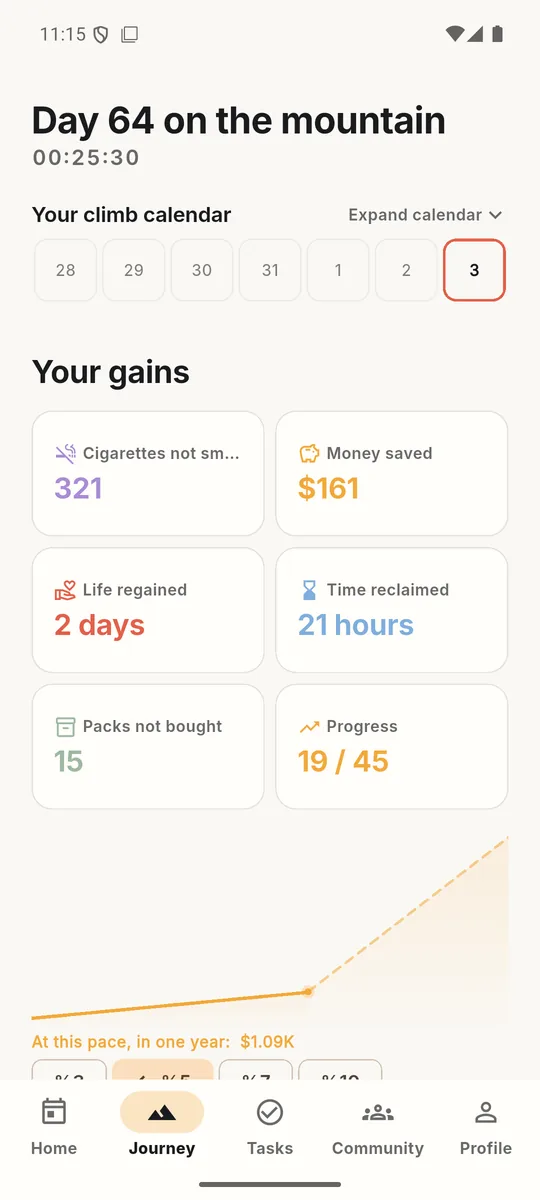
Your gains day by day: cigarettes not smoked, money saved, life reclaimed.
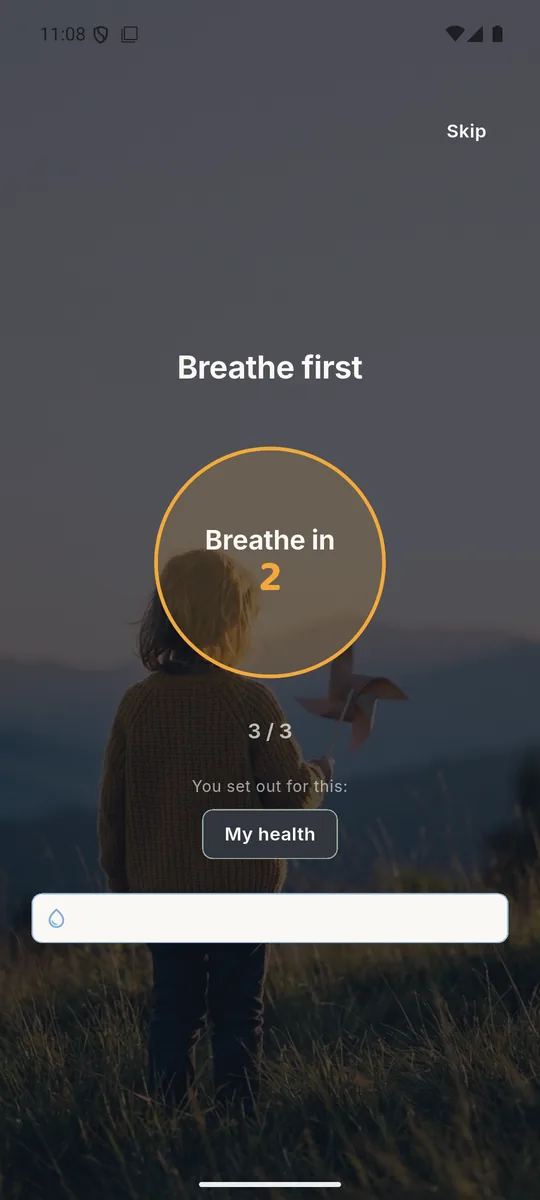
One tap when a craving hits: breathe first. A three-round guided breathing exercise.
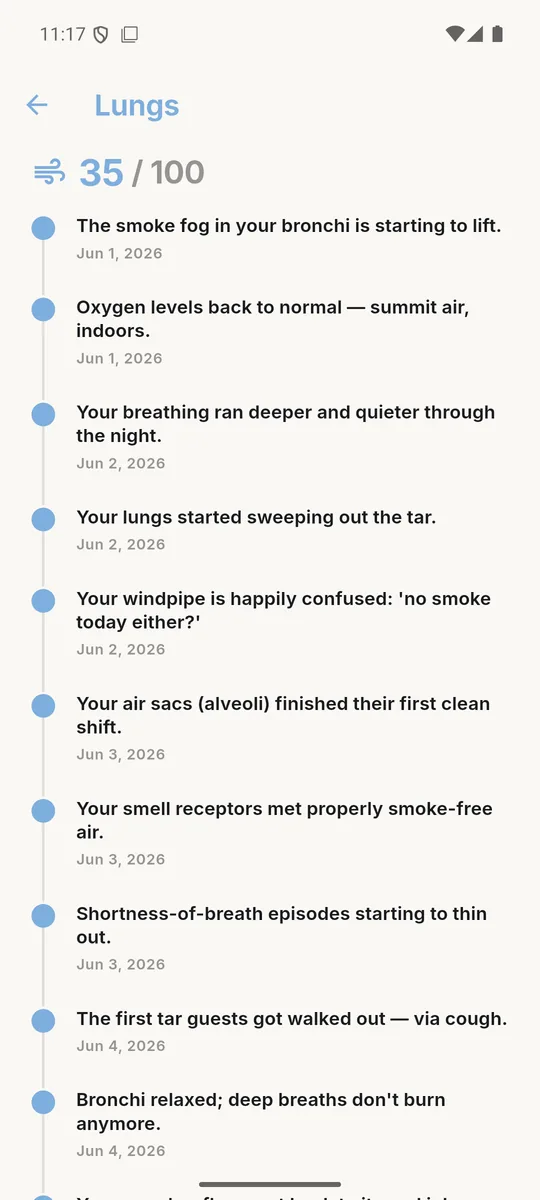
Six routes, 600 stops. Whatever is repairing in your body, you read it there.

You choose the view you are climbing — summit, forest, sea, or your own photo.
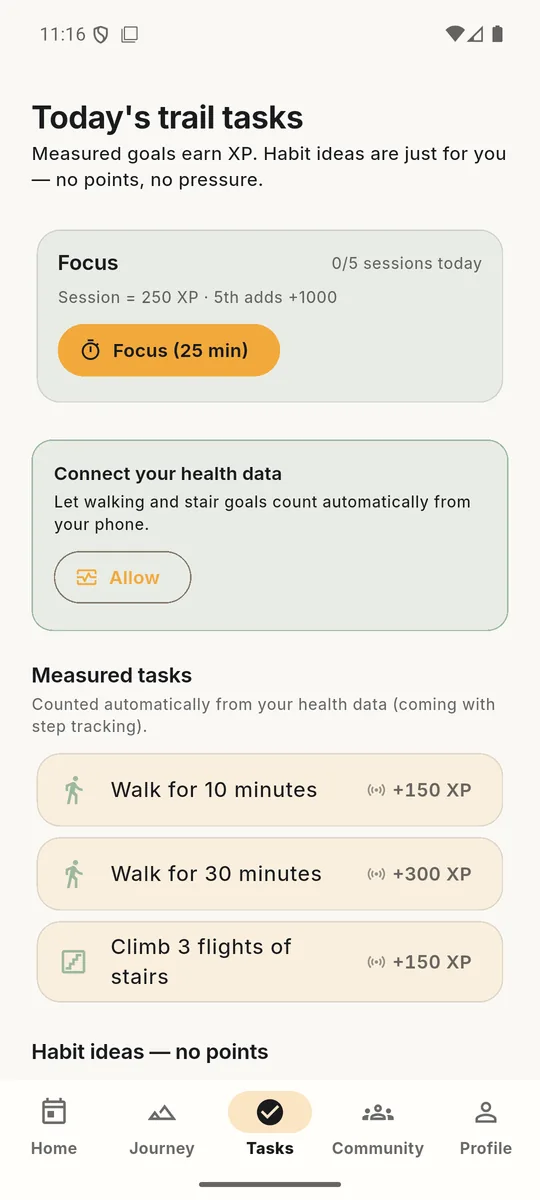
Small tasks every day. You are building a habit, not willpower.
Real screens from the app.
- Hear your own voice when a craving hits — the reason you quit, in your own words. You can add the voices of people you love, too.
- One tap for guided breathing and a distracting task — enough to fill those four minutes.
- 600 stops across six routes: read exactly what is repairing in your body today.
- Your numbers live on your device and keep counting offline — even on a plane.
- You pick the view you are climbing: summit, forest, sea, or your own photo.
- Interface, content and notifications in 14 languages.
You start free. The first day of the journey and the last are both yours.