How many times have you tried to quit? That is not a failure
July 29, 2026·7 min read
Tried to quit smoking several times and feel like you’re failing? Research says multiple attempts are normal. Here’s how to use each one to your advantage.
"This is my fifth try."
People usually say that with embarrassment. But it actually sits right in the middle of the statistics – it’s one of the most typical sentences you could say.
How many attempts does it really take to quit?
For years, the guess was “three or four attempts.” Then someone checked where that number came from: they had only asked people who had already succeeded. Everyone still trying wasn’t even counted.
In 2016, a study published in BMJ Open tried to correct that mistake and estimated the real average at between 6 and 30 attempts.
That gap matters: you’ve been comparing yourself to the wrong average.
Attempt number five isn’t “late.” It doesn’t even sit in the middle of the curve.
That kind of mistake has a name: survivorship bias. It’s like only looking at the ships that made it to port and then saying, “See? Sailing is safe.” You heard that low number, compared yourself to it, and came out feeling behind – when in fact the number you used was miscalculated from the start.
Beckett summed this up long before the quitting‑smoking literature, in four short lines:
“Ever tried. Ever failed. No matter. Try again. Fail again. Fail better.” (Samuel Beckett, Worstward Ho, 1983)
The key is in the last line: the goal isn’t to never fail. It’s to fail better. To get further than last time, to last longer, to fall in a place you recognize. The rest of this article is exactly about how to do that.
Why does quitting need so many attempts?
Because “quitting” isn’t a single skill. It’s a bundle of different skills you build over time:
Learning to ride out a craving wave
Learning to say no at a table where everyone’s drinking
Learning to get through a stressful day without a cigarette
Learning to keep going after you’ve had one
You don’t learn these by reading; you learn them by living through them. Each attempt lets you tick off one more item from that list.
So your number of attempts is not a measure of your ability. It’s a measure of how much data you’ve collected.
What did you gain from your past attempts?
This question almost never gets asked. The attempt gets stamped “failure” and filed away. Yet you walked away with two very real gains:
Your body actually lived those days. If you stayed quit for three weeks, then for those three weeks your circulation, blood pressure, and carbon monoxide levels really did improve. The healing timeline didn’t rewind; it just paused.
You now know your own triggers. On a first attempt, you have no idea when you’ll slip. You do now – and that knowledge is the map for what you’ll change this time.
The sentence “I just can’t do it”
This sentence turns something you observed into an identity – and once it’s an identity, the story’s over.
Put these two side by side:
“I can’t quit.” → A fixed trait. If it’s who you are, there’s no point trying.
“So far I haven’t managed to quit in four attempts.” → A record. It says nothing about attempt number five.
The second one is both more accurate and more useful. Quitting isn’t a personality trait; it’s a direction you repeat.
A single cigarette is not the same as a full relapse
This is the most practical distinction to get clear on, so it gets its own section.
Slip: you smoke one cigarette. There’s barely any measurable reversal in your body.
Relapse: after that one cigarette, you tell yourself “I’ve blown it anyway” and go back to the pack.
The bridge between them is not the cigarette, it’s the sentence you say. What turns a slip into a relapse isn’t the nicotine – it’s the decision.
⚠️ That’s why, after that first cigarette, the question to ask yourself is not “Is everything ruined now?” but “Am I going to skip the next cigarette?” Those are completely different questions – and you still have full control over the second one.
Three moves for the moment you slip
The slip moment is the one that decides the fate of the whole attempt. And if you haven’t written down in advance what you’ll do at that moment, it tends to decide for you.
1. Check the time and write it down. “2:20 p.m., after work, with a friend.” Those few words are the single most valuable piece of data for your next attempt – and the act of writing turns what happened from a disaster into a record.
2. Dump the rest. Whatever is left in the pack, throw it out. That’s the only physical barrier in front of the “might as well keep smoking” line – and it takes ten seconds.
3. Eat your next meal as usual, go to bed as usual. Punishing yourself on slip day (skipping meals, staying up late) just makes you lose the next day as well. Punishment is not a strategy.
When you do these three, a slip lasts one day. When you don’t, it averages out to about three weeks – because that “I’ve blown it anyway” sentence slips in.
When is it a relapse, and when is it the same attempt?
People mix these up – and because they do, they restart from zero when they don’t need to.
If you pull yourself back within a day or two, it’s the same attempt. No need to change the quit date, no need to redo all the prep. You just add one safety measure around the place you fell.
If it goes on longer than two weeks, that counts as a new attempt: your old triggers have had time to settle back in, your home may have “re‑smoked” itself. Then you run through the seven‑day prep again – only much faster this time, because you already have half the list in place.
Do you have to reset your counter?
Technically, yes. But there’s a trap: a reset counter feels like “I lost everything.”
Try this instead: imagine you’re tracking two separate numbers. One is continuous smoke‑free days. The other is total smoke‑free days in your life. That second number never goes back to zero – and it’s a much better measure of what you’ve actually gained.
If you’ve quit three times and spent a total of 90 days smoke‑free, those 90 days are done, in the bank. Nobody can take them away.
There’s a very concrete side to this too: 90 days, at one pack a day, is about 1,800 cigarettes not smoked and the cost of ninety packs not spent. When you reset the counter, those numbers vanish from the screen – but they don’t vanish from reality. Those cigarettes were never smoked.
There’s also a third number almost nobody talks about: your longest streak. If across three attempts you went 4, then 19, then 41 days, you start attempt number four with a 41‑day proof right there. The sentence “I just can’t do this” doesn’t hold up next to that.
One change for this attempt
The most valuable question your past attempts give you is this: in your last three tries, did you fall in the same place?
If the answer is “yes,” then this time there’s only one thing that needs to change: that point. Not a whole new level of willpower – a concrete plan for that exact situation.
If the answer is “no,” it means you’re getting further each time – which is already good news.
The seven‑day prep list is there to turn that analysis into an actual plan.
Your number of attempts isn’t a list of failures. It’s a learning log.
Today’s one‑minute task: write a single sentence about where you slipped last time. What’s different this round will come straight out of that sentence.
If you want to see your total smoke‑free days, put your dates into the counter on the right. And if you want something in your pocket for those exact crisis minutes, the Tar2Star app was built for them.
This page is a photo. The app is the film.
These numbers show today. Tar2Star shows you a new one every morning — and stays with you when a craving hits.
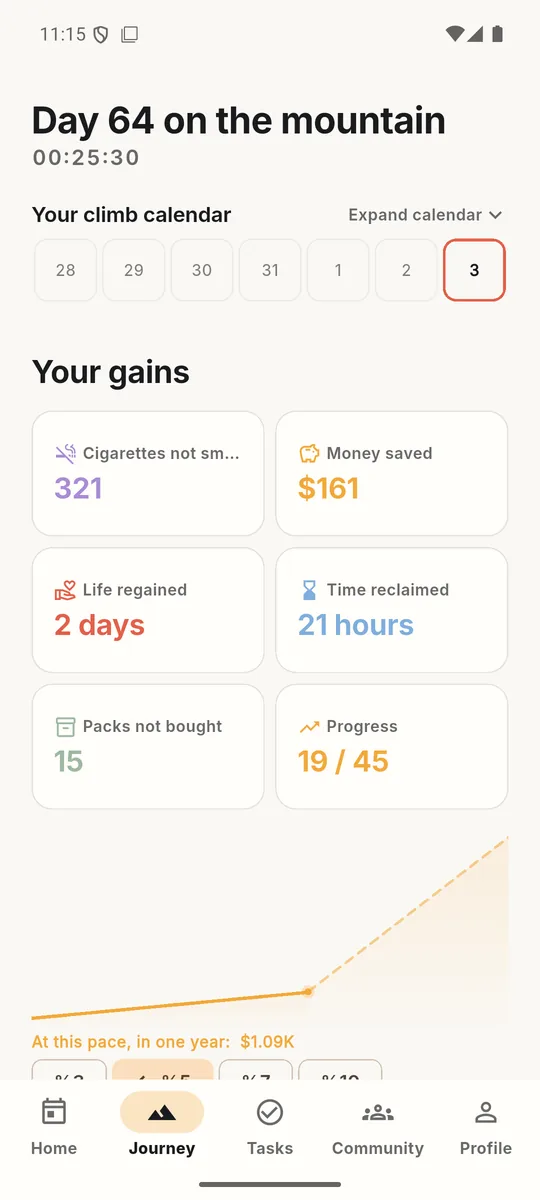
Your gains day by day: cigarettes not smoked, money saved, life reclaimed.
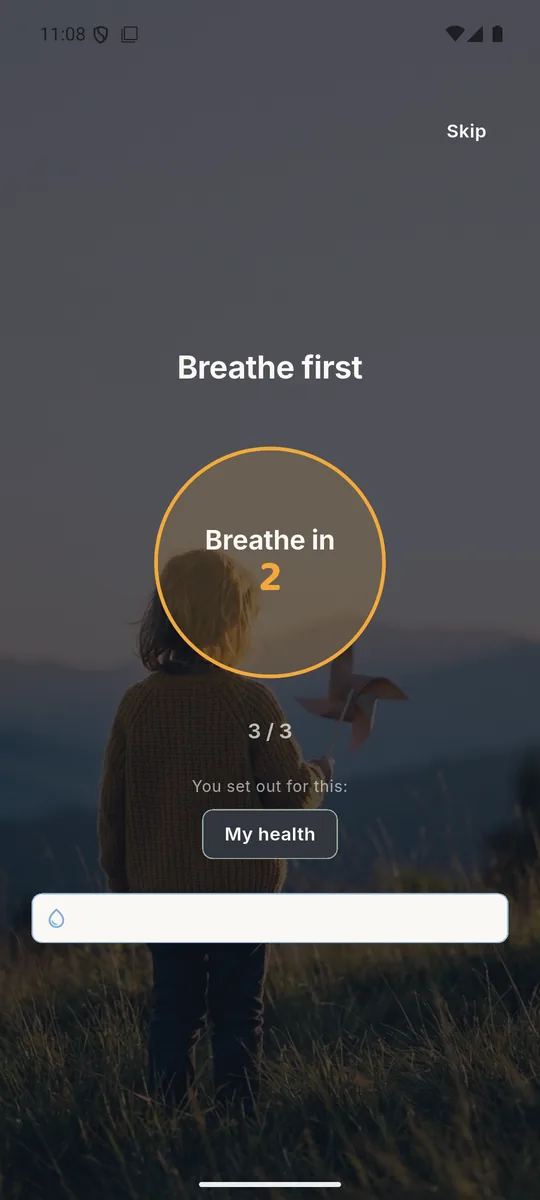
One tap when a craving hits: breathe first. A three-round guided breathing exercise.
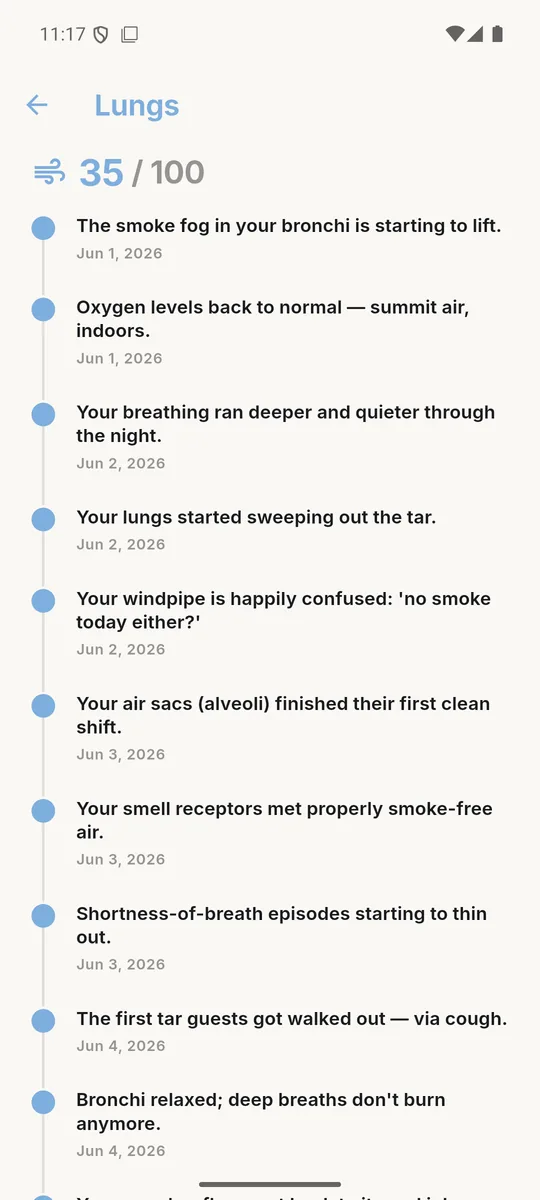
Six routes, 600 stops. Whatever is repairing in your body, you read it there.

You choose the view you are climbing — summit, forest, sea, or your own photo.
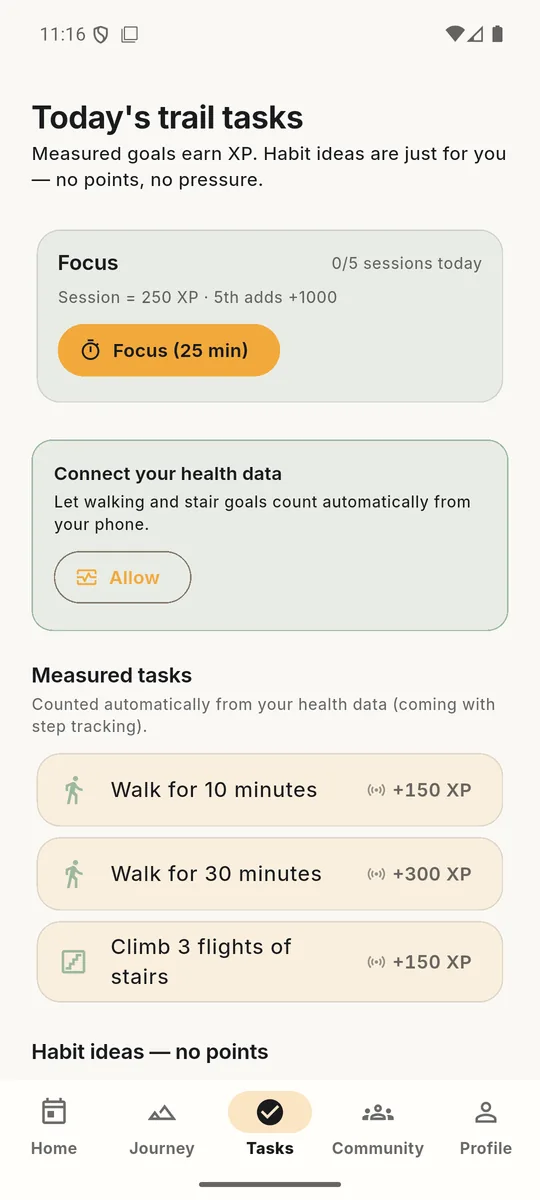
Small tasks every day. You are building a habit, not willpower.
Real screens from the app.
- Hear your own voice when a craving hits — the reason you quit, in your own words. You can add the voices of people you love, too.
- One tap for guided breathing and a distracting task — enough to fill those four minutes.
- 600 stops across six routes: read exactly what is repairing in your body today.
- Your numbers live on your device and keep counting offline — even on a plane.
- You pick the view you are climbing: summit, forest, sea, or your own photo.
- Interface, content and notifications in 14 languages.
You start free. The first day of the journey and the last are both yours.