How to pick your quit date: a 5‑question checklist
July 29, 2026·7 min read
Choosing a quit date is more than circling a day on the calendar. Use these 5 questions to time it right, prepare well and get through the hardest 72 hours.
Choosing a quit date isn’t just circling a random day and hoping for the best.
Pick the wrong date and the plan can collapse in 48 hours — the circle is still on the calendar, but your decision is gone. Pick the right one and those first rough days land at the easiest possible moment in your own life.
You can get from one to the other with five questions:
How far ahead should the date be?
Which day of the week works best?
Which days should you avoid?
What do you actually do before that date?
On that day, do you quit all at once?
In order.
How far ahead should your quit date be?
No more than two weeks.
That number isn’t random. A date that’s too soon (“tomorrow”) leaves no room to prepare. A date that’s too far away (“in three months”) drains all the energy from your decision.
A two‑week window solves both problems: enough time to clear out your home, tell your people, and make a cravings plan — but not so long that you forget why you chose to quit in the first place.
⚠️ One warning: once you pick a date, don’t push it back. A date that’s moved once is much easier to move a second time. If the date keeps sliding, the problem usually isn’t the date — it’s the decision itself.
What’s the best day of the week?
The hardest stretch is usually day 2 and 3 after you stop. That’s when nicotine withdrawal tends to peak — we’ve broken down why day two can feel tougher than day one in a separate guide.
So the real question is: where do you want days 2 and 3 to land?
If you start on a Thursday or Friday, your toughest two days fall on the weekend. Upside: no work pressure, sleep schedule is flexible. Downside: more empty time, more social plans (and often more alcohol).
If you start on a Monday, your hardest days land on weekdays. Upside: busy days, lots of distraction. Downside: work stress and your usual cigarette breaks all show up together.
There’s no one right answer. Ask yourself: in a crisis, do I do better with free time or with structure?
There is one simple rule that makes the decision easier: look at your smoking log. Where do your heaviest smoking hours cluster? If most of your cigarettes happen during work hours (outside the office, on breaks, after meetings), a weekend start can help: your toughest two days fall when your usual triggers are at their lowest. If most of your cigarettes are at home in the evening, the opposite is true: a weekday start means those hours are already filled.
So you don’t have to guess this. Your own notes are already telling you.
Which dates should you skip?
Some days look great on paper and backfire in real life:
Weddings, big holidays, New Year’s Eve, birthdays. Crowds, alcohol, and the “just this once” mindset all at once.
The first day of a vacation. Your routine is completely different and you haven’t decided what will replace the habit yet.
Right before a major deadline. You’re already under heavy pressure; this just adds another load on top.
Symbolic but distant dates. Saying “I’ll quit on January 1st” when it’s October gives three long months for the decision to fade. January 1st is also when gyms sell the most memberships; we all know what those gyms look like by February.
I picked a date. What do I do before then?
Don’t let the days in between just drift by. You’ve got four jobs:
1. Clear your space. Get rid of ashtrays, lighters, hidden packs. Yes, that one too — the “emergency pack” at the back of the drawer. The “emergency” is exactly the situation you bought it for. This isn’t just symbolic: if there’s no cigarette at home during a craving, you don’t have to re‑make the decision from scratch in that moment.
2. Write down your triggers. When do you smoke? With coffee, on the phone, in the car, after work? Decide now what you’ll put in those slots instead.
3. Tell one person. One is enough. A decision you’ve said out loud is harder to walk back than one that lives only in your head.
4. Make a cravings plan. You want to know beforehand what you’ll do when a strong urge hits. Crisis moments are terrible times to start planning — understanding why most cravings pass in a few minutes really helps here.
Don’t cram all four into the last day. A setup that actually works looks more like this: do your trigger list and cravings plan in the first couple of days (when your brain is still curious and motivated), tell your person in the middle, and clear out your home the day before you quit. That last one is late on purpose: if you empty the house a week early, those in‑between days get needlessly hard, and you burn through your motivation without getting anything back.
On the day: quit all at once?
Yes — and there’s good head‑to‑head data behind that.
A randomized controlled trial of about 700 people published in 2016 in the Annals of Internal Medicine compared two methods: one group picked a quit date and stopped all at once, the other cut down gradually over two weeks before quitting.
At four weeks, quit rates were 49% in the abrupt group and 39% in the gradual group. The difference was still there at six months.
The interesting part: most people in the study originally preferred the gradual method. In other words, our instincts point one way, the data point the other. We’ve unpacked the “cold turkey or cut down?” question in a separate article.
The date is here but I don’t feel ready. Should I delay?
No — and this might be the single most useful line in this whole page.
Waking up on quit day and not feeling ready is not an exception; it’s the default. Readiness is not a mood, it’s a checklist. If you’ve done the checklist, you’re ready — regardless of how you feel that morning. We go deeper into the difference between feeling ready and being ready here.
There’s only one fair reason to move the date: if one of those four prep jobs genuinely isn’t done. Even then, don’t turn it into a postponement; keep it to a small shift, not a long delay — think a day or two, not a week. A week‑long postponement opens up the whole decision for debate again. A two‑day shift doesn’t.
⚠️ And expect this in advance: on quit morning your brain will offer you a brand‑new, extremely reasonable‑sounding excuse to delay. The date you write down today is your defense, today, against the version of you who will wake up that morning.
After all five questions: your body’s calendar runs faster
Your body’s calendar moves quicker than your wall calendar.
After 20 minutes: heart rate and blood pressure start to drop toward normal. After 12 hours: carbon monoxide in the blood falls, oxygen rises. After 48 hours: taste and smell start to sharpen. After 72 hours: your airways relax and breathing gets easier.
This timeline comes from the World Health Organization and the CDC; we’ve laid out the full, hour‑by‑hour version.
Open your calendar. Pick a day within the next two weeks. Write it down.
Then use the days in between to finish those four prep jobs. Your first climb starts that morning.
If you’ve written your date, add it to the counter on the right — it will show you what’s changing from day one. And if you’d like the same tracking on your phone, plus a tool in your hand when a craving hits, the Tar2Star app is built for exactly that.
This page is a photo. The app is the film.
These numbers show today. Tar2Star shows you a new one every morning — and stays with you when a craving hits.
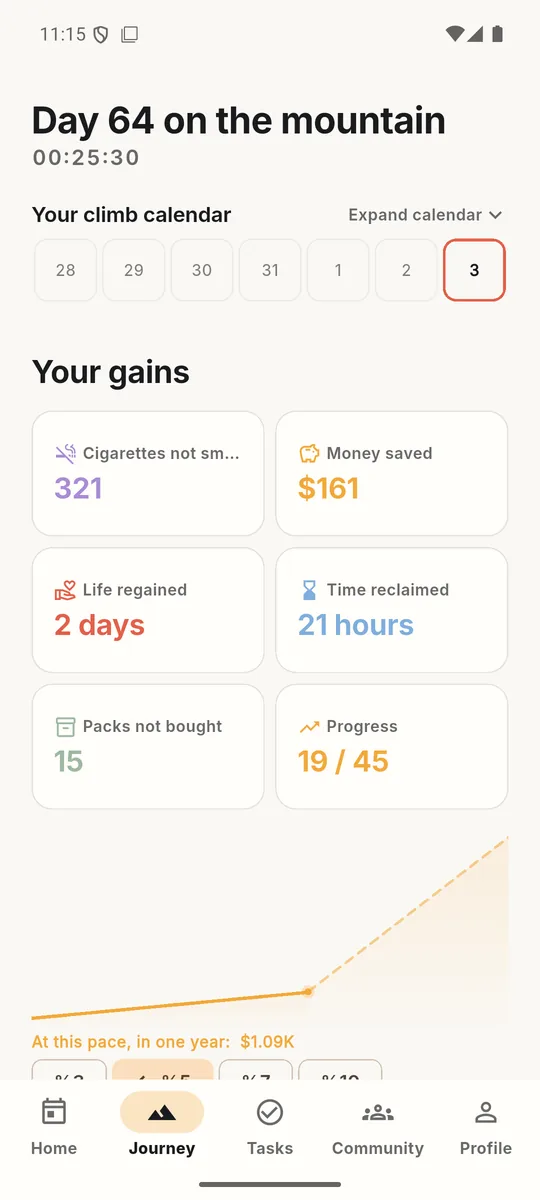
Your gains day by day: cigarettes not smoked, money saved, life reclaimed.
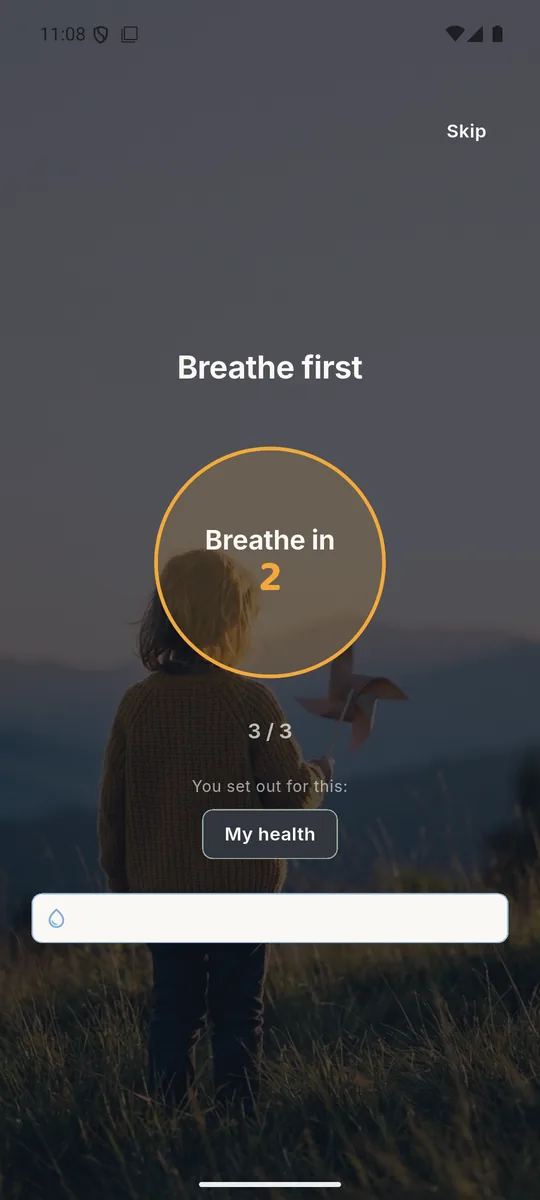
One tap when a craving hits: breathe first. A three-round guided breathing exercise.
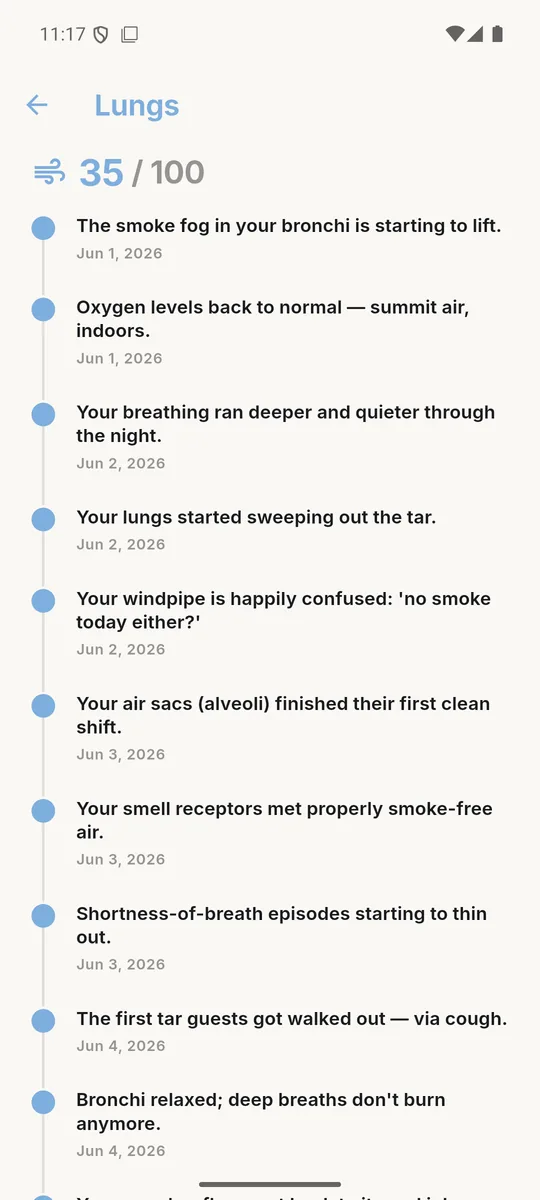
Six routes, 600 stops. Whatever is repairing in your body, you read it there.

You choose the view you are climbing — summit, forest, sea, or your own photo.
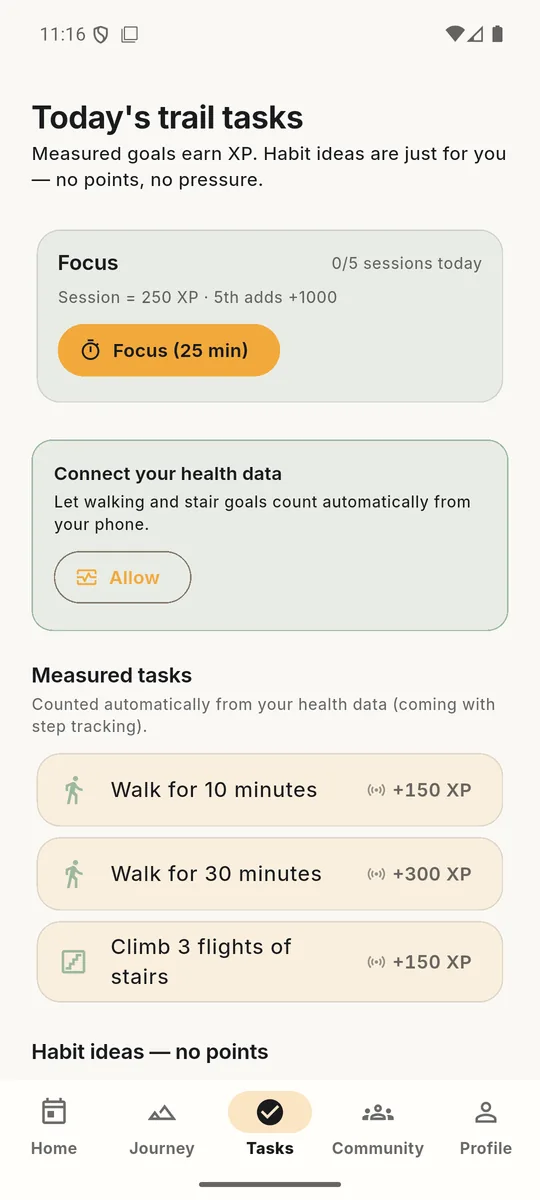
Small tasks every day. You are building a habit, not willpower.
Real screens from the app.
- Hear your own voice when a craving hits — the reason you quit, in your own words. You can add the voices of people you love, too.
- One tap for guided breathing and a distracting task — enough to fill those four minutes.
- 600 stops across six routes: read exactly what is repairing in your body today.
- Your numbers live on your device and keep counting offline — even on a plane.
- You pick the view you are climbing: summit, forest, sea, or your own photo.
- Interface, content and notifications in 14 languages.
You start free. The first day of the journey and the last are both yours.