Betting on “good genes” to keep smoking: why the odds are terrible
July 30, 2026·8 min read
“Nothing will happen to me” isn’t a prediction, it’s a 30‑year blind bet. Even if you “win,” all you get is more of what you already want to quit.
“My body can handle it. Nothing will happen to me.”
That sounds like a prediction, but it’s really a bet. And like any bet, you can break it down: what’s the time frame, what’s the prize, what’s the cost, what are the odds?
When you put all four on paper, the picture is… odd. And the best reason to quit smoking ends up being less about scary health warnings and more about how bad this bet actually is.
What kind of bet is “I’ll just keep smoking”?
What are you betting on? That your genes make you tougher against the harms of smoking than most people.
What’s the prize if you’re right? You get to keep smoking.
What’s the cost? If you’re wrong: disease. If you’re “right”: years of money, smell, shortness of breath and nicotine dependence.
What’s the time frame? 20–30 years. You don’t find out how the bet ended until then.
What are the odds? You don’t know. And not knowing is the most important part of this bet.
Trusting your genes: why you can’t actually check your own odds
Here’s what’s known about genetics and smoking: people differ. The enzymes that process carcinogens, the ability to repair DNA, the way your body handles inflammation — all of that varies from person to person.
But in practice you hit two problems:
*1. There’s no way to measure your “toughness.”* There is no test that says “you’re resistant, you’re safe.” No symptom tells you that, either. Your level of vulnerability only shows up once the outcome shows up.
2. Feeling healthy is not proof of resistance. Being 40 with no complaints doesn’t mean you’ll be 60 with no complaints. No symptoms is not the same as no effect.
So you’re betting on something whose probability you don’t know. In gambling terms, that’s a blind bet.
Pascal, in Pensées (1670), talks about betting when a key piece of information is unknown. He writes:
“If your gain is finite and your loss is infinite, hesitating makes no sense.”
The asymmetry here is basically the same: if you “win,” you gain something small and finite; if you lose, what you lose can’t be taken back. Different topic, same math.
Flip the bet: would you ever take this deal from scratch?
There’s a simple thought experiment that changes how this looks for most people.
Imagine you don’t smoke at all today, and someone offers you this deal:
“You’ll smoke a pack a day. In return you’ll pay the price of a holiday every year, you’ll smell, you’ll get winded on stairs, and in about 30 years we’ll roll the dice on your health.”
Nobody signs that contract.
But someone who already smokes quietly agrees to that exact same deal every single day.
The difference isn’t in the contents of the deal, it’s in the framing: starting a new bet is hard; walking away from a bet you’re already in is also hard. Our brains are wired that way — and that wiring fuels all the “I’ll quit later” stories.
The time‑delay problem: no feedback for decades
This is why the “my body is strong” line can survive for so long.
With most bad bets, you lose quickly, you learn, you stop. Here, the outcome is 20–30 years away.
In the meantime, every year you stay “fine” feels like confirmation of the bet: “see, it’s been ten years and nothing happened.” But ten years isn’t a result; it’s just ten years of waiting.
⚠️ This is the same pattern you see with “weekend only” smoking: the “evidence” gets produced over and over, but it’s measuring the wrong thing.
Even if you “win” the bet, the prize is tiny
This is the weakest part of the whole setup — and it almost never gets talked about.
Say you really are genetically on the tougher side. You smoke for decades and don’t get sick. What did you actually win?
You got to keep smoking for years. Which means:
All the money you paid (a pack a day over ten years adds up to a serious number)
The dependence itself — checking if you have cigarettes, feeling restless on a plane, the tension until the first cigarette of the day
Smell, breath, stamina
Secondhand smoke for people you live with — that part has nothing to do with your genes
So even in the “winner” scenario, your prize is just more of the thing you keep saying you’d like out of your life.
The part of the bet that was never just about you
This is the biggest hole in the “my body is strong” logic.
That sentence is a claim about your body. But the effects of smoking don’t stop at your skin: they include secondhand smoke at home, the chance your kid starts smoking, the load your family carries.
Your “good genes” don’t shield your child’s lungs.
And there’s another catch: even if the bet “wins,” you still paid all the non‑disease costs. Those don’t depend on any dice roll; they’re guaranteed:
Around 456 hours a year (15 cigarettes a day × 5 minutes)
A big pile of money over ten years
The constant habit of checking where your pack is
That part of the bet is already lost and doesn’t wait 30 years to show itself.
“But I know people who never smoked and still got sick”
That objection is valid — and the answer is about numbers.
Yes, people who never smoke can get lung cancer. There are causes besides smoking. That often leads to: “See? It can happen anyway. So what’s the difference?”
The difference is the rate. The large majority of lung cancer cases are linked to smoking. The existence of exceptions doesn’t erase the rule — it shows the rule has exceptions.
In gambling terms: winning one hand doesn’t erase the casino’s built‑in advantage.
⚠️ The twin of this argument shows up with seatbelts: “People die in car crashes even with a seatbelt. So what’s the point?” Almost no one unbuckles because of that, because again, the answer isn’t in a story, it’s in the odds.
The solid instinct inside trusting your genes
The point here isn’t that the thought is 100% nonsense. There is a true piece in it: people really do respond differently to smoking. Some smokers live a long time.
The problem isn’t the observation, it’s the leap from observation to decision.
“Some people are more resistant” is a fair sentence. “I must be one of them” is a guess with nothing under it.
And the most common “proof” is a story: “my grandpa smoked till 90.” We broke down why that argument doesn’t hold up in a separate piece.
Quitting: the only way to leave the table
This bet has one unusual feature: you can walk away at any moment, and there’s no exit fee.
The moment you quit, the blind bet is over — and part of the risk you’ve built up actually starts to reverse. On the heart side, some of that happens on the scale of days and weeks — we’ve gone through that here.
So getting up from the table is not “losing.”
In most bets, once you’ve put money down, it stays on the table. Here, some of what you “put down” is handed back. For your heart, you see change in days; for your circulation, weeks; for the remaining risk, years. We mapped out what changes when from the moment you quit.
Put the bet on paper: ten minutes of real numbers
This article has one small homework assignment — and it usually hits harder than any argument, because the numbers are yours.
Take a sheet of paper and draw a line down the middle. On the left, write “If I win this bet, what exactly do I get?” On the right, write “What am I already paying, right now?”
The left side usually fits into one line: “I get to keep smoking.”
The right side doesn’t end: yearly cost, about 456 hours a year (15 cigarettes × 5 minutes), smell, constantly checking for your pack, secondhand smoke at home, tense hours on planes and in hospitals.
⚠️ One rule as you write: on the right side, list only what’s true today — not future diseases. Because the weakest part of this bet isn’t the future, it’s the present. Thirty years from now is debatable; this month’s numbers aren’t.
If you want to see those numbers with your own prices filled in, the counter on the right side of this page does the same list in about two minutes.
“Nothing will happen to me” isn’t a prediction. It’s a 30‑year blind bet. And even in the “win” scenario, all you get back is the continuation of the habit itself.
One thing you can actually do today: put both sides of the bet on paper. The left side is usually one line. The right side keeps going — and that’s what really shows you the shape of the deal.
To see what changes when you step away from the table, plug your quit date into the counter on the right. For rough moments and cravings, the Tar2Star app is built for exactly those minutes.
This page is a photo. The app is the film.
These numbers show today. Tar2Star shows you a new one every morning — and stays with you when a craving hits.
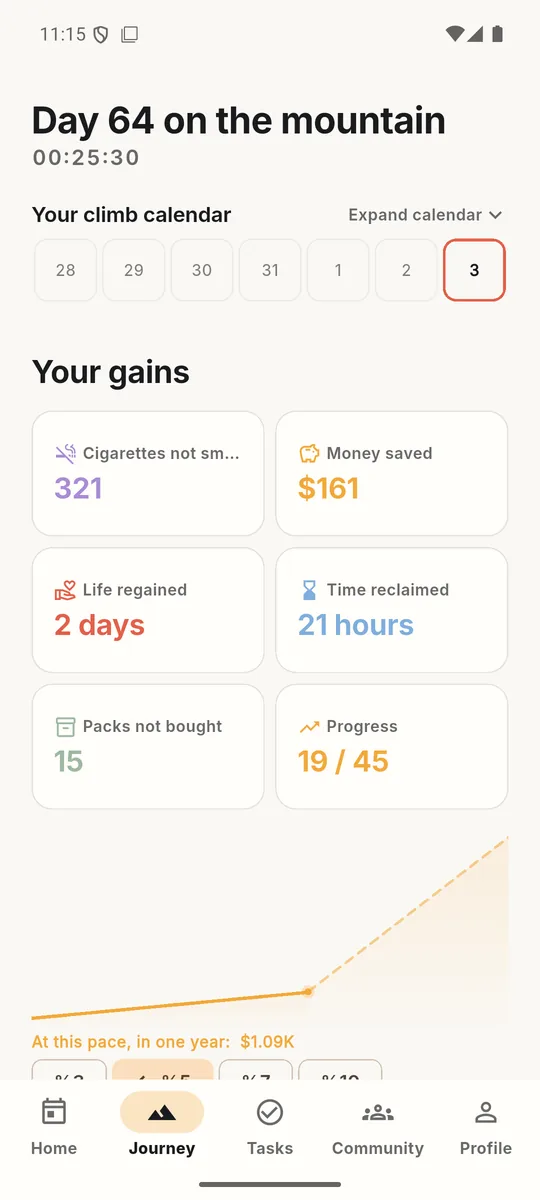
Your gains day by day: cigarettes not smoked, money saved, life reclaimed.
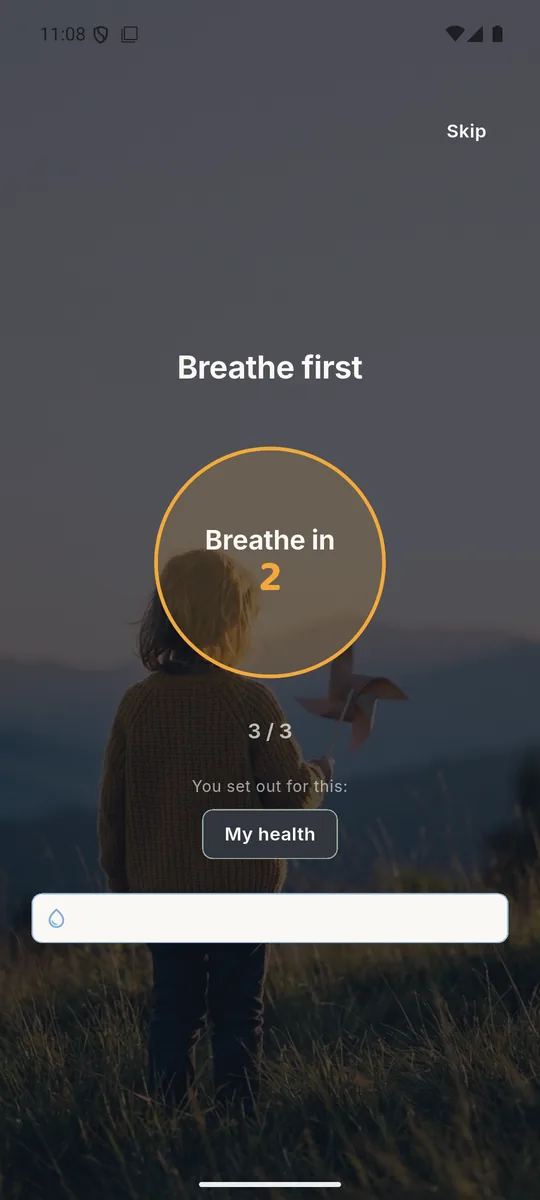
One tap when a craving hits: breathe first. A three-round guided breathing exercise.
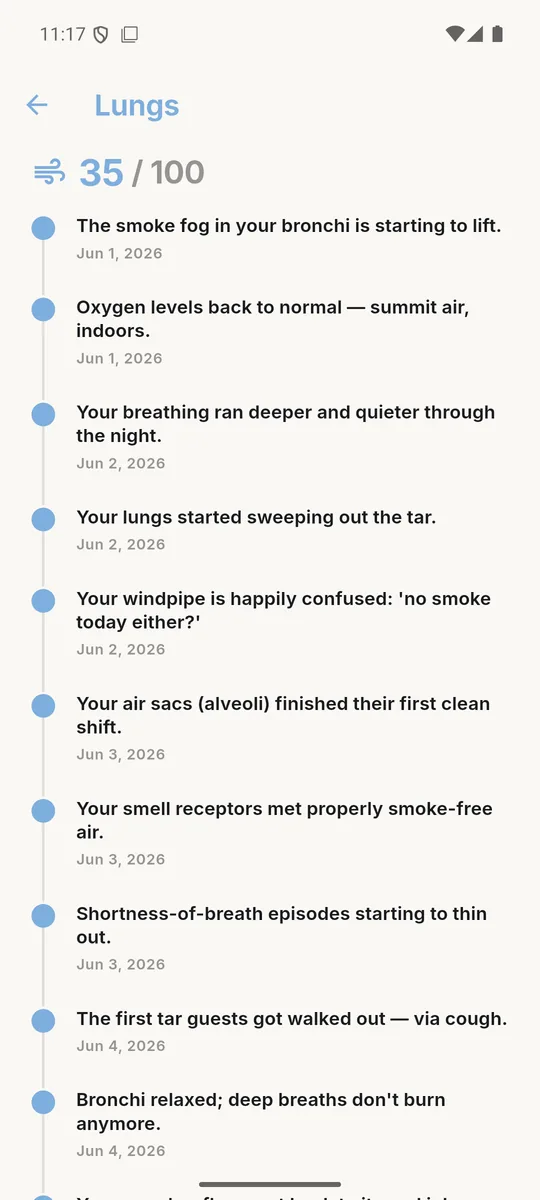
Six routes, 600 stops. Whatever is repairing in your body, you read it there.

You choose the view you are climbing — summit, forest, sea, or your own photo.
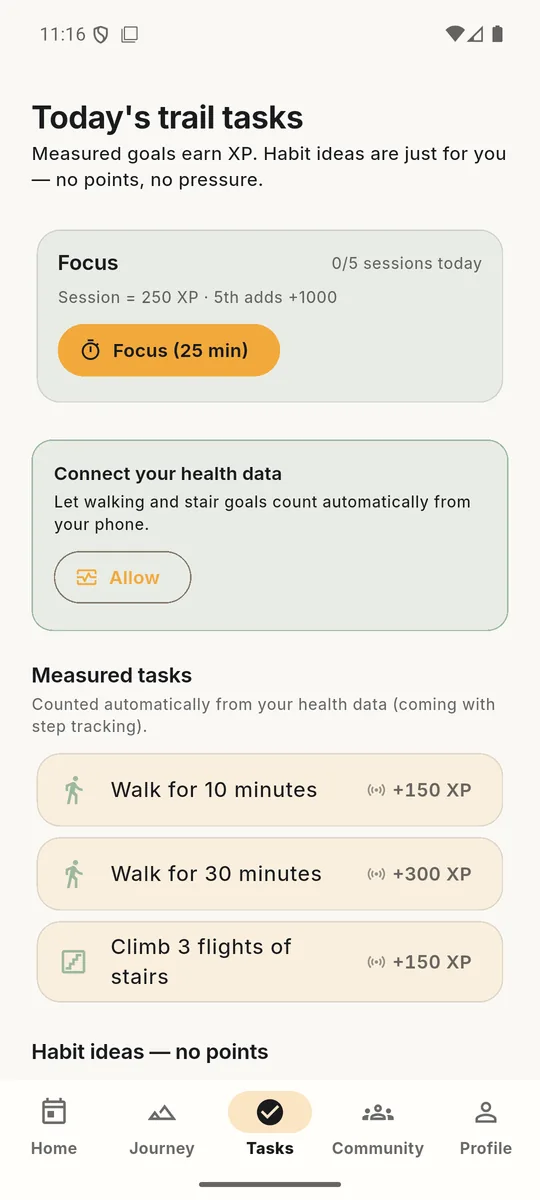
Small tasks every day. You are building a habit, not willpower.
Real screens from the app.
- Hear your own voice when a craving hits — the reason you quit, in your own words. You can add the voices of people you love, too.
- One tap for guided breathing and a distracting task — enough to fill those four minutes.
- 600 stops across six routes: read exactly what is repairing in your body today.
- Your numbers live on your device and keep counting offline — even on a plane.
- You pick the view you are climbing: summit, forest, sea, or your own photo.
- Interface, content and notifications in 14 languages.
You start free. The first day of the journey and the last are both yours.