Why Day 2 Feels So Much Harder Than Day 1 Smoke‑Free
July 29, 2026·5 min read
Day 1 felt almost easy, Day 2 feels awful? That’s normal. Here’s what actually happens in your body and mind, and 5 ways to get through it.
You got through Day 1 surprisingly well. You even caught yourself thinking:
“Was that it?”
Then Day 2 showed up and flipped the table.
This happens to almost everyone. It’s not bad luck. Two different curves collide on Day 2.
Why is Day 2 harder than Day 1?
Because two things are happening at the same time: your excitement drops, your withdrawal rises.
Day 1 is decision day. There’s adrenaline, novelty, that “I’m actually doing this” buzz. That buzz is real fuel — it covers up a lot of the struggle in the first 24 hours.
On Day 2, that fuel runs low. The novelty wears off. What’s left is… the emptiness.
Meanwhile, nicotine withdrawal is climbing. Measurable nicotine leaves your body in about 72 hours, and most people hit peak symptoms around Day 2–3. So just as the excitement fades, withdrawal reaches its highest point.
Those two curves cross on Day 2. The “this is so hard” feeling is that intersection.
What does Day 2 actually feel like?
Most commonly people report:
Irritability. Big reactions to tiny things. This is the one people notice most.
Trouble focusing. Reading the same paragraph three times and still not remembering it.
Cravings in waves. Short, sharp bursts — more frequent and more intense than Day 1.
Sleep disruption. Struggling to fall asleep or waking up during the night.
A sense of emptiness. Hands not knowing what to do, feeling like something is missing.
⚠️ Every one of these has a timeline. Every one of them is temporary. We broke down the full list of withdrawal symptoms and how long they last in a separate guide.
The most dangerous sentence: “I guess it’s not working”
The real risk on Day 2 isn’t in your body. It’s in your thoughts.
This line shows up:
“Day 1 was fine, Day 2 is awful. So it’s getting worse. I guess it’s not working.”
That conclusion is off, because it only looks at one slice of the curve. Day 2 isn’t the start of a downhill spiral — it’s the peak. After the peak, the only direction left is down.
Same trap as when you’re studying: the moment you feel most exhausted is usually the moment you’re closest to the finish line — you just can’t see the finish yet.
What changes on Day 3?
Day 3 is when measurable nicotine is out of your system.
That doesn’t mean every symptom magically stops. But the peak is behind you, and the curve starts to slope down. Most people notice a clear easing around Day 4–5.
After that, it’s less about chemistry and more about habit.
Coffee and a cigarette. Reaching for one in the car. Wanting one as soon as you pick up your phone. Those aren’t about nicotine anymore; they’re about repetition — and repetition is also how they fade. We break down the full first 72 hours in another article.
Five things that make Day 2 easier
Day 2 is easier when it’s treated like weather you knew was coming — not a surprise storm. Here are five things people say help:
1. Keep your day busy.
Empty time is the toughest part of Day 2. If your day is full — work, a walk, chores, errands — craving waves tend to pass in the background instead of filling the whole screen.
2. Know how long a craving lasts.
One craving wave lasts about 3–5 minutes.
Waiting out five minutes is a much smaller job than wrestling with “I will never smoke again for the rest of my life.” We explained why cravings fade in just a few minutes in another article.
3. Postpone tough conversations.
The irritability is real and your fuse is short on Day 2. Pushing an important talk to tomorrow isn’t avoidance — it’s smart risk management.
4. Measure the day.
How many hours has it been? How many cigarettes didn’t you smoke? How much money have you already kept in your pocket?
Concrete numbers beat vague discomfort. Seeing progress in cold, hard data is often stronger than the “this feels awful” fog.
5. Go to bed early.
You don’t have cravings while you’re asleep.
Shortening Day 2 is the most honest “cheat code” there is — and nobody needs to apologize for using it.
What if you have a cigarette?
It can happen. If it does, the only thing that really matters is what you do afterward.
One cigarette doesn’t erase three days. The nicotine that already left your body doesn’t magically come back. The cleaning your lungs have started doesn’t suddenly stop. It just means you took one step backward on that particular day.
Quitting isn’t a single day, it’s a direction. One rough day can tilt the direction of that day — it doesn’t have to change the direction of your journey.
Day 2 is the top of the curve. To get past the top, you don’t have to be superhuman — you just have to keep walking.
Tomorrow is Day 3, and that’s when the nicotine part is done. After that, the rest of this first climb becomes a lot more manageable.
If you want to see how many hours you’ve already put in, check the counter on the right. And if you’re right in the middle of a wave and need something to hold onto, the Tar2Star app opens a breathing exercise with one tap — built for getting through those five minutes.
This page is a photo. The app is the film.
These numbers show today. Tar2Star shows you a new one every morning — and stays with you when a craving hits.
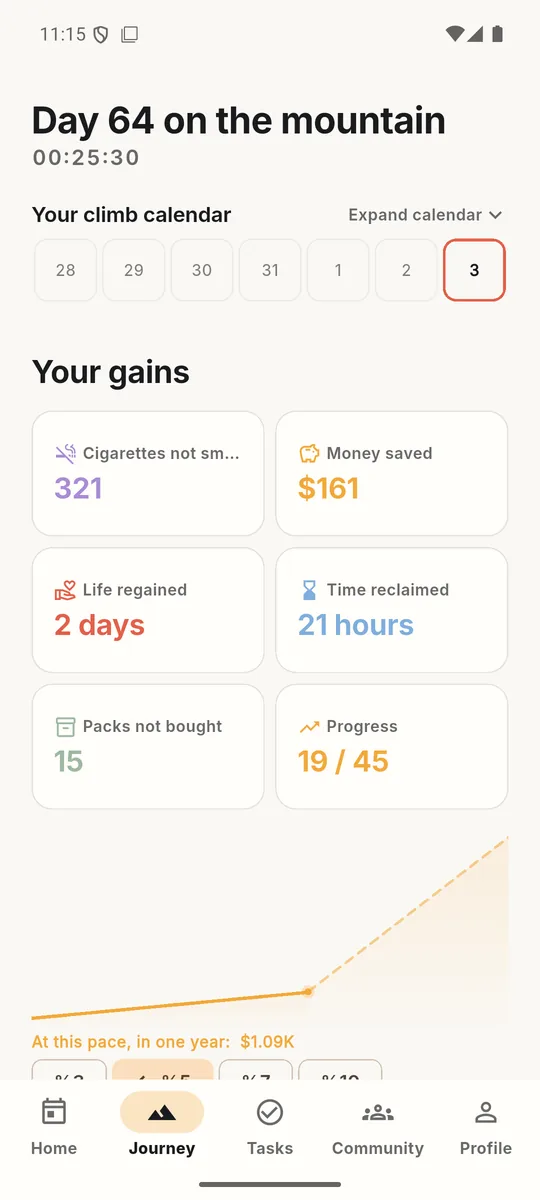
Your gains day by day: cigarettes not smoked, money saved, life reclaimed.
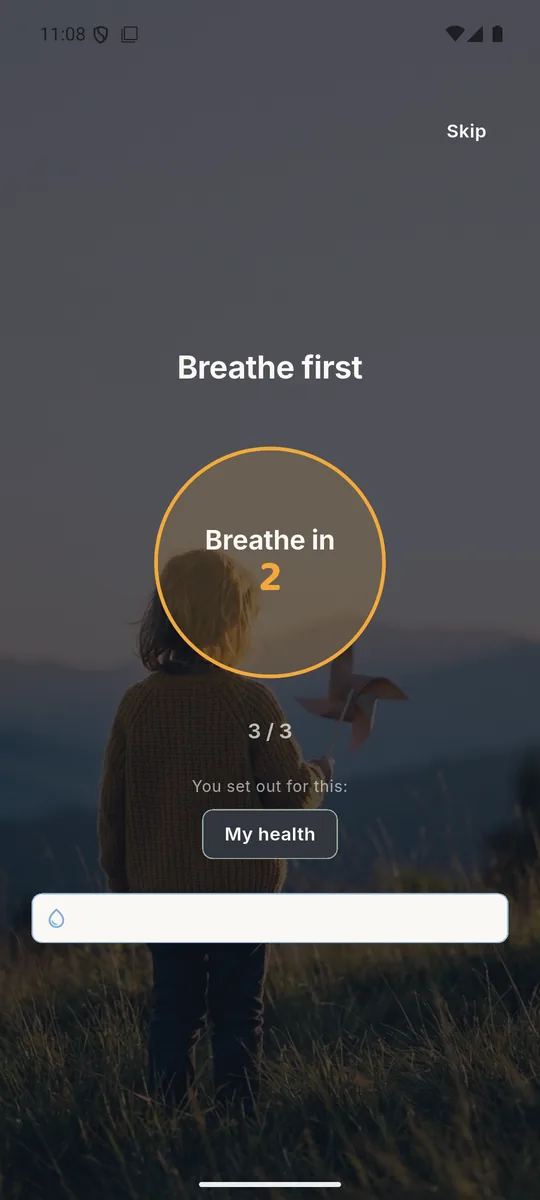
One tap when a craving hits: breathe first. A three-round guided breathing exercise.
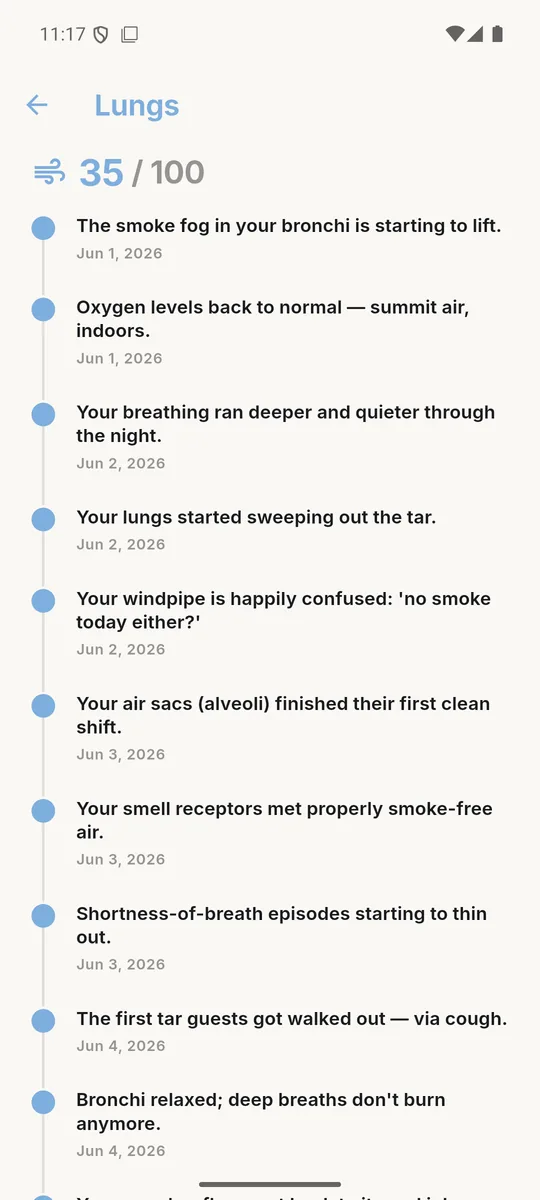
Six routes, 600 stops. Whatever is repairing in your body, you read it there.
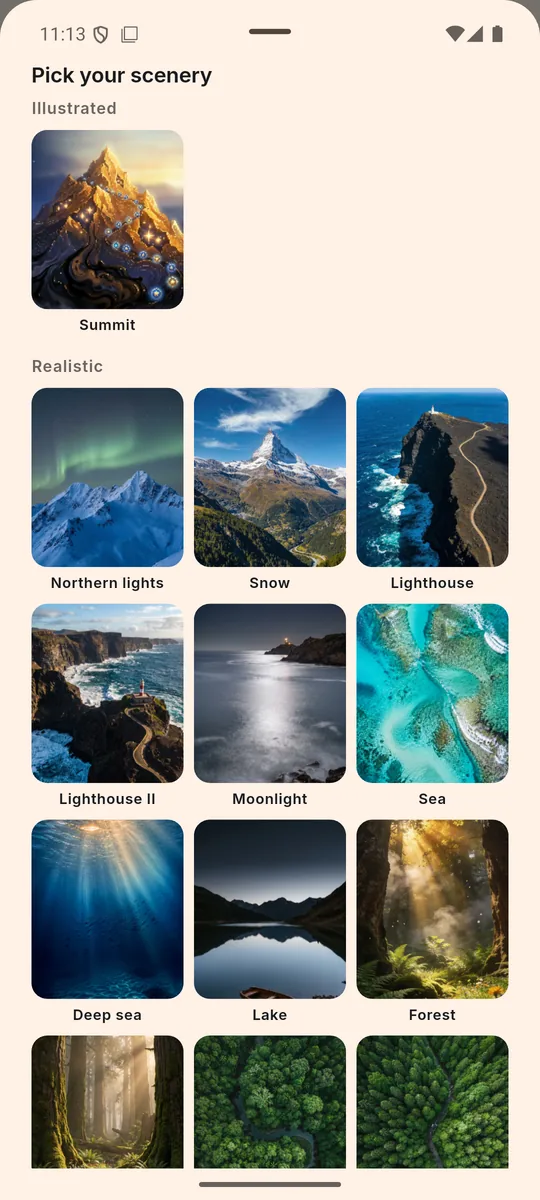
You choose the view you are climbing — summit, forest, sea, or your own photo.
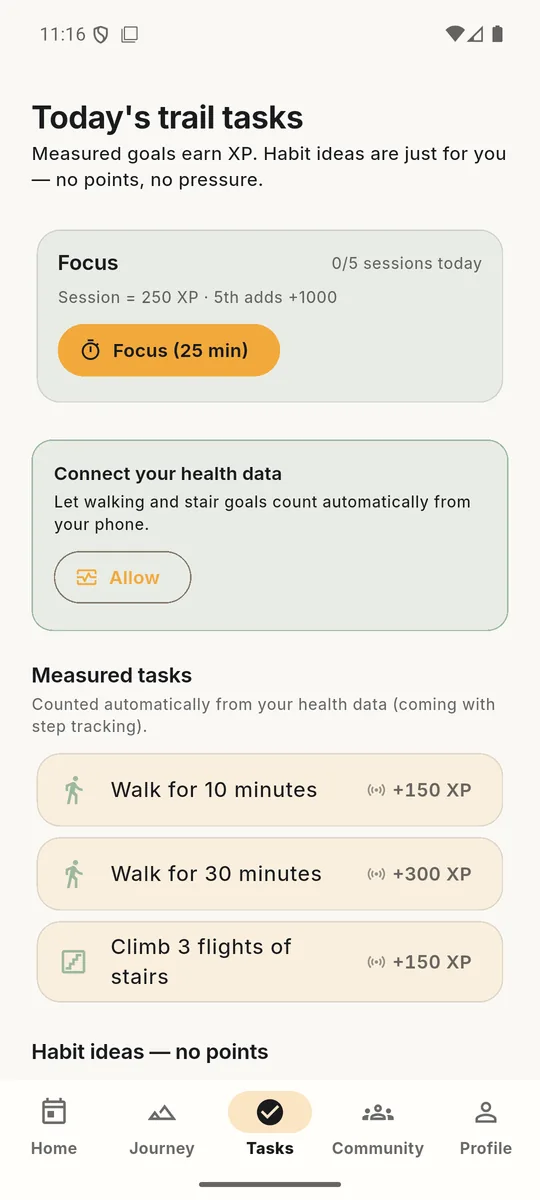
Small tasks every day. You are building a habit, not willpower.
Real screens from the app.
- Hear your own voice when a craving hits — the reason you quit, in your own words. You can add the voices of people you love, too.
- One tap for guided breathing and a distracting task — enough to fill those four minutes.
- 600 stops across six routes: read exactly what is repairing in your body today.
- Your numbers live on your device and keep counting offline — even on a plane.
- You pick the view you are climbing: summit, forest, sea, or your own photo.
- Interface, content and notifications in 14 languages.
You start free. The first day of the journey and the last are both yours.