Final pre-quit check: what’s in your backpack?
July 30, 2026·6 min read
You’re almost ready to quit smoking. Use this one‑page pre‑quit checklist to spot what’s missing, pick a date, and pack your “backpack” for day one.
If you’ve made it this far, you already have all the prep you need. This page is just everything in one place.
The goal isn’t to teach you new tricks. It’s to spot what’s missing. Six sections, a few lines in each.
1. Decision
[ ] Have you written your reason in one sentence? Not a vague slogan – your real life. 3‑question exercise
[ ] Whose reason is it? At least one reason on your list should belong only to you. Who are you quitting for?
[ ] Are you saying “I’m quitting”, not “I should quit”? Why that wording matters
2. Date
[ ] Is there an actual day on the calendar? “Soon” is not a date. How to choose it
[ ] Is it less than two weeks away? There is no perfect time
[ ] Have you decided: Friday night or a workday? Side‑by‑side comparison
3. Measurement
[ ] Have you tracked a full day? Do you know the real number? The very first step
[ ] Did you write down your three hardest moments? Your 3‑point triggers from that log.
[ ] Have you calculated the yearly cost? The math
[ ] Do you know what that money is for? Turning it into a goal
4. Environment
[ ] Any packs, lighters, ashtrays left? Home, car, jacket pockets, bottom of your bag. Why this actually helps
[ ] Has the house had a clean‑up? Room‑by‑room guide
[ ] Car? Often the heaviest exposure zone. Why it’s the worst one
[ ] Is there a no‑smoking rule for home/car now? Why the open window doesn’t fix it
5. Plan
[ ] Do you have a written “answer” for your three hardest moments? “I’ll tough it out” is not a plan.
[ ] Is your first hour mapped out? Morning playbook
[ ] Is the first 24 hours blocked out? Hour‑by‑hour plan
[ ] Is there a written bad‑day plan? Four relapse scenarios
[ ] Alcohol‑free for the first three weeks? This one rule helps more than most.
6. Support
[ ] Do you know exactly who you’ll text when it’s rough? The box people most often leave blank.
[ ] Have you decided who you’ll tell? The small‑circle approach
[ ] Do you know what you’ll say? Situation + ask + boundary
[ ] If your dependence is high, have you asked your doctor? If your first cigarette is within five minutes of waking, this one is non‑negotiable. What to ask your doctor
[ ] What’s in your bag? Seven essential items
The three you really don’t want to skip
If there are unchecked boxes above, that’s fine — this list is not an entrance exam. But these three make a very real difference:
1. A date on the calendar. Without this, the rest is just reading, not preparing.
2. One person. Among people who restarted, this is the box most often left blank.
3. Extra support if dependence is high. If you smoke your first cigarette within five minutes of waking, going in with “willpower only” is making it needlessly hard.
If your list isn’t full
This part is for the “I’ve done, what, half of this?” crowd — and what needs to be said is meant to ease, not pressure.
The six sections don’t all weigh the same. Without Decision and Date, the rest doesn’t really work; but people do quit even if Environment, Plan, and Support aren’t perfect — it’s just tougher.
So think of this list as a booster, not a locked door. If five out of fifteen are done, you can still start; waiting three more weeks to tick all fifteen goes against why this list exists.
⚠️ Here’s a practical rule of thumb: do everything today that can be done today, spread the rest between now and your date. A one‑day log takes one day, the money math takes two minutes, throwing out an ashtray five. Do those three and suddenly half your list is done.
Time to wrap up prep
⚠️ One last warning, and it might be the single most important line in this stage: prep shouldn’t drag on for more than two weeks.
Any longer and it’s not preparation; it’s a polite form of stalling. All ten classic delay lines show up right here.
Go through this checklist today, spread the missing bits across this week, and write down the date.
What comes after this?
This is the end of the “Takeoff” stage. Next is [First Climb](/tr/kategori/ilk-tirmanis) — the days after your quit date.
It helps to know in advance what shows up there:
Why the first 72 hours are the steepest stretch
Why day two often feels harder than day one
Withdrawal symptoms and how long each tends to last
Craving waves and why they peak around four minutes
And if you’re curious about the body side: what happens hour by hour is its own guide.
What this stage really showed
Across sixty pieces, one line kept repeating: quitting is not a test of character, it’s a preparation job.
Three ideas came up again and again:
Measuring beats convincing. Counting cigarettes, adding up the money, writing down each wave — all of that works better than any lecture. “Smoking is harmful” doesn’t move people; their own numbers do.
Distance beats willpower. Throwing out the ashtray, taking the lighter out of the car, setting a balcony rule. Each one puts distance between decision and action, and that distance quietly removes a lot of “automatic” cigarettes.
Knowing the duration shrinks the fear. A four‑minute wave, 2–4 weeks of irritability, three weeks of social weirdness. When something is vague, it feels endless; when it’s timed, it becomes carry‑able.
Those three will still matter in [First Climb](/tr/kategori/ilk-tirmanis) — the only thing you’ll be measuring there is days behind you.
The three most skipped — and most powerful
Out of all sixty pieces, these are the three steps people skip the most in real life — and that change the most:
Keeping a log for one full day. Takes one day, costs nothing, and gives you a list of your three hardest moments. Skip it, and section three of your “contract” is filled in by guesswork — and those guesses are usually wrong. First step
Adding one person’s number to your favorites. Takes thirty seconds. Among people who go back to smoking, this is the most frequently missing box — usually because of shame: “I don’t want to bother anyone.” Item five on the bag list
Writing a bad‑day plan. Two lines. Plenty of people build a flawless plan and leave the bad‑day line empty — then hit their first bad day with no map. Four scenarios
⚠️ All three together take less than a day, and none of them delay your quit date. So the blocker isn’t time, it’s sequence — and the right sequence is: today.
Prep ends here. Everything that needs to be in your backpack is listed above.
For today, there’s just one job: read through the checklist, count the unchecked boxes. If the three critical ones are done, you’re ready to start.
Add your date to the counter on the right — [First Climb](/tr/kategori/ilk-tirmanis) starts that day. To keep the counter and your crisis‑toolkit with you on the way, the Tar2Star app was built exactly for this.
This page is a photo. The app is the film.
These numbers show today. Tar2Star shows you a new one every morning — and stays with you when a craving hits.
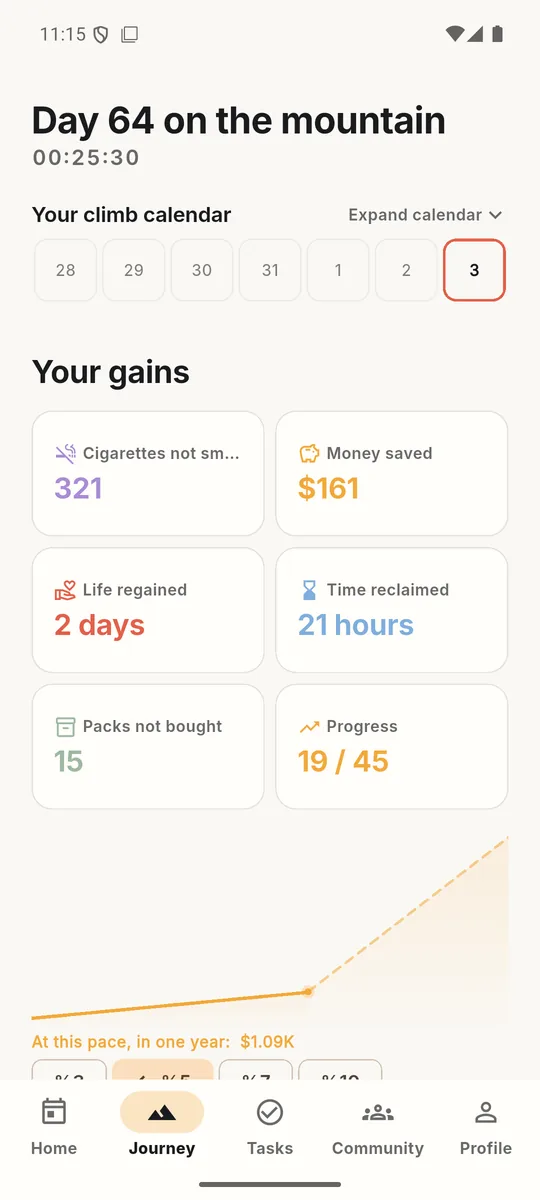
Your gains day by day: cigarettes not smoked, money saved, life reclaimed.
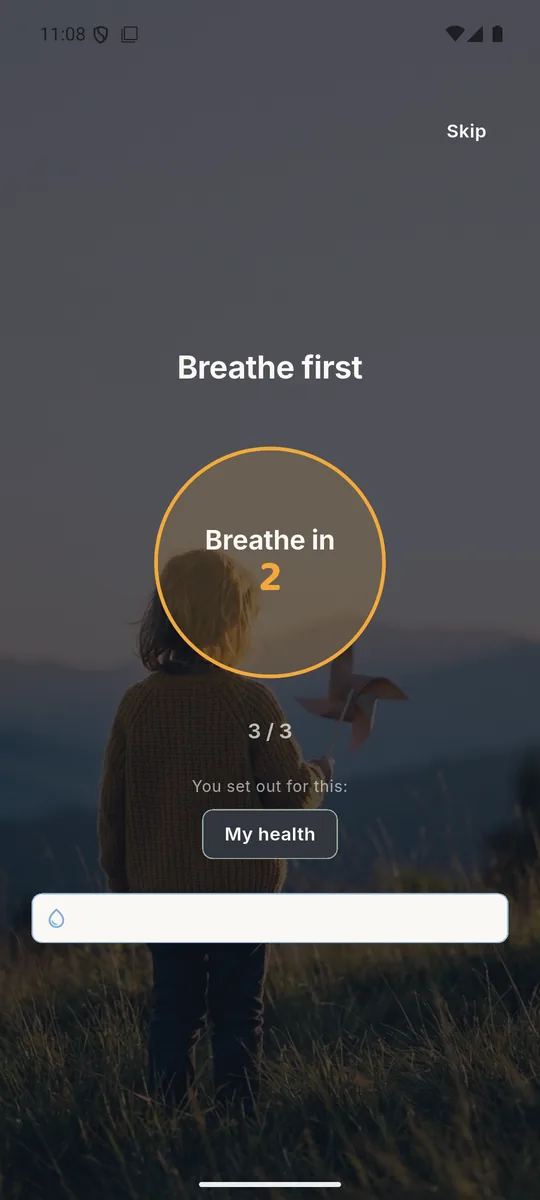
One tap when a craving hits: breathe first. A three-round guided breathing exercise.
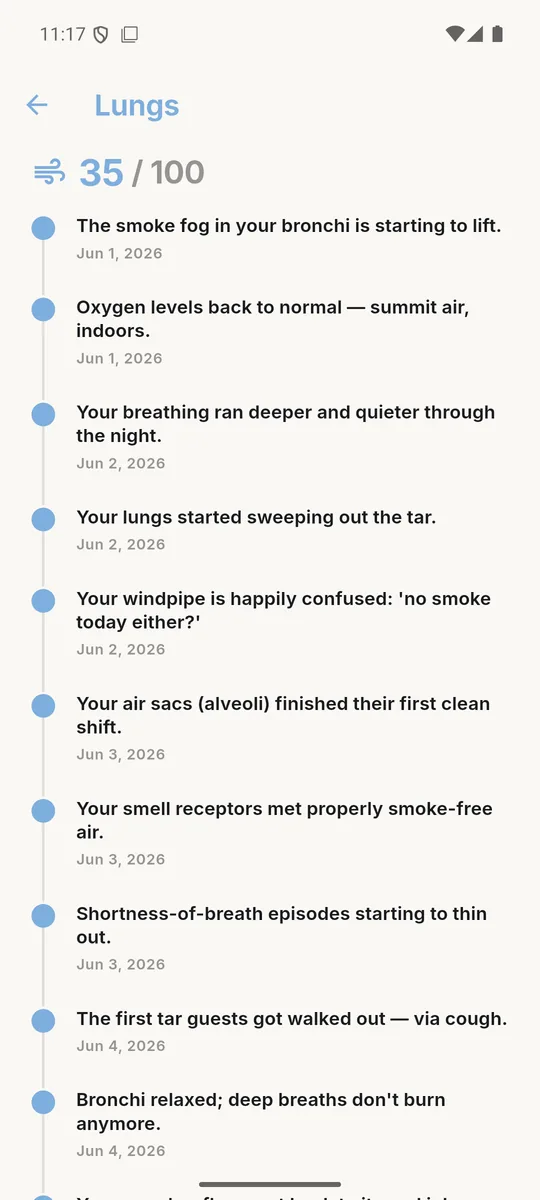
Six routes, 600 stops. Whatever is repairing in your body, you read it there.

You choose the view you are climbing — summit, forest, sea, or your own photo.
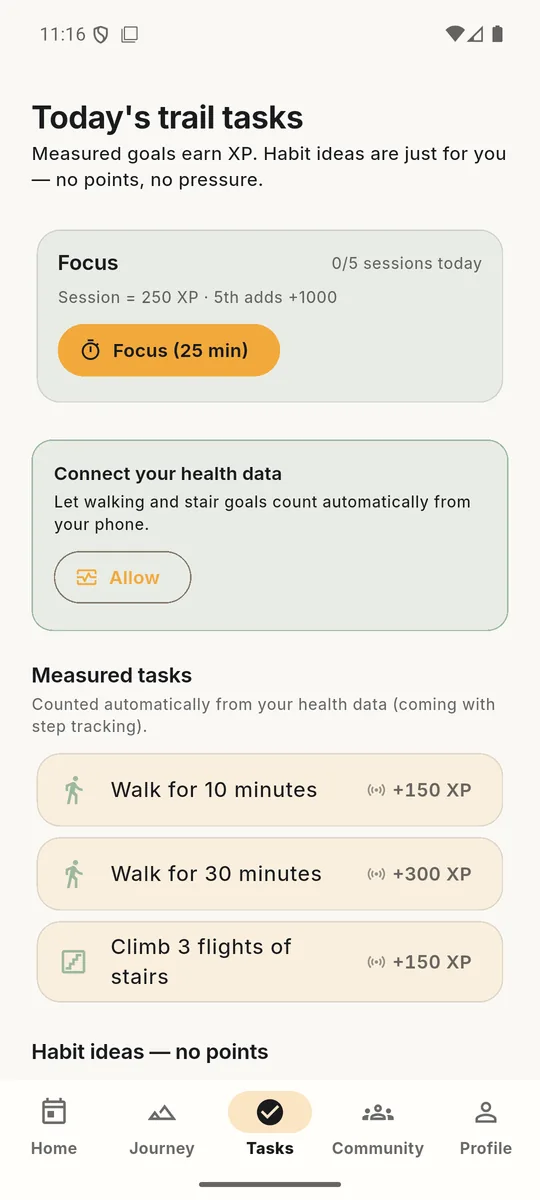
Small tasks every day. You are building a habit, not willpower.
Real screens from the app.
- Hear your own voice when a craving hits — the reason you quit, in your own words. You can add the voices of people you love, too.
- One tap for guided breathing and a distracting task — enough to fill those four minutes.
- 600 stops across six routes: read exactly what is repairing in your body today.
- Your numbers live on your device and keep counting offline — even on a plane.
- You pick the view you are climbing: summit, forest, sea, or your own photo.
- Interface, content and notifications in 14 languages.
You start free. The first day of the journey and the last are both yours.