Quit Smoking Survival Kit: 7 Things to Keep on You
July 30, 2026·6 min read
Quit day coming up? Here’s a 7‑item “survival kit” that fits in your pocket and helps you through cravings without white‑knuckle willpower.
This is a list, and the whole thing fits in one pocket.
Each item has one job. No fancy rituals, no Pinterest‑level prep. These are the things your hand should reach for when a craving hits.
1. Water
Boring and extremely effective.
It does three things: changes the taste in your mouth, keeps your hand busy, and gives you that “break” feeling. Reaching for a glass replaces reaching for a pack.
Keep a bottle with you — many people skip it if they’d have to get up and go find water.
2. Something for your mouth
Gum, sugar‑free mints, toothpicks, cinnamon sticks, seeds. The exact thing doesn’t matter; what matters is your mouth isn’t empty.
Part of smoking is pure mouth habit. Filling that part with something else takes a chunk of the load without even touching the nicotine side.
⚠️ Watch sugary gum: your appetite usually climbs in the first weeks, and chewing forty sugary gums a day is a serious sugar load.
Also, have variety. If you tie yourself to one thing, the day you get sick of it this whole list stops working — and in the first two weeks, chewing thirty of the same gum is usually enough to get sick of it.
3. Something for your hands
Pen, paperclip, keychain, stress ball, a nut, prayer beads.
Your hands will go looking for a cigarette — give them something else to look for. This one’s often underestimated, but for someone sitting at a desk it’s the one that gets used the most.
There’s a measurable reason: one cigarette is roughly 10–12 puffs, which means 10–12 hand‑to‑mouth movements. If you smoke twenty a day, that’s about two hundred repetitions of the same movement. Two hundred reps of anything is a habit on its own, independent of nicotine — and that’s exactly what small tools are designed to target.
4. Your anchor sentence
The single sentence you got from the three‑question exercise, written down.
Your phone lock screen is ideal, because you’re already looking at your phone in a crisis. A slip of paper in your wallet also works.
Reason: a craving is a bad time to try and think clearly. A written sentence lets you read instead of trying to reason your way through.
5. One person to text or call
The name and number of the person you’ll message when it gets hard — already saved in your favorites.
On the preparation checklist, this is the line most people leave blank. Usually because of shame: “I don’t want to bother anyone.”
Here’s the trade‑off: that person doesn’t even have to give advice. Their one job is to be there.
The selection rule is simple and often applied wrong: not the person who loves you the most, but the person who panics the least. If someone freaks out when they hear you’re struggling, you’ll end up calming them down, which makes things harder. You’re looking for calm, not intensity.
6. A counter
Hours passed, cigarettes not smoked, money saved.
This one does a different job from the others: it turns each craving into something you’d lose. “It’s been four days” carries more weight than a sentence you’re trying to convince yourself with.
The counter on the right does this in your browser; if you want it on your phone, an app does the same job.
7. Nicotine support (if appropriate)
Patches, gum, or lozenges — if your doctor/pharmacist has said they’re right for you.
This isn’t for everyone. But if you light your first cigarette within five minutes of waking, your nicotine dependence is high and going on willpower alone gets tougher.
⚠️ Don’t leave this for the morning of day one. In the seven‑day countdown list, it sits three days earlier for a reason; you don’t want to be the person running around looking for a pharmacy at the last minute.
What doesn’t belong in your kit
Three things:
A backup pack. The “just in case” pack is really a backup plan. And a decision with a backup plan isn’t a decision.
A lighter. You can keep a single one in the kitchen for the stove; not in your pocket.
E‑cigarettes — without talking to a doctor. This is a separate, debated topic; we don’t put it on the list as a stand‑alone solution.
⚠️ There’s a fourth, and it’s controversial: a single cigarette, “for emergencies.” More people carry this than you’d think. The problem is that cigarette isn’t comfort, it’s an offer: it pops up in every tough moment and turns that moment into a decision point. It’s the first thing that needs to go, along with the lighter.
Shrinking the list week by week
This list isn’t meant to be a permanent load, and if you treat it that way it gets exhausting.
First week: all seven items. Difficulty is highest, preparation is fullest.
Second–third week: water, something for your mouth, and the counter stay. The anchor sentence is usually memorized by then; no paper needed.
After the first month: for most people, only water is left — and by then it’s just a normal habit.
This shrinking is a quiet sign of progress. One day you’re packing your bag and notice you didn’t put gum in — and that moment says more than the number on the counter.
Where should the list live?
Spread it across three spots, because cravings don’t wait for you at one location:
Pocket/bag: water, something for your mouth, something for your hands
Car: gum and seeds (no lighter — the car is a major exposure zone)
Desk/home: the same three + your anchor sentence where you can see it
⚠️ There’s a fourth place people often skip: your coat pocket. That’s where your pack sat for years, and your hand still goes there automatically. Putting something small in that pocket — a pen, a pack of gum — stops the weird, empty‑pocket feeling.
When to prepare your kit
The answer is “before quit day,” and there’s a concrete reason.
Spending the first morning running around stores or pharmacies means spending your most fragile hours outside — and in places that sell cigarettes. In the first‑24‑hours emergency plan, the morning block is already the sharpest block; adding errands there is extra risk you don’t need.
A practical rule: have the kit ready one day before, and pack your bag the night before. If item seven (nicotine support) is in the picture, that has to happen even earlier — getting to a pharmacy and, if needed, talking to a doctor can take a few days.
⚠️ The prep itself does a job: packing your bag turns a decision into a physical action. Same logic as the second step of the quit‑day ritual — not just a thought, a movement.
Seven items, one pocket. Each with a single job.
Today’s only task: put water, gum, and a pen in your pocket. All three are findable today.
If you want to set up item six now, enter your date in the counter on the right. And if you’d like four of the seven in one place, the Tar2Star app keeps your counter, anchor sentence, breathing exercise, and distraction tasks together.
This page is a photo. The app is the film.
These numbers show today. Tar2Star shows you a new one every morning — and stays with you when a craving hits.
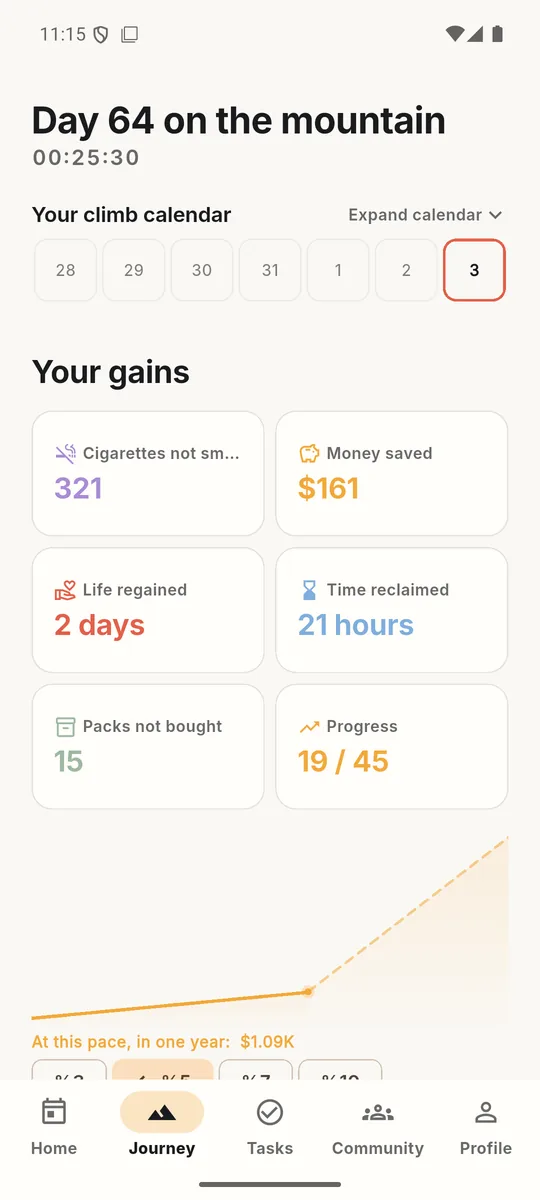
Your gains day by day: cigarettes not smoked, money saved, life reclaimed.
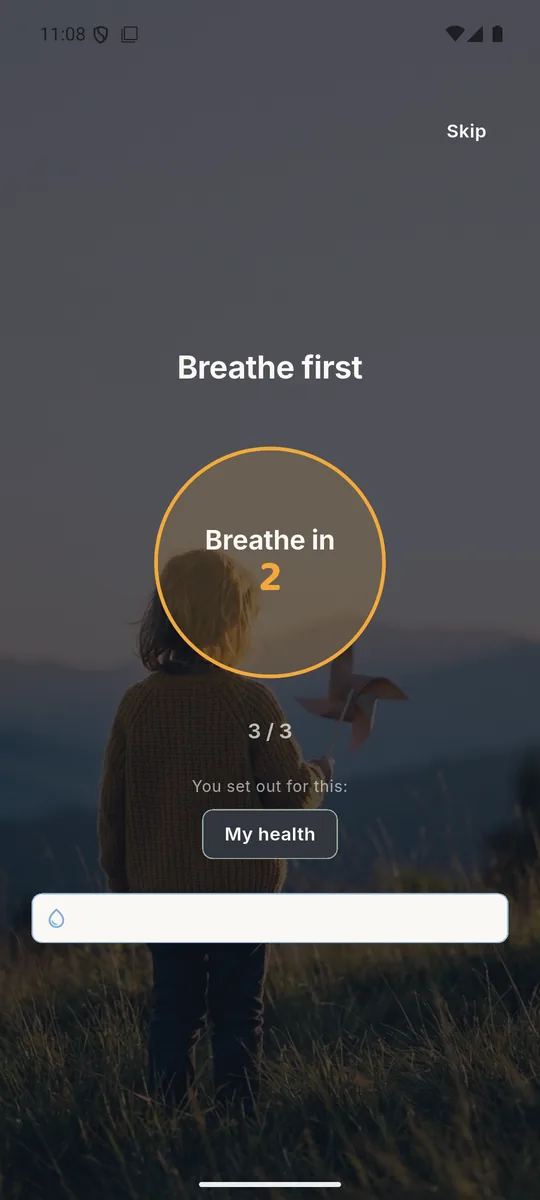
One tap when a craving hits: breathe first. A three-round guided breathing exercise.
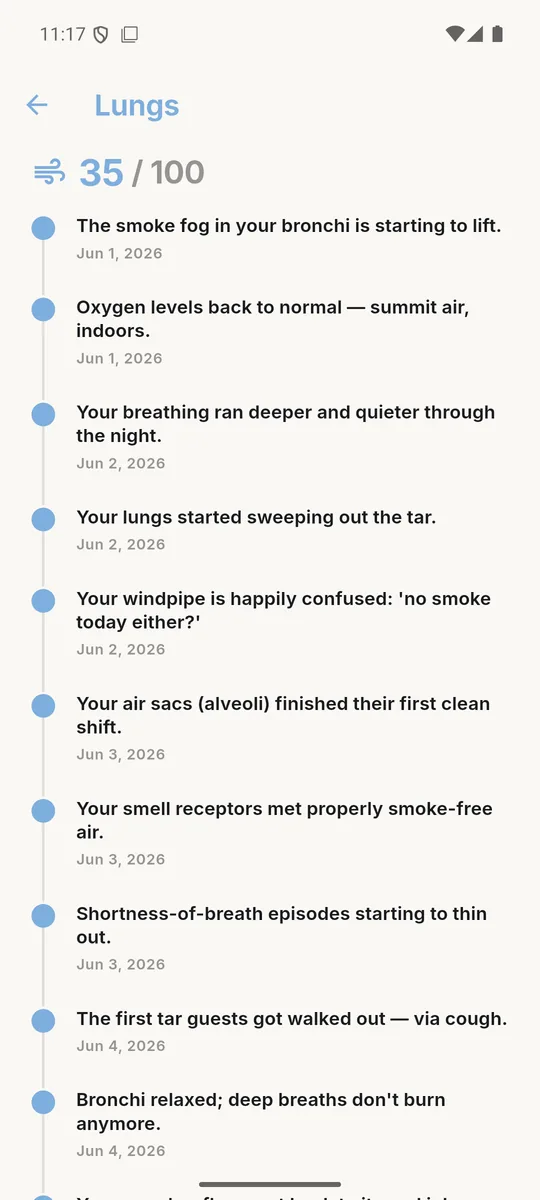
Six routes, 600 stops. Whatever is repairing in your body, you read it there.

You choose the view you are climbing — summit, forest, sea, or your own photo.
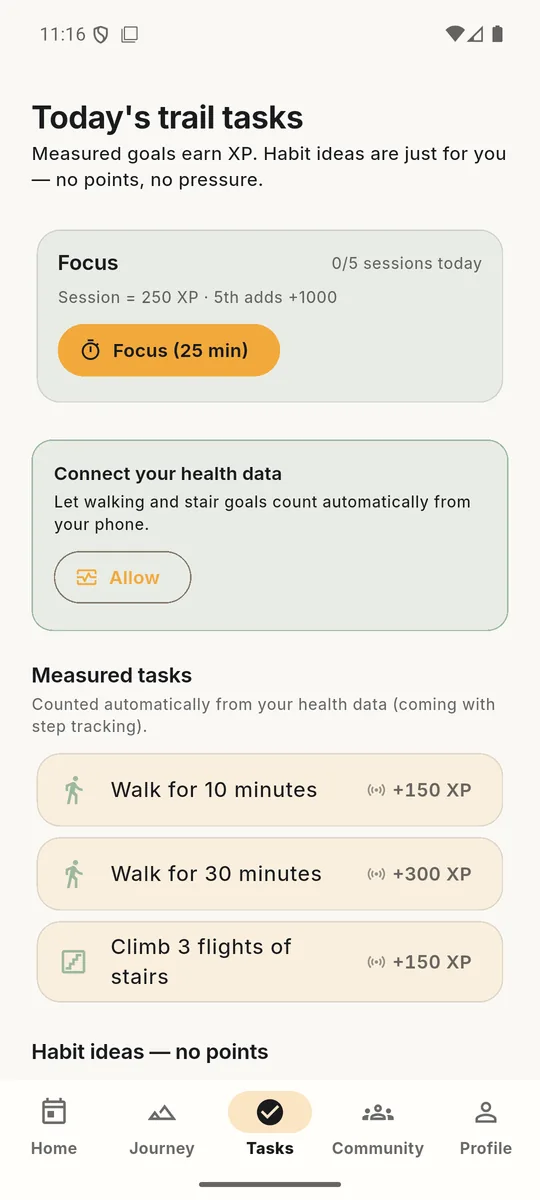
Small tasks every day. You are building a habit, not willpower.
Real screens from the app.
- Hear your own voice when a craving hits — the reason you quit, in your own words. You can add the voices of people you love, too.
- One tap for guided breathing and a distracting task — enough to fill those four minutes.
- 600 stops across six routes: read exactly what is repairing in your body today.
- Your numbers live on your device and keep counting offline — even on a plane.
- You pick the view you are climbing: summit, forest, sea, or your own photo.
- Interface, content and notifications in 14 languages.
You start free. The first day of the journey and the last are both yours.