“My grandpa smoked till 90”: why that argument doesn’t hold up
July 30, 2026·7 min read
“My grandpa smoked until 90” rests on a real observation but falls into survivorship bias. The grandpas nobody talks about, and why the argument only ever runs one way.
“My grandpa smoked two packs a day and lived to 90.”
Most of the time, that sentence is true. There really is such a grandpa and he really did live that long.
The issue isn’t whether the story is true. It’s what people try to conclude from it. And that’s where one of the oldest statistical traps shows up — this sentence is the go‑to support for trusting “good genes” instead of the numbers.
Survivorship bias: the grandpas you don’t hear about
It has a name: survivorship bias.
Here’s how it works: only the ones who survive get to become stories. The grandpa who smoked to 90 becomes family lore; the grandpa who died at 58 becomes grief. Grief doesn’t get told at dinner. If there’s lung cancer in the family, that silence is even louder.
So the “data” behind this argument is filtered from the start. Out of all the people whose outcomes we know, only a slice gets picked and shown.
Notice what you never hear: no one says “My grandpa died at 45 and I still smoke” as a serious argument. The argument always works in one direction — because it’s selective by design.
The classic example of this bias is from World War II. Engineers wanted to reinforce the parts of returning planes that had the most bullet holes. Then someone said: the armor should go where the returning planes DON’T have holes. The planes hit there never made it back.
Smoking stories are like that: the grandpas you hear about are the planes that landed. The “holes” — the damage — show up in the ones who didn’t return. The same selective view hides inside the “I’m already damaged” line too: the parts that feel comforting get remembered; the rest of the data disappears.
How many people does one grandpa represent?
This question shows the real scale of the argument, and the answer is blunt.
Smoking‑related diseases are linked to millions of deaths every year worldwide; the World Health Organization publishes that picture regularly. On one side you don’t have a vague statistic, you have an enormous number.
And what’s put on the other side as “evidence”? One person. A person who is picked because the outcome was good.
⚠️ Quick way to see it: in that same town, same years, same amount of smoking — how many people were there, and how many made it to 90? No one knows, because no one counted. People only remember the winner.
Why smoking risk is probability, not a guarantee
This is the core misunderstanding: risk is probability, not certainty.
Saying smoking increases your risk doesn’t mean every smoker will get sick. Some smokers live a long time — that doesn’t disprove the stats; it’s exactly what the stats predict.
Think of a die. Rolling it once and not getting a six doesn’t mean the die has no sixes. The reverse is also true — smoking “only” three cigarettes a day isn’t risk‑free; it’s just lower risk.
So “there are exceptions” does not mean “there is no rule.” And one grandpa isn’t evidence that can stand against data from millions of people.
The parts of the grandpa story you don’t hear
There’s another catch: the grandpa story is almost always told with missing pieces.
What he smoked. Hand‑rolled? No filter? How deep did he inhale?
How he lived. Walking to work? Working fields? Mostly outdoors? Smoking in the house or only outside?
How his last years went. Living to 90 is not the same as living well to 90. Ten years of breathlessness usually don’t make it into the story. (If you want to see this difference on your own side, the counter on the right shows, day by day, what’s changing from the moment you quit.)
How many siblings he had and what happened to them. The other people who grew up in the same house are usually left out.
Life span isn’t the only measure. How those years feel from the inside is a measure too.
How this argument keeps smoking going
If we’re honest, the person who says this sentence usually isn’t trying to win a debate.
It’s a permission sentence. A way to find a reason to keep going, and to hold on to it. “I’m too old now,” “the damage is done,” “nothing will happen to me” are the same kind of sentence.
Seeing that helps, because then the real question appears: Are we really talking about one grandpa, or about what I’m going to do today?
⚠️ Permission sentences have a common fingerprint: they drag the conversation away from your health right now. “My grandpa” shifts it to statistics, “I’m too old” to the calendar, “I’m already damaged” to the past. All three quietly remove the question of what happens today from the table. Recognizing that pattern is more useful than “winning” the argument.
When someone else throws this line at you
So far this has been about the sentence you say to yourself. But you’re most likely to hear it from other people — at the table where you say you’re thinking of quitting.
Getting into a debate rarely helps; the table turns to the topic, and suddenly you’re defending yourself.
The shortest, most effective reply doesn’t touch the argument at all:
❌ “But that’s an exception, if you look at the data…” → long debate, you’re dragged in.
✅ “Maybe. I’m quitting anyway.” → usually, nothing to argue with.
The power of the second answer: it doesn’t argue about who’s right. It quietly states who’s making the decision. We wrote more about how to tell people you’ve quit; for this group, one sentence is enough.
If people in your family really do live long
That might mean something — just not what people usually think.
Yes, there are real genetic differences in susceptibility. Two problems, though: you can’t measure your own precisely, and you only find out the result 20–30 years later. Why this is still a blind bet is a separate topic.
And the flip side: if there is lung cancer in your family, then the data leans against you, and quitting gives the biggest benefit in exactly that group.
What’s interesting is how we use family history: when it’s reassuring, we remember it. When it’s worrying, we decide it “doesn’t matter that much.”
⚠️ There’s a quick self‑check here: if you found out that same grandpa had also had a heart attack, would you still feel like using his story as your shield? If the honest answer is no, then this isn’t really “evidence” — it’s a preference.
Your grandpa’s era is not your era
This may be the most concrete weak spot in the whole argument — and it’s almost never mentioned.
A 90‑year‑old grandpa’s youth looks nothing like today’s smoking life. The gaps show up in three places:
Amount and consistency. Cigarettes were expensive and often hard to get; the daily number wasn’t as steady as it is now.
Age at start. People now often start much younger, and total exposure is heavily shaped by that starting age.
Everything else in life. Walking for work, living outdoors more, far less processed food — all of it belongs in the same health picture.
So “my grandpa smoked and lived” is describing a different level of exposure inside a very different lifestyle. If you’re going to compare, you’d need to know both sides. Usually, one side is completely unknown.
Putting the missing half of the picture back
One last piece.
Every person lost to smoking‑related disease was, for someone, a grandparent. Those stories exist too — they just don’t get told.
This isn’t about scaring you. It’s about balance. The argument leans on one‑sided data; remembering the missing side just evens it out.
One grandpa is a story, not solid evidence. An exception existing doesn’t mean there’s no rule.
So next time you hear yourself using that line, it might be worth asking: what job is this sentence doing for me? Is it an argument — or a permission?
This whole piece has been about a story versus a number. If you want to see your own numbers in under two minutes, use the counter on the right: how many years you’ve smoked, what it’s cost, and what would start adding up from today if you stopped. Someone else’s story is debatable; your numbers aren’t.
And if you want that same number in your pocket on the rough nights, the Tar2Star app is built for exactly those minutes: days smoke‑free, cigarettes not smoked, and something to keep your hands busy when the urge hits.
This page is a photo. The app is the film.
These numbers show today. Tar2Star shows you a new one every morning — and stays with you when a craving hits.
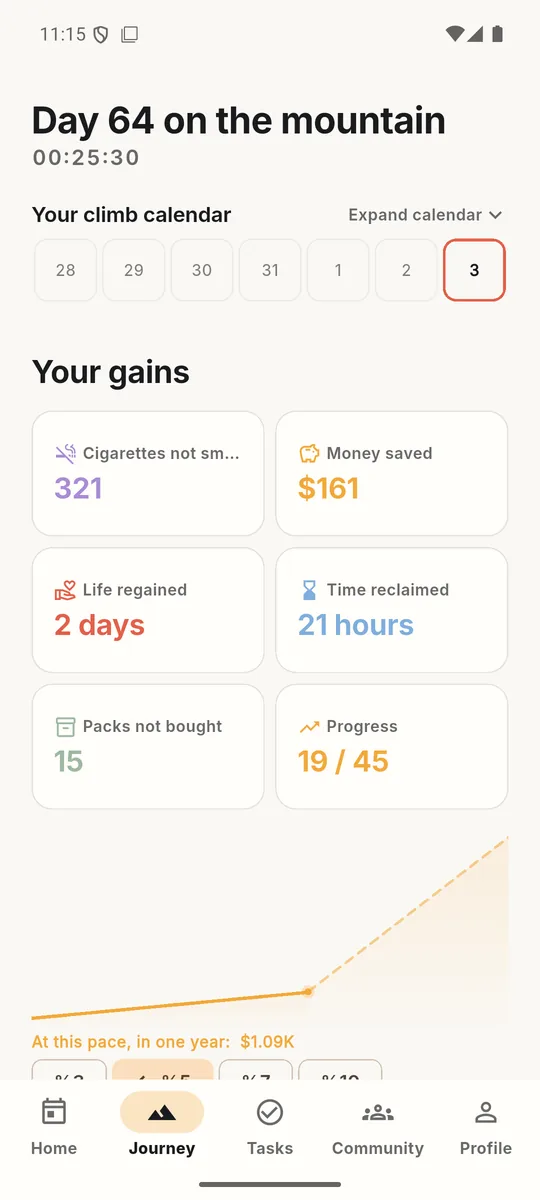
Your gains day by day: cigarettes not smoked, money saved, life reclaimed.
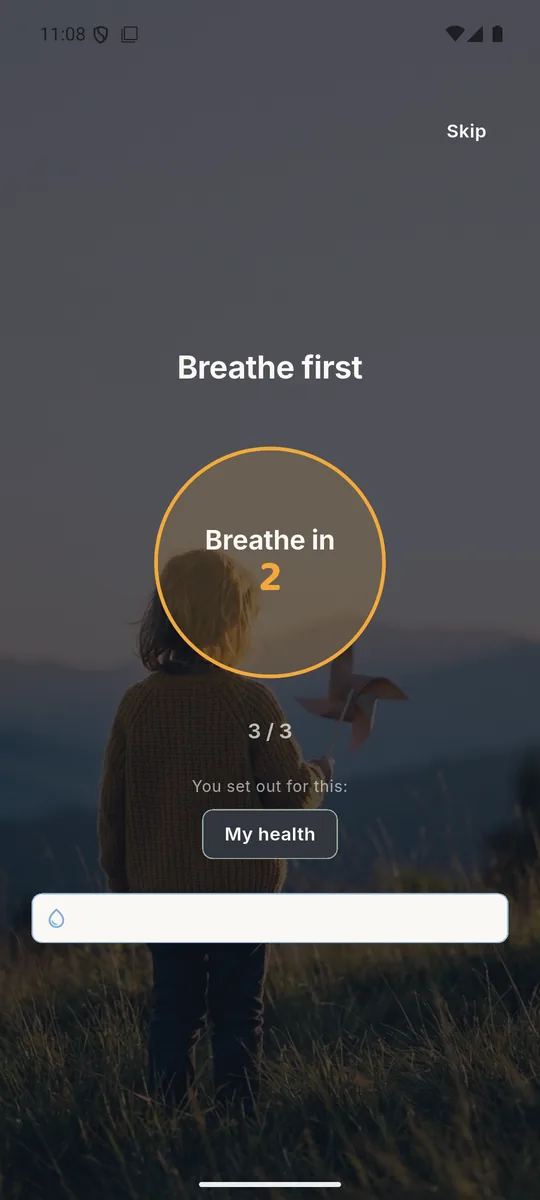
One tap when a craving hits: breathe first. A three-round guided breathing exercise.
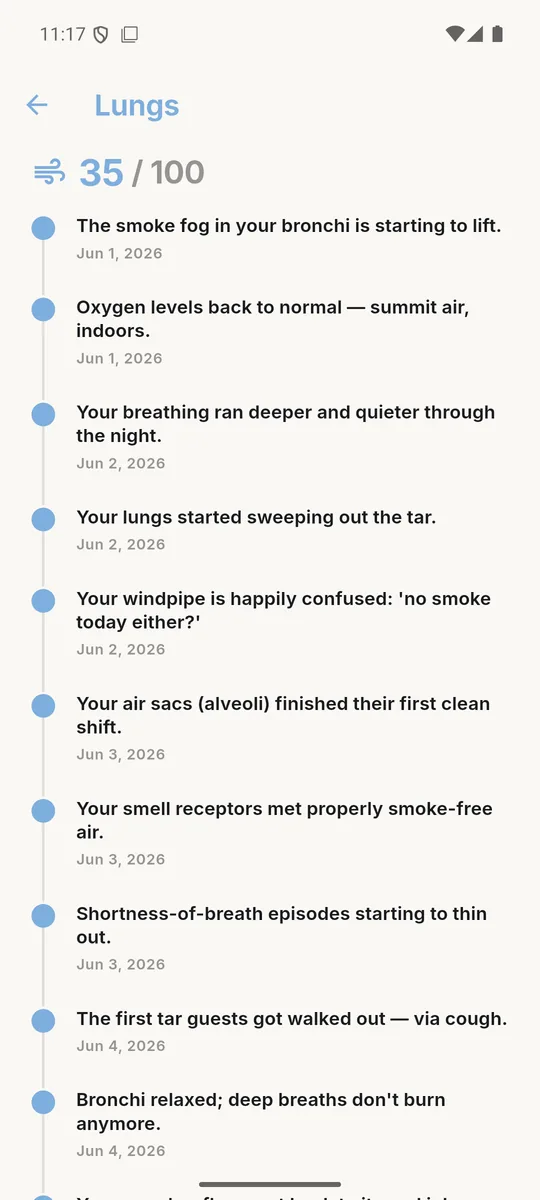
Six routes, 600 stops. Whatever is repairing in your body, you read it there.

You choose the view you are climbing — summit, forest, sea, or your own photo.
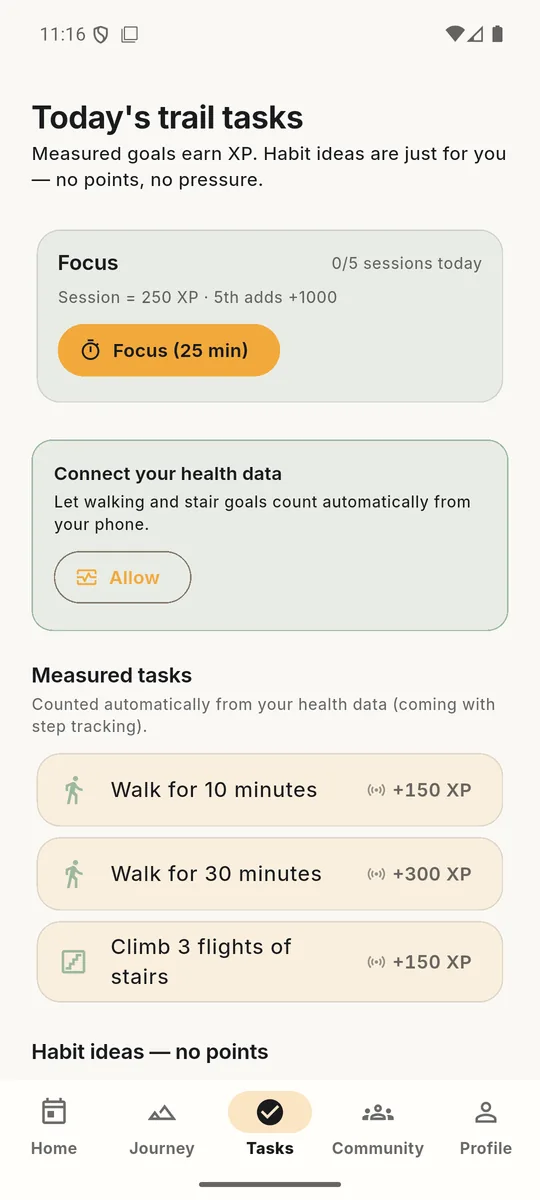
Small tasks every day. You are building a habit, not willpower.
Real screens from the app.
- Hear your own voice when a craving hits — the reason you quit, in your own words. You can add the voices of people you love, too.
- One tap for guided breathing and a distracting task — enough to fill those four minutes.
- 600 stops across six routes: read exactly what is repairing in your body today.
- Your numbers live on your device and keep counting offline — even on a plane.
- You pick the view you are climbing: summit, forest, sea, or your own photo.
- Interface, content and notifications in 14 languages.
You start free. The first day of the journey and the last are both yours.