Should You Quit If You Only Smoke 3 Cigarettes a Day?
July 30, 2026·6 min read
Only smoke 3 cigarettes a day? It’s less than a pack-a-day, but far from zero. Here’s what the data says about risk, habit, and why quitting is easier for you.
“I only smoke three a day, it can’t be that bad.”
Hidden in that sentence is an assumption: risk goes up in a straight line with how many you smoke. If twenty cigarettes mean “twenty units of risk,” then three must mean “three units,” right?
The data doesn’t back that up.
Why risk doesn’t increase in a straight line
For your heart and blood vessels, the curve is steepest at the very bottom. The first few cigarettes create the biggest proportional jump in risk; after that, the curve flattens out.
It feels counterintuitive, but the mechanism makes sense: the way the inner lining of blood vessels reacts, how easily blood clots, and how carbon monoxide crowds out oxygen in your blood — all of these kick in quickly, even at low doses. For these effects, there’s no clear “safe” minimum.
For things like lung cancer, the picture is more about total exposure over time; there, the number really does matter more. So it won’t fit into a single slogan: some risks keep rising with dose, others are already high at low daily levels.
The honest summary: three a day is better than twenty, but it’s still a long way from zero. And the “benefit curve” gets really steep as you approach zero.
What does “I smoke a little” actually mean?
There’s also a measuring problem most people don’t see.
Someone who “only” smokes three a day usually doesn’t count: the one a friend offers, the ones they smoke outside at work, the ones with drinks, or the extras on a stressful day. When they write every cigarette down for a day, the number often lands closer to five or six.
Then there’s this: people who smoke less often drag harder on each cigarette. Because the count is low, they squeeze more out of every one — the same compensation mechanism we see when people “cut down.”
The real advantage of being a light smoker
Now the good part, because this group has a genuine edge.
Physical dependence is lower. If you smoke three a day, your blood nicotine level doesn’t stay high all day; withdrawal symptoms are usually milder and shorter. The list of symptoms will probably show up more softly for you.
Your habit network is thinner. There are fewer “wires” to unplug: typically coffee, alcohol, and stress. Someone who’s smoked a pack a day for twenty years might have ten strong links; you might have three.
So, in objective terms, quitting is easier for you. The catch is that this very ease can drain your motivation to actually do it.
The most common trap: the number creeping up
“Three a day” isn’t a fixed point; it’s a position on a slope.
A typical pattern looks like this: you’ve been on three a day for three years, then a rough patch hits and you slide up to five. After a while, five becomes the new normal. The next rough patch nudges you to eight.
⚠️ Almost nobody starts by deciding, “I’ll smoke twenty a day.” Nearly everyone on a pack a day once started as “I only smoke a few.”
So if you’re a light smoker, the main question isn’t just about current health risk: will it still be three a day five years from now?
The climb in numbers has fairly predictable triggers, and they’re all familiar: a new job, moving, a breakup, a loved one’s illness, exam season. The increase isn’t random — it happens in hard seasons, and hard seasons come to everyone.
There’s also a one‑way effect downward: the person at three a day has usually come down from five, or eight. That number is already the result of a reduction. If it stopped there, it’s not because you “lack willpower”; it’s because those three are the most stubborn ones — we explain why the last cigarettes turn into “rewards” when you cut down in a separate piece.
What does three a day add up to in a year?
Because the daily number looks small, the yearly total feels small too. The math says otherwise:
Three cigarettes a day → about 1,100 cigarettes a year, roughly 55 packs.
In five years that’s 5,500 cigarettes, 275 packs.
Time-wise: say 5 minutes per cigarette → 15 minutes a day → about 91 hours a year.
These numbers don’t “prove you smoke a lot”; they simply give that “I don’t smoke much” sentence a scale. Three a day over ten years means about eleven thousand cigarettes — and no one would look at eleven thousand cigarettes and call that “a little.”
⚠️ There’s also something sneaky about how packs work: light smokers often let packs go stale before finishing them, so they pay for more cigarettes than they actually smoke. The counter on the side runs this with your own prices.
“I’m not addicted, I can quit whenever I want”
There’s a neat way to test that: go two weeks without smoking.
If you’re really not dependent, it’ll be easy — and you’ve basically quit. If it’s hard, you’re more attached than you thought — and that’s useful information.
The trick with “I can quit whenever I want” is that it stays true as long as you never test it. The moment you test it, it either gets confirmed or corrected. Either way, you win something.
“I’m a social smoker” is not the same as “I smoke three a day”
These two groups often get lumped together, but they behave differently when it comes to quitting.
Three‑a‑day smokers are regular users: every day, often at similar times, usually from their own pack. There’s a small but real physical dependence, and the ritual is part of daily life.
A social smoker is irregular: maybe once or twice a week, usually from someone else’s pack, in the same type of setting. Physical dependence is almost zero; the whole connection is about the environment.
That changes the plan. For a three‑a‑day smoker, the focus is on work hours and daily routines; for a social smoker, it’s basically about one thing: drinking occasions. In the second case, going alcohol‑free for the first three weeks is often enough by itself.
Figuring out which you are is simple: in the last month, have you smoked when you were completely alone? If the answer is yes, you’re in the first group.
Where do you start?
If you’re a light smoker, your prep can be short:
Count a full day. See the real number — it’s probably higher than you think.
Write down your three strongest triggers. When exactly do you smoke?
Set a quit date. Don’t push it more than two weeks out.
Keep the first two weeks alcohol‑free. For most light smokers, that’s the strongest link.
You can check the full eight‑step prep list, but these four are usually enough for this group.
Three cigarettes a day is better than twenty. It’s still far from zero. And most importantly: it doesn’t stay put by itself.
The only step for today is to start the two‑week test. If it’s easy, you’re done; if it’s hard, you’ve learned something valuable.
If you want to see what even three a day adds up to over a year, plug your numbers into the counter on the right — most people are surprised. And if you want tools in your pocket for rough moments, the Tar2Star app was built exactly for that.
This page is a photo. The app is the film.
These numbers show today. Tar2Star shows you a new one every morning — and stays with you when a craving hits.
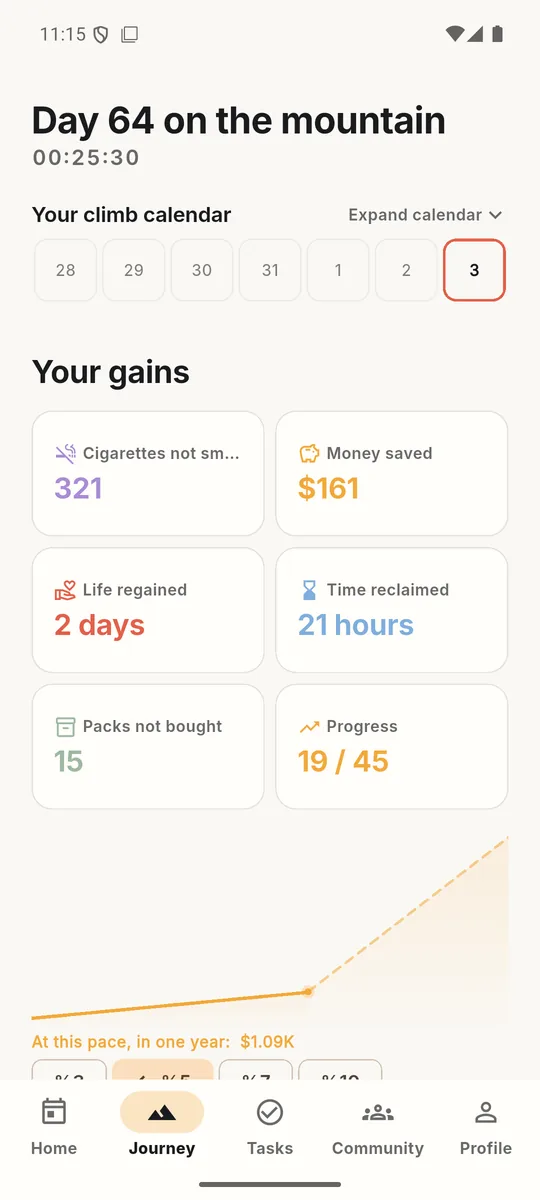
Your gains day by day: cigarettes not smoked, money saved, life reclaimed.
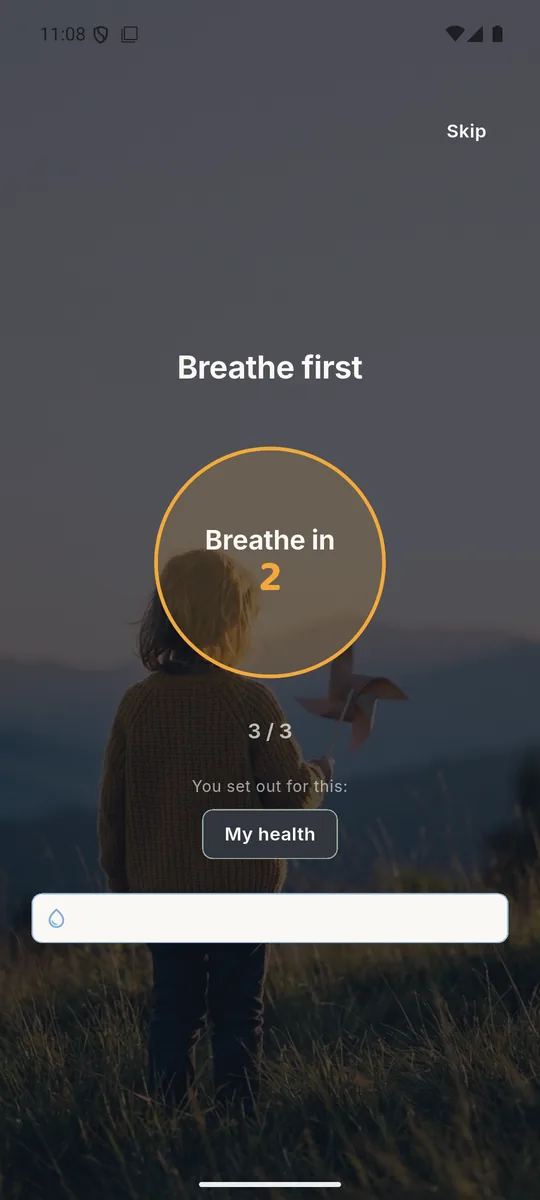
One tap when a craving hits: breathe first. A three-round guided breathing exercise.
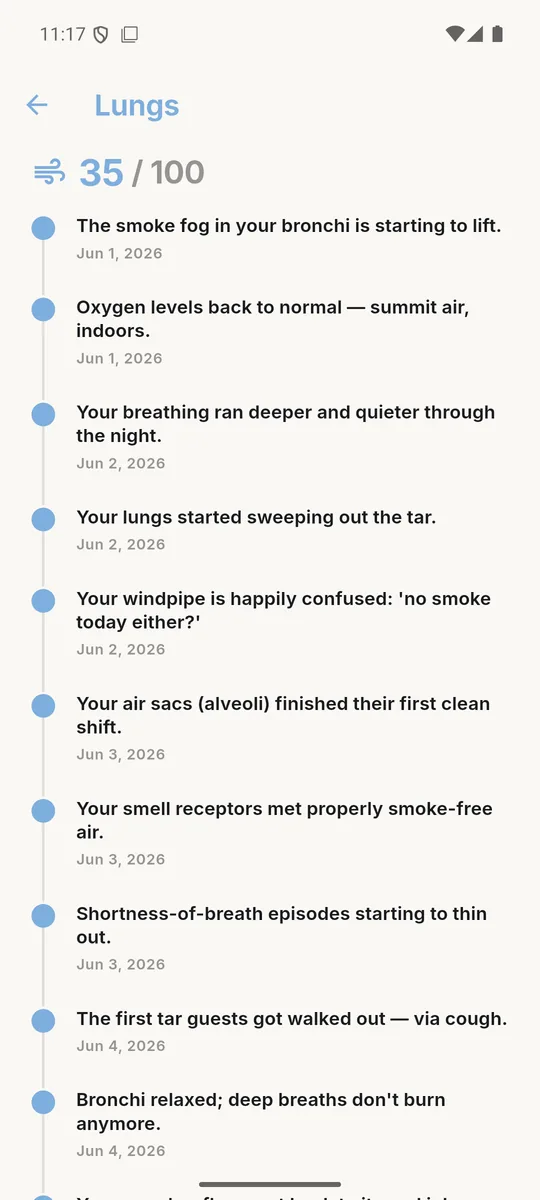
Six routes, 600 stops. Whatever is repairing in your body, you read it there.

You choose the view you are climbing — summit, forest, sea, or your own photo.
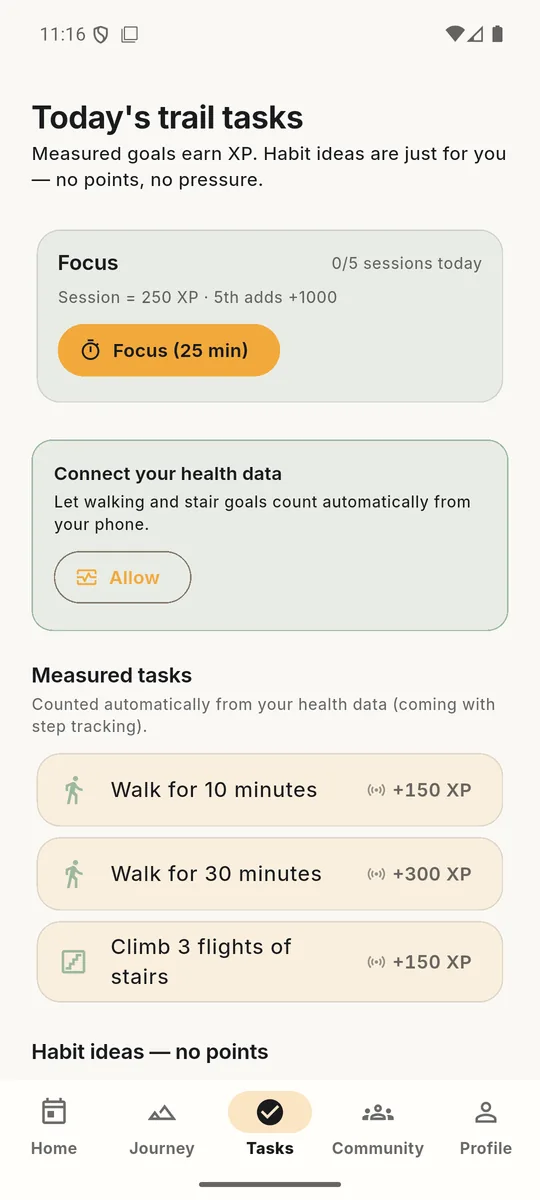
Small tasks every day. You are building a habit, not willpower.
Real screens from the app.
- Hear your own voice when a craving hits — the reason you quit, in your own words. You can add the voices of people you love, too.
- One tap for guided breathing and a distracting task — enough to fill those four minutes.
- 600 stops across six routes: read exactly what is repairing in your body today.
- Your numbers live on your device and keep counting offline — even on a plane.
- You pick the view you are climbing: summit, forest, sea, or your own photo.
- Interface, content and notifications in 14 languages.
You start free. The first day of the journey and the last are both yours.