“I only smoke when I’m out” – is that really harmless?
July 30, 2026·7 min read
Only smoke when you’re out drinking? It feels harmless, but social smoking can quietly add up to thousands of cigarettes — and often slides into daily smoking.
"I don’t smoke. I just have a few when I’m out."
Most people who say this aren’t lying — in their mind, they really don’t see themselves as smokers. And that’s exactly why social smoking can be the hardest pattern to let go of. It usually sits one notch beyond the “3 cigarettes a day” group.
The identity trap: “I’m not a smoker”
Quitting is a behavior change for someone who sees themselves as a smoker. For a social smoker, there’s no “smoker identity” to change — because they already feel like a non‑smoker.
That creates a simple paradox: there’s never a quit decision, because there’s nothing to “quit.” Ten years of “just a few on weekends” never makes it onto the “I should stop” list.
But ten years × three a week = roughly 1,500 cigarettes.
It’s a number almost nobody counts — and when you actually write them down for a day, the real frequency is usually higher than you’d guess.
Is social smoking an addiction?
Honest answer: most of the time there’s *no strong physical dependence, but there is a behavioral bond.*
On the physical side the test is simple — if you don’t wake up wanting a cigarette, don’t feel withdrawal during the day, and your blood nicotine never stays high, the classic dependence picture isn’t there. The “first cigarette in the morning” question is basically “never” for you.
Behavior is a different story. If any of these sound familiar, there is a bond:
In that social setting, not smoking feels uncomfortable
You tell yourself “I won’t smoke tonight” and still end up smoking
It’s genuinely hard to say no when someone offers you one
This isn’t a moral failing; it’s just information. And there’s some good news in it: a behavioral bond is usually much easier to undo than full‑on physical dependence — the list of withdrawal symptoms will be mostly blank for you.
Why does this pattern last the longest?
Other smoking patterns eventually hit some wall: coughing, money, smell, comments from people around you. For social smokers, almost none of that kicks in.
Three things line up in the same direction:
No clear symptoms. A few cigarettes a week don’t wreck your breathing, don’t give you a “smoker’s cough,” don’t show up on basic tests. Your body never clearly says “stop.”
No visible cost. You often don’t even buy your own pack — you just take one from someone else’s. It’s hard to find a strong reason to quit something you never directly pay for.
No one brings it up. Family and friends don’t tell you “you should quit,” because in their mind you’re not really a smoker either. The “maybe it’s time to stop” conversation never happens.
Result: fifteen years can slide by in exactly the same pattern. In other smoking styles, that amount of time usually brings either escalation or at least a few quit attempts. Here, nothing “happens” — and that very nothingness is what keeps it going.
Is smoking a little basically risk‑free?
Two different things are worth separating.
Risks tied to total lifetime exposure (like lung cancer) are clearly lower for social smokers — the total number really does matter.
But for heart and blood vessel disease, the curve is steep even at low doses. As we break down in the 3‑cigs‑a‑day article, there’s no convincingly “safe” threshold we can point to, even for light smoking.
So social smoking is not “the same as a pack a day,” but it’s also not “the same as never smoking.”
The real problem: the number doesn’t stay small
The biggest risk with social smoking isn’t today’s health snapshot, it’s the direction of travel.
A very typical path looks like this: a couple of cigarettes a week during college. Then five a week once you’re working. Then, in a stressful period, “just one after work” — now it’s not purely social anymore. Then a cigarette with your morning coffee.
⚠️ Most people who smoke a pack a day once started as “only when I’m out.” Almost no one chooses that endpoint; they just slide into it bit by bit.
For a social smoker, the core question is: five years from now, will it really still be “only when I’m out”?
How easy would quitting actually be for you?
Probably easier than you think — for a very concrete reason: you usually have just one main link to break.
After twenty years, smoking is wired into ten different moments — coffee, driving, breaks, phone calls, after meals, stress, and so on. For you, it’s typically only one: social settings with alcohol.
Once that single link is cut, you’re done. No physical withdrawal waves, no morning cravings, no “first 72 hours” drama.
A practical three‑step plan
1. See the real number. Write down how many cigarettes you had over the last month. Not a guess — go back through nights out and actually count. That number is usually the first jolt. You can also plug your weekly number into the counter on the right to see the yearly total in two minutes.
2. Prepare one sentence. A line that shuts down the offer without being rude: “I’ve quit, don’t offer me one.” We’ve put together some ready‑made scripts you can borrow.
3. Plan your first three social events. Those are your real test — not the first 72 hours at home. Keep your hands busy, leave a bit earlier if you need to, and decide in advance how the night will go.
⚠️ The most important detail: make the decision at home, while you’re sober. Decisions made at the table usually get broken at the table. Alcohol’s effect is often the single biggest factor for social smokers.
What to expect at the first event
In this group there’s no “classic” first 72 hours; the real challenge starts with the first invite.
Roughly, it plays out like this:
First half hour: fairly easy. The decision is fresh, the night is just starting, nobody’s offered you anything yet.
Second hour: tougher. Drinks are on the table, the first pack is open, people start heading outside. The crucial moment is, “Come out with us.” And that sentence is really a “come chat with us” invitation, not a literal cigarette offer — which makes it harder to refuse.
The workaround is not to refuse at all: go outside, have the conversation, don’t smoke. For a social smoker, what you’d actually miss is those five minutes of talk, not the cigarette itself. Once you separate the two, most of the problem is solved.
After the third hour: it gets easier again. People stop offering, everyone has registered that you’re not smoking, and the topic dies on its own.
⚠️ There’s also the drink‑count issue: a lot of social smokers reliably break their decision after a specific number of drinks — and that number tends to be very consistent. If you know your own “uh‑oh” number, staying one drink below it for the first few nights out lets you protect your choice without having to “power through” anything.
“I’ve pretty much quit already, though”
That’s partly true — and it’s a sentence that deserves one real‑world test.
Go one full month without smoking. Go into social settings and don’t smoke. If that’s easy, you really have basically quit, and your sentence is accurate. If it’s hard, you’re a bit more attached than you thought.
Either way, it’s useful to know.
Social smoking isn’t just about how “harmless” it feels right now; it’s mostly about which way it’s pointing.
One thing for today: write down your last month’s total. Then run a one‑month test.
To see how many cigarettes and how much money it adds up to in a year, plug your number into the counter on the right. And if you want something to lean on during those social moments, the Tar2Star app is built for exactly those minutes.
This page is a photo. The app is the film.
These numbers show today. Tar2Star shows you a new one every morning — and stays with you when a craving hits.
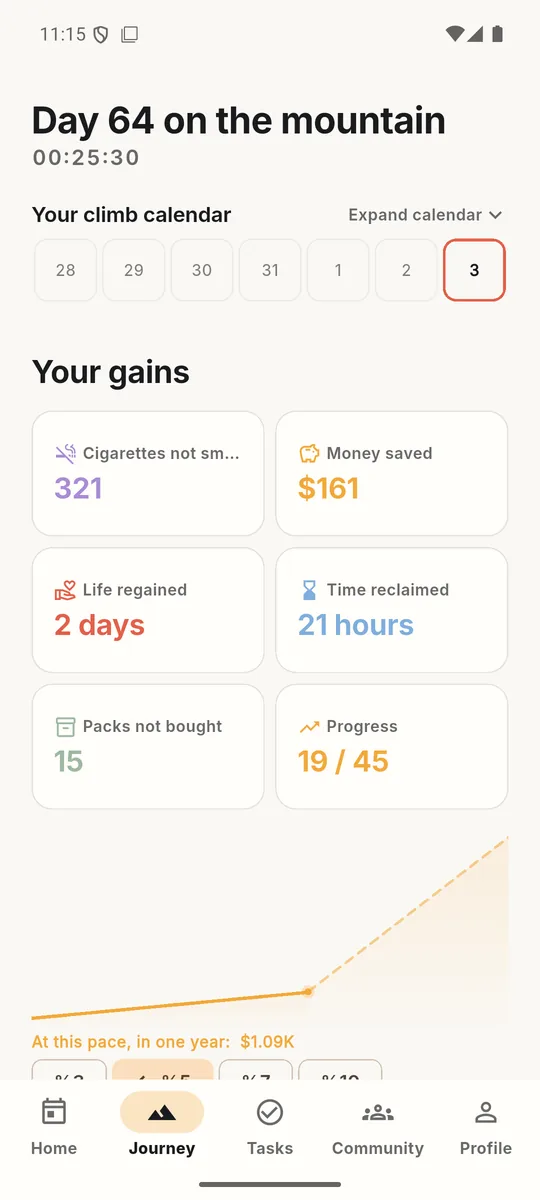
Your gains day by day: cigarettes not smoked, money saved, life reclaimed.
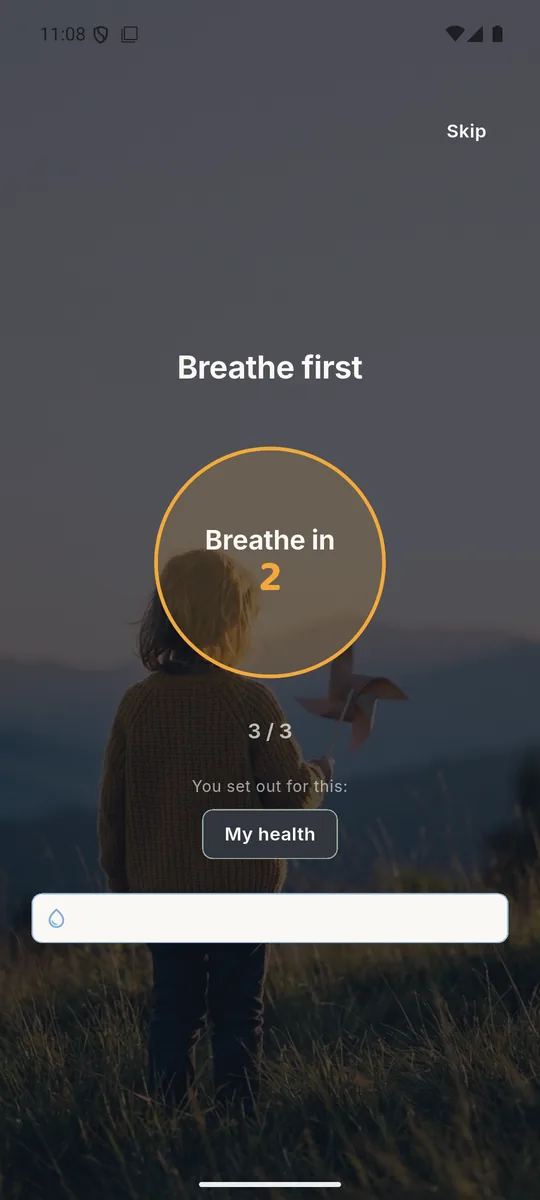
One tap when a craving hits: breathe first. A three-round guided breathing exercise.
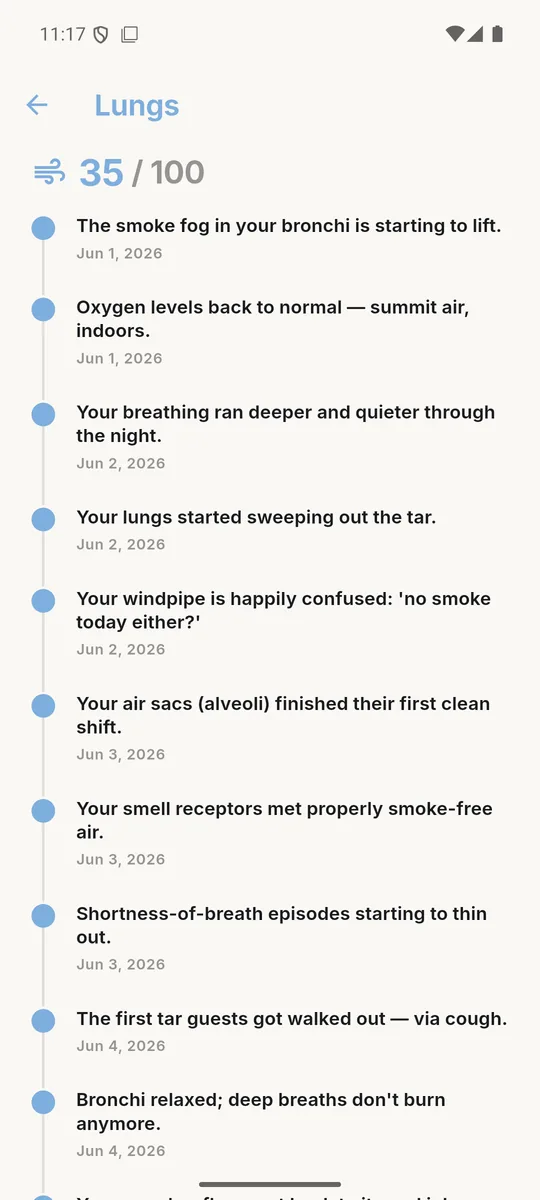
Six routes, 600 stops. Whatever is repairing in your body, you read it there.

You choose the view you are climbing — summit, forest, sea, or your own photo.
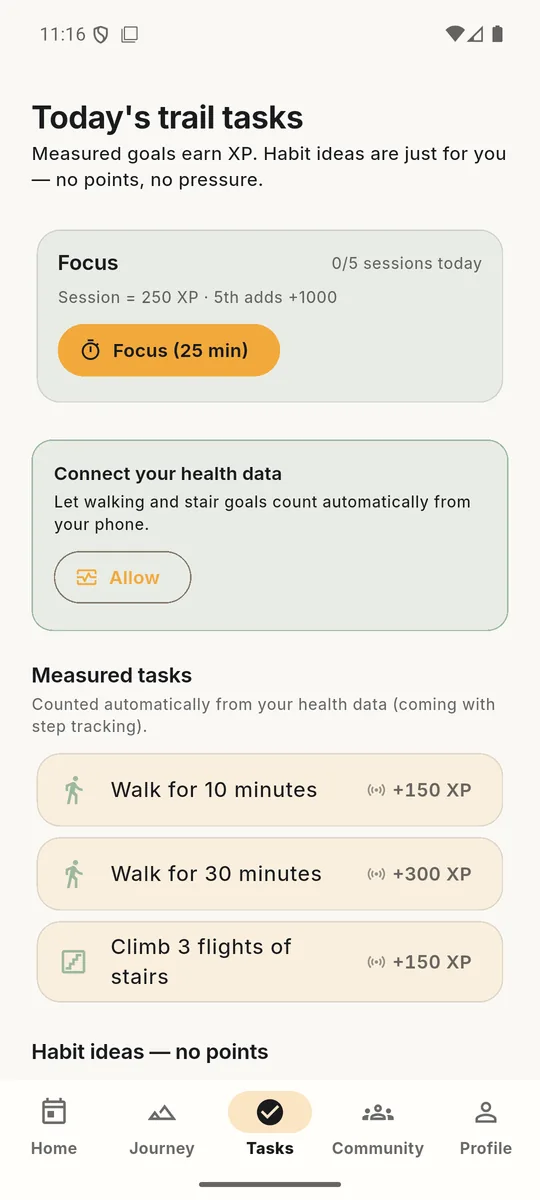
Small tasks every day. You are building a habit, not willpower.
Real screens from the app.
- Hear your own voice when a craving hits — the reason you quit, in your own words. You can add the voices of people you love, too.
- One tap for guided breathing and a distracting task — enough to fill those four minutes.
- 600 stops across six routes: read exactly what is repairing in your body today.
- Your numbers live on your device and keep counting offline — even on a plane.
- You pick the view you are climbing: summit, forest, sea, or your own photo.
- Interface, content and notifications in 14 languages.
You start free. The first day of the journey and the last are both yours.