Quit smoking fears: what are you actually afraid of?
July 30, 2026·7 min read
Thinking about quitting but scared of cravings, weight, mood or “failing again”? Here’s how long each fear really lasts—and what actually helps.
Putting off quitting isn’t always an excuse. Sometimes it’s fear.
And fear needs a different kind of response than an excuse. You don’t argue with it, you measure it. Because what usually makes fear grow is not knowing how long it will last.
This guide puts seven common fears on a timer.
1. “I won’t be able to handle it”
True part: The first days are hard. Withdrawal is a real physical state.
Measured: A craving surge lasts about 3–5 minutes. You’ll get roughly three to four strong waves a day. So the total “really rough” time on day one is around twenty minutes.
That changes the story: it stops being “survive a whole day” and turns into “get through twenty minutes in chunks.” We broke down how a craving wave works in a separate article.
What eases it: Having something ready to fill those minutes. The seven‑item “quit bag” checklist is written exactly for those twenty minutes.
2. “I’ll be irritable and snap at people”
True part: Irritability is one of the most common withdrawal symptoms.
Measured: It usually peaks around day 2–3. Most of it fades within 2–4 weeks. You’ll find the full list of symptoms and timelines in another guide.
What eases it: Telling people ahead of time. A sentence like “I might be cranky the first week, it’s not about you” prevents a lot of pointless arguments before they even start. We wrote separately about how to tell people you’re quitting.
3. “I’ll gain weight”
True part: On average, people report gaining about 4–5 kilos.
Measured & balanced: The health gains from quitting are clearly larger than the impact of that increase. And there are three concrete things that limit the gain. Details here.
4. “My social life will disappear”
True part: For many people, the smoke break is the most relaxed five minutes of their day. Losing that feels like losing something real.
Measured: The “this feels weird” phase lasts about three weeks. And most of what you lose is the setting, not the actual friendships.
Another way to measure it: how many “smoke‑break friends” do you also see outside the break? That number is what usually stays after you quit — and for most people it turns out higher than they expected.
What eases it: Don’t disappear from social life; just skip the smoking area for the first three–four days. More on that here.
5. “I’ll fail again and look stupid”
True part: You’ve tried before and it didn’t stick. That’s real.
Measured: The average number of serious attempts is estimated between 6 and 30. So being on attempt number five doesn’t make you late; it makes you normal.
What eases it: Not announcing it to everyone. Telling a small circle gives you support and privacy.
6. “I’ll lose my way to relax”
True part: Three parts of a cigarette break really do feel calming — deep breathing, stepping away, and the ritual itself.
Measured & balanced: You can get all three without nicotine: breathing exercises, changing what you do on your breaks, building a new ritual. We go through them one by one in the “small tools” article.
And this: after the first weeks, people who quit often report that their overall tension goes down — because the all‑day up‑and‑down cycle stops.
7. “I don’t know who I’ll be without it”
This is the quietest fear — and the deepest.
If you’ve smoked for twenty years, cigarettes aren’t “just a habit.” They’re part of how you see yourself: who you are on a break, what’s in your hand, which group you stand with.
True part: Completely real. And it is a loss.
Measured: This one isn’t on a withdrawal clock. You don’t count it in weeks but in months. But something else moves into that space: a new identity — you become the person “who quit.”
What eases it: Having a reason that’s yours. When you quit mainly for someone else, that empty space feels bigger. When you quit as your decision, that space gets filled by a choice you made.
Two fears people rarely say out loud
These seven are the most common, but there are two more that almost never get mentioned — mostly because they feel embarrassing.
“Life will be boring.” Cigarettes filled the empty moments, and those moments come back. The fear is valid; the duration is short. Within a few weeks, those gaps usually get filled with other things. But in the first days, without knowing that, the brain records it as “my life got dull.”
“I’ll never be allowed to smoke again.” This is basically grief for a loss — and it’s real.
What helps: no one is asking you to sign a lifetime contract. Clause five of the quit agreement exists exactly for this reason — “never again” is too heavy to carry, and when you do slip, that sentence makes the whole thing collapse.
Why does knowing the duration help this much?
Everything in this article rests on one mental trick, and it’s worth naming.
A hardship with no end date feels endless. The same hardship, with a clear time limit, becomes bearable — because your mind is no longer stuck on “when will this stop?”
In practice: “I’ll be irritable” is scary; “I might be irritable for 2–4 weeks, worst on days 2–3” is a plan. Both describe the same thing, but only the second one fits into a calendar.
⚠️ That’s why simply putting a time next to each fear often helps more than debating it. If there’s no time attached, the fear is still vague.
Which fears actually show up?
You see the answer when you listen to people after they quit — and the pattern is surprising.
The first three fears (not coping, irritability, weight gain) are the ones people talk about most, but they’re also the shortest. All three are measured in weeks, and all three have known ways to respond.
The last two (losing your way to relax, not knowing who you are) are the ones people talk about least, but they last the longest. And when people go back to smoking, most don’t mention the first three — they point to these two.
What that means in practice: most preparation is built around the wrong fear. Gum and water are tools for the first fear; what you need for the second group is a reason that really belongs to you and a picture of a smoke‑free day you’ve already walked through in your head.
⚠️ In other words: the gum in your pocket carries you through week one. The reason you wrote down carries you through week three. They do different jobs; one doesn’t replace the other.
Writing your own fears down
Here’s the one practical step in this article: pick your fear and write it down.
You’ll likely circle one or two from the seven above. And whatever you circle already has a timer and a toolkit written next to it — that turns it from a foggy threat into something you can plan for.
⚠️ Telling yourself “don’t be silly, don’t be scared” doesn’t help. “You’re worrying for nothing” has never shrunk anyone’s fear. Measuring does: how long will it last, what takes the edge off.
You can add a small line to your quit agreement: fear + duration + what helps.
Most fears feed on not knowing. Once you put a time frame on them, they usually shrink.
If you do one thing today: pick your fear from the seven and write its duration next to it.
If you want to see that duration in real time, enter your quit date into the counter on the right — seeing “day three” is more concrete than asking “when will this end.” And for those spike‑in‑the‑moment minutes, the Tar2Star app is built for exactly those crises.
This page is a photo. The app is the film.
These numbers show today. Tar2Star shows you a new one every morning — and stays with you when a craving hits.
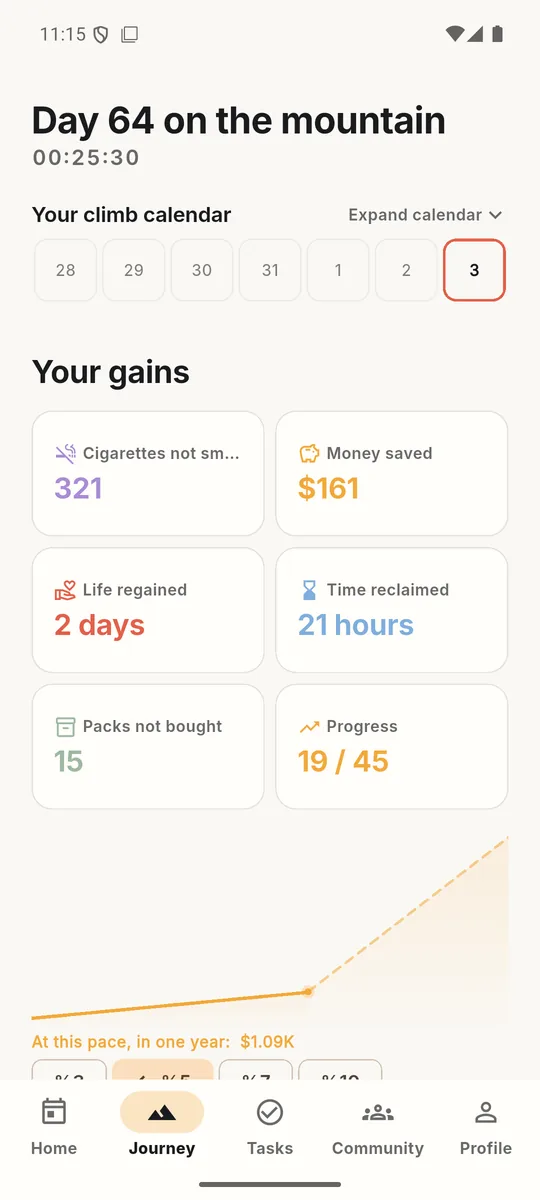
Your gains day by day: cigarettes not smoked, money saved, life reclaimed.
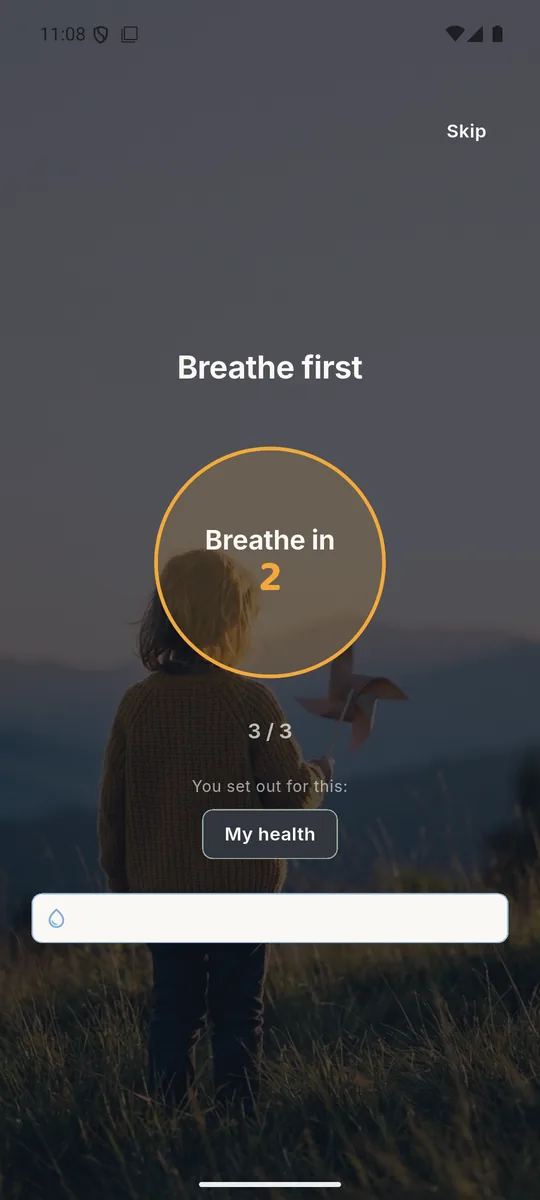
One tap when a craving hits: breathe first. A three-round guided breathing exercise.
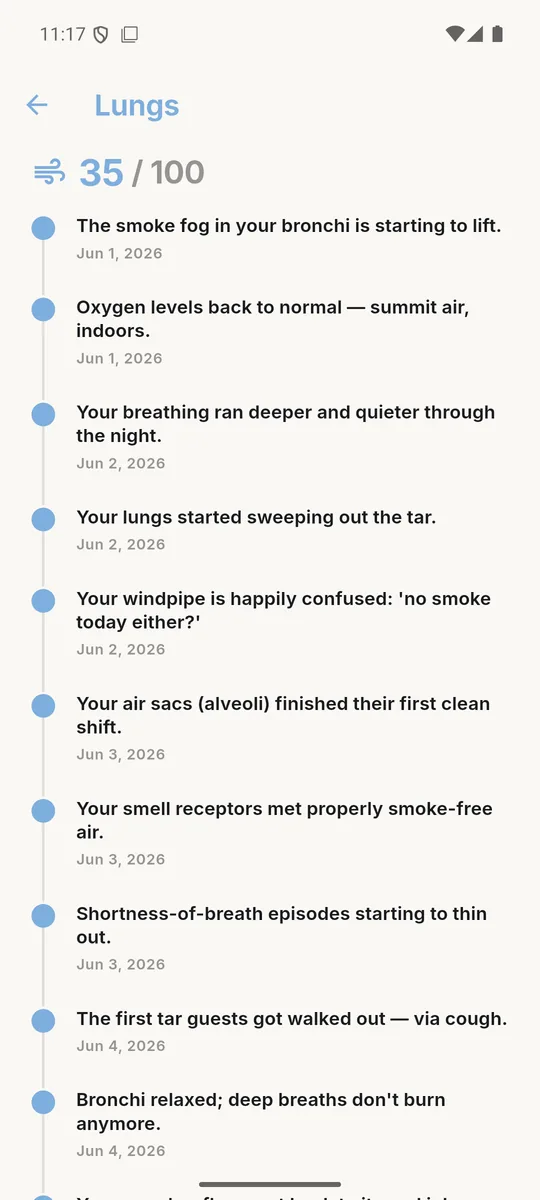
Six routes, 600 stops. Whatever is repairing in your body, you read it there.

You choose the view you are climbing — summit, forest, sea, or your own photo.
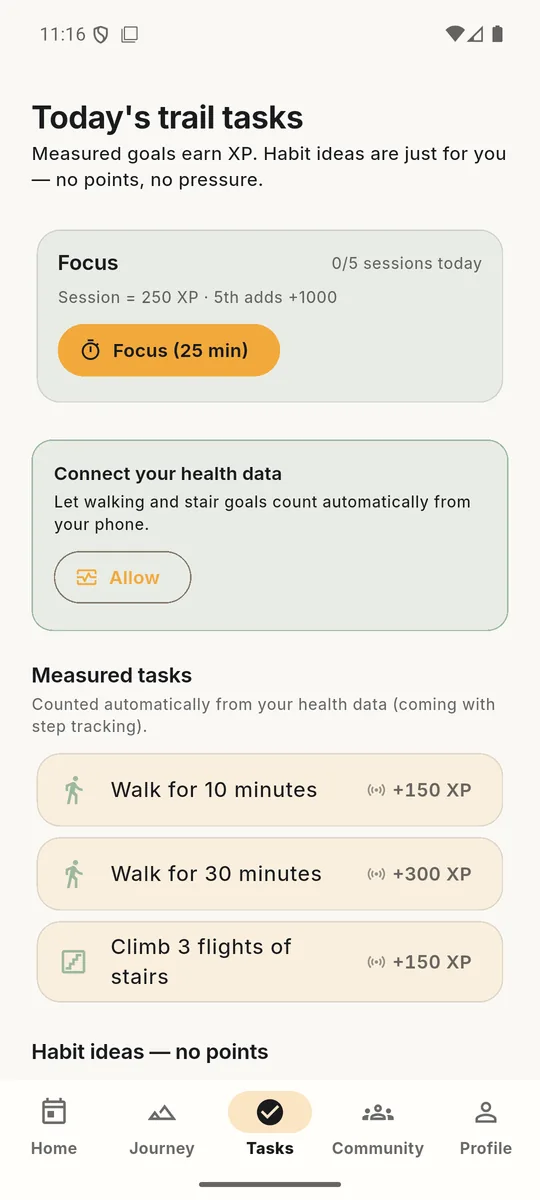
Small tasks every day. You are building a habit, not willpower.
Real screens from the app.
- Hear your own voice when a craving hits — the reason you quit, in your own words. You can add the voices of people you love, too.
- One tap for guided breathing and a distracting task — enough to fill those four minutes.
- 600 stops across six routes: read exactly what is repairing in your body today.
- Your numbers live on your device and keep counting offline — even on a plane.
- You pick the view you are climbing: summit, forest, sea, or your own photo.
- Interface, content and notifications in 14 languages.
You start free. The first day of the journey and the last are both yours.