Why Throwing Out Your Ashtrays Is a Real Quit-Smoking Step (Not Just Symbolic)
July 29, 2026·7 min read
Keeping ashtrays isn’t “just in case guests come.” It keeps cigarettes within seconds of reach. Here’s why clearing them out makes quitting easier.
“Why would I throw away my ashtray? I might need it when friends come over.”
It sounds reasonable. That’s exactly why it’s risky.
Why an ashtray is more than “just an object”
An ashtray isn’t just a dish. It’s an invitation.
If you’ve smoked for years at the same table with the same ashtray, your brain has wired that object together with smoking. When your eye catches the ashtray, your mind doesn’t remember the cigarette; it waits for it.
Mouth starting to water, hands wanting to move, that slight restlessness — they all show up seconds after you see the thing.
And they kick in below the level where willpower operates. “I’ll ignore it, it doesn’t bother me” is a sentence that never even reaches the layer where this reaction happens.
You’ve already seen this in your journal when you looked at how the chain is built: before the cigarette itself, there’s always something that comes first. The ashtray is the most visible form of that “something.”
The real issue: the backup plan
Objects have a second, heavier job.
If you still have ashtrays and lighters at home, there’s a quiet footnote under your decision: “if I change my mind, I’m ready.”
No one phrases it like that. But when the hard moment comes, that little difference turns into a gap between seconds and twenty minutes:
Ashtray in the cabinet: Craving → reach out → you’re smoking. Time: seconds.
No ashtray, no pack: Craving → get dressed → walk to the store → stand in line → walk back. Time: 20+ minutes.
In the second scenario, the four-minute craving wave burns out halfway through the trip. It’s not willpower that saves the day; it’s distance.
That difference hides one of the least talked about but most useful principles of quitting: swap willpower for design. Willpower is limited and gets drained through the day; distance, once set up in the morning, stays put until night. Fifteen minutes of cleanup permanently cuts down how many tough decisions you’ll have to make that day.
There’s also this: a crisis decision is not the same as a calm decision. When a craving hits, your brain’s priority list reshuffles, and “I’ll regret this tomorrow” quietly slides to the very back. Getting rid of the objects today moves that choice out of the crisis and back into now — when you’re at your clearest.
⚠️ That’s why “throwing away” and “putting away” are not the same move. A box on top of the closet is still three minutes away. An ashtray in the trash can does not walk back.
What should go? Full checklist
Grab a trash bag; this takes about fifteen minutes:
Ashtrays — in the house, on the balcony, in the car, on your desk. All of them.
Lighters — the ones in drawers, bags, pockets. One lighter can stay for the kitchen stove; bury that one at the very back of a drawer.
Packs — the open one, the spare one, the forgotten one. Coat pockets and the bottoms of bags are the classic hiding spots.
“Helper” items — rolling tobacco pouches, filters, cases, the car’s cigarette lighter adapter.
The “special” ones — gift lighters, ashtrays from trips. These are the hardest, and precisely because of that, they’re the most important.
“But that lighter was a gift”
This is real, and it’s not something to shrug off.
The solution isn’t that you must dump everything in the trash. The point is to get it out of sight and out of your home. Give it to a friend, ask someone to keep it for you, or box it up and stick it in the trunk.
The rule: the object is not in your home and not somewhere you can easily reach. You don’t have to destroy something with emotional value; you just need to build distance.
The “for my guests” excuse
This is the most common line, so it deserves its own space.
Here’s the honest version: keeping an ashtray “for guests” is a polite way of leaving the door open for yourself.
The practical answer is simple: if a smoker visits, a small plate on the balcony does the job. When they leave, the plate goes too. No one gets offended, no one is upset.
The same pattern shows up in other reasons, and they all come from the same mold:
“What if I can’t quit, then I’ll have to buy everything again.” — True; and if that day comes, buying a new ashtray takes fifteen minutes. Right now, the only job your ashtray has is pulling that day closer.
“My partner/roommate still smokes; their stuff is already here.” — Then their ashtray lives in their space. Having one on your desk is a choice that belongs to you.
“It’s an antique / part of a collection.” — Box it, put it on a top shelf, or let someone else store it. Nobody’s asking you to smash it.
The common point: none of these objections is wrong. But all of them argue for the object staying, and not one explains what you actually gain by keeping it there.
And another thing: in the first weeks, having people smoke inside your place isn’t a great idea anyway. Smell alone is a strong trigger — in the home detox guide, we wrote about why that smell can hang around for months.
If you really can’t throw it out: distance steps
Sometimes you genuinely can’t get rid of certain items — you share the home, the lighter is a keepsake, the ashtray is part of the kitchen set. In that case, don’t treat it as all-or-nothing. Build distance in steps:
Out of your direct line of sight. From the counter into a drawer. It’s a small move but a powerful one: what you don’t see doesn’t start the chain.
Out of easy reach. From the drawer up to a high shelf — somewhere you can’t grab without getting up on a chair.
Out of your home. Into the trunk, a storage unit, or a friend’s place. Now it’s not measured in seconds or minutes; it’s a whole trip away.
Out of your life. Throw it away or give it away.
Each step doesn’t erase the craving, but it adds seconds in between — and in a four-minute wave, those seconds can make all the difference.
When should you do this?
The day before your quit date. Do it much earlier, and you risk buying new stuff in the meantime; leave it for the morning, and it eats half of your “preparation” day.
In the seven-day countdown checklist, this task sits on the final day for exactly that reason.
⚠️ One more warning: don’t turn this into a ceremony. “I’ll smoke one last cigarette and then throw everything away” is the classic escape hatch from this step. Throwing stuff out isn’t a celebration; it’s just cleaning up. We talked about why your last cigarette shouldn’t become a ritual in another post.
Round two: take another look a week later
The first cleanup always misses something.
The reason is simple and physical: about 48 hours after you quit, your sense of smell comes back noticeably. In the first round your nose simply didn’t register certain places. In week two, you suddenly find them — the car’s glove box, the pocket of your winter coat, the lighter that slipped under the bottom of a drawer.
That’s why a week later, you do a second ten-minute round. Whatever you find then is not a failure sign; it just means your nose is working better.
Today’s job is one bag and fifteen minutes.
While you’re tossing things, ask yourself: where do I want this object to be tomorrow morning? If the honest answer is “nowhere,” then it’s in the right bag.
Set your date in the counter on the right and watch that first day unfold after this cleanup. If you want something to lean on during tough minutes, the Tar2Star app was built exactly for those moments, with breathing exercises and small tasks to ride out the wave.
This page is a photo. The app is the film.
These numbers show today. Tar2Star shows you a new one every morning — and stays with you when a craving hits.
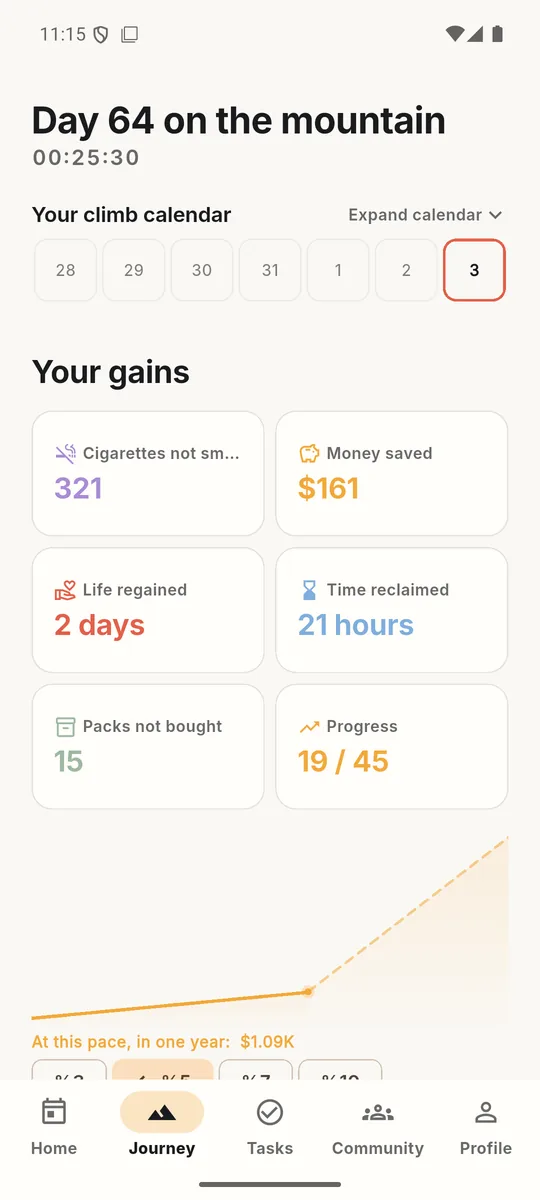
Your gains day by day: cigarettes not smoked, money saved, life reclaimed.
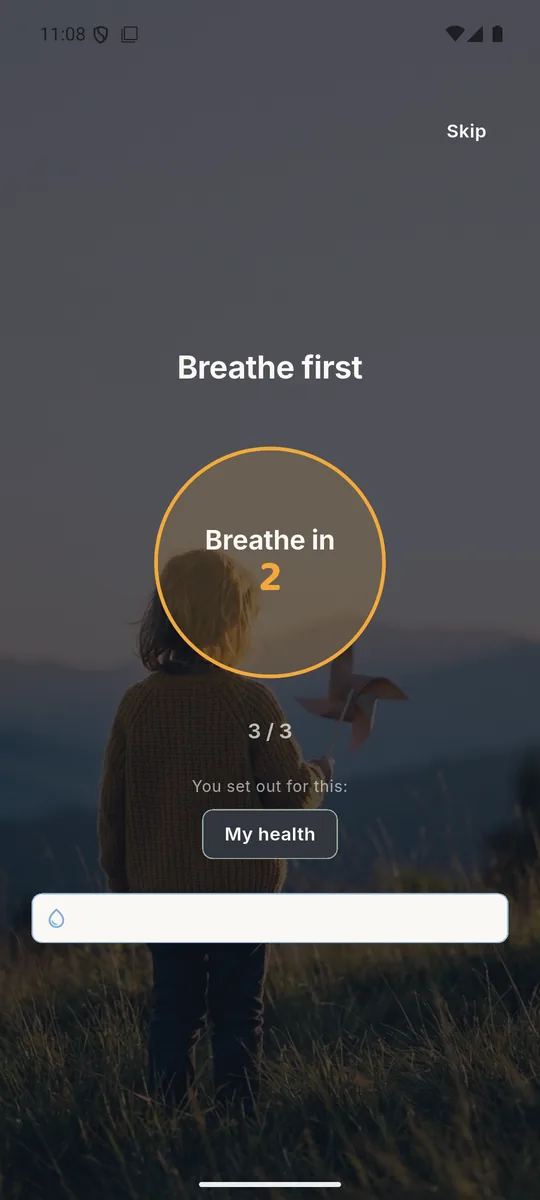
One tap when a craving hits: breathe first. A three-round guided breathing exercise.
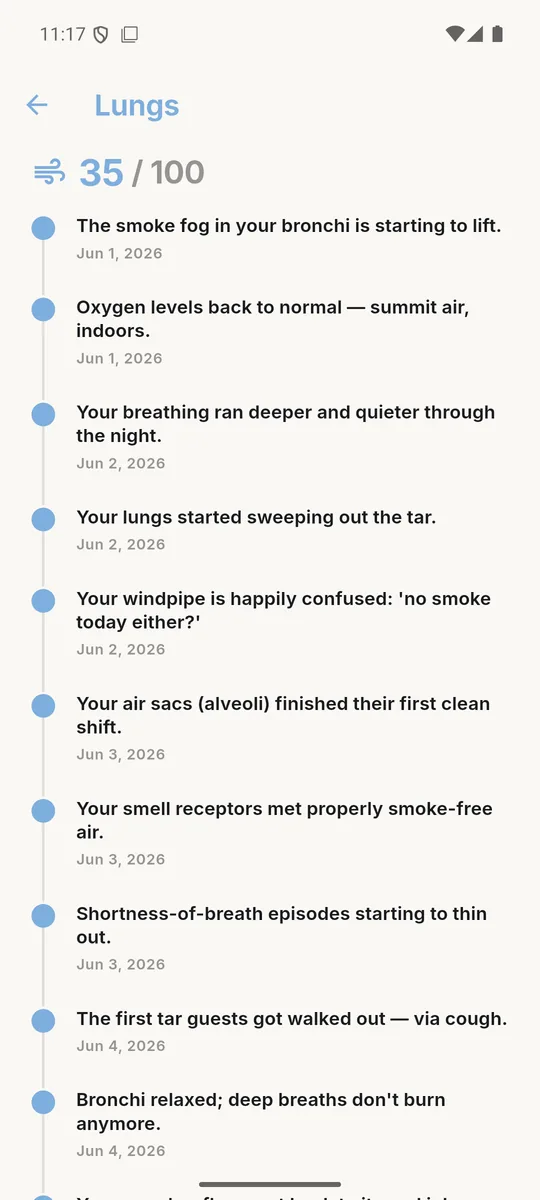
Six routes, 600 stops. Whatever is repairing in your body, you read it there.

You choose the view you are climbing — summit, forest, sea, or your own photo.
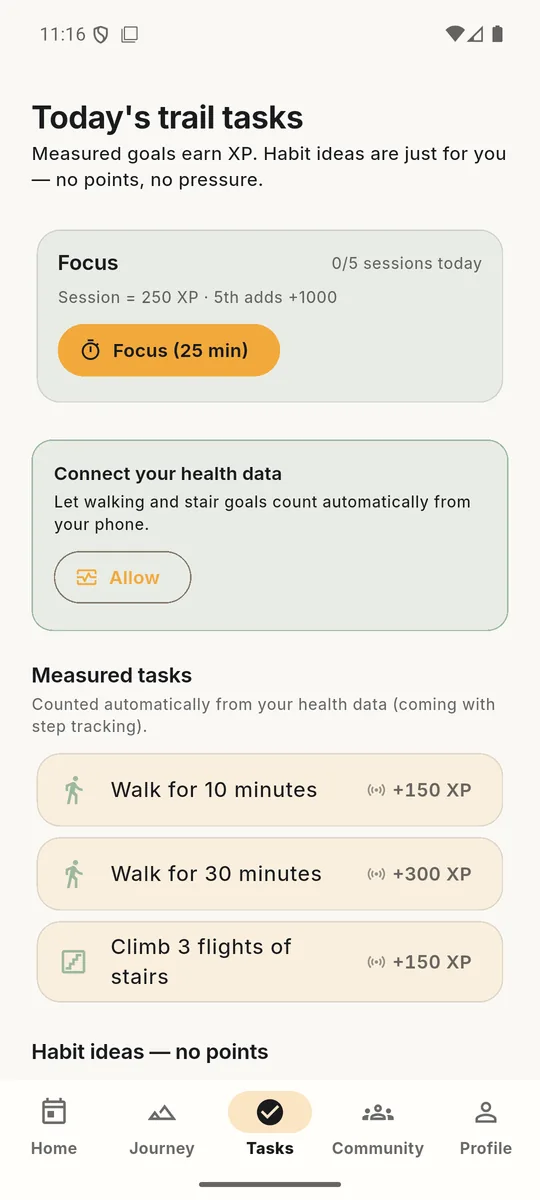
Small tasks every day. You are building a habit, not willpower.
Real screens from the app.
- Hear your own voice when a craving hits — the reason you quit, in your own words. You can add the voices of people you love, too.
- One tap for guided breathing and a distracting task — enough to fill those four minutes.
- 600 stops across six routes: read exactly what is repairing in your body today.
- Your numbers live on your device and keep counting offline — even on a plane.
- You pick the view you are climbing: summit, forest, sea, or your own photo.
- Interface, content and notifications in 14 languages.
You start free. The first day of the journey and the last are both yours.