Your doctor said “You need to quit smoking.” Now what?
July 30, 2026·8 min read
Doctor told you to quit smoking and you left with one sentence and a knot in your stomach. Here’s how to turn that warning into a concrete quit plan today.
--- The visit ends, your doctor says “You really need to quit smoking,” you walk out the door.
The sentence is clear. What comes after… usually isn’t.
What do you actually walk out with? Most of the time: one sentence and a vague anxiety. No plan.
This guide is for filling that gap.
Why “you should quit smoking” isn’t enough on its own
Because that warning gives you information, not a method.
That’s not really anyone’s fault. You can’t walk through a full quit-smoking plan in a 15‑minute appointment. The result, though, is predictable: you understand that it’s serious, and you have no idea what to do next.
And fear, on its own, is not great fuel. It pushes motivation up for a short time, then fades — and tends to leave anxiety behind.
You can’t put an exact number on how long fear lasts, but the pattern is familiar: very high the day of the appointment, high the next day, a remembered sentence a week later, nothing a month later.
That’s why the value of the warning doesn’t depend on the warning itself, but on what you do in the first 24 hours. The four steps below all fit into that window.
How your doctor’s words differ from other kinds of pressure
Quitting because someone else wants you to comes with its own trap: if the decision stays external, it usually creates resistance.
A doctor’s advice is different and more useful in one key way: it’s not a personal demand, it’s information. Your partner’s wish and your doctor’s findings are not the same category — the second one doesn’t put you in anyone’s debt.
You still need the same shift, though: over time, “the doctor told me to” needs to turn into “my breathing is better, this is what I want.”
You can tell when that shift has happened by listening to how you explain it to someone else. When a friend asks why you quit, what sentence comes out?
If you’re still saying “because my doctor said so,” the decision is still sitting outside of you. If you’re saying “I don’t wake up coughing anymore,” it’s moved inside.
That shift usually shows up somewhere between weeks three and six — so in the first month, not having that internal sentence yet is completely normal.
Don’t wait for the next appointment: three questions to ask
There are three questions to ask your doctor. You can often do it by phone, via a portal or email, or through your pharmacist — you usually don’t have to wait for a full visit.
1. “Based on my level of dependence, is some form of support appropriate?” If you smoke your first cigarette within five minutes of waking, that’s information your clinician needs. There are nicotine patches/gum and prescription options; the person who knows your chart can tell you which fits you.
2. “Do any of my medications need to be adjusted?” Smoking speeds up certain enzymes in the liver, and that can change how some medications are dosed. When you quit, the same dose can have a stronger effect. We broke this down in detail in the article on quitting at 60.
3. “Can you recommend a quit program or support line?” Many countries have free quit‑lines and clinics. Combining behavioral support with medication clearly works better than relying on willpower alone.
⚠️ What these three have in common: none of them can be answered by the internet. Dose, interactions, and what’s safe for you depend on your medical picture — and these three questions are what turn a one‑sentence warning into an actual plan.
“I already knew this”
A lot of people’s first reaction to the warning isn’t shock. It’s: “I knew this already.”
And you’re right — no one thinks cigarettes are harmless. But there’s a big difference between knowing and measuring. General knowledge (“smoking is harmful”) doesn’t usually move anyone. Seeing your own blood pressure, your own lung function, your own test results often does.
That’s why the most valuable thing you carry out of that visit isn’t the sentence, it’s the numbers that were written down. Numbers don’t get argued with, they don’t evaporate, and you can compare them three months from now.
“I’m scared, but I don’t know what to do”
This is the most common place to be. The answer: turn fear into a plan. Four steps, all doable today.
1. Set a date. Keep it within two weeks. There’s a separate article on how to pick it.
2. Track one day. Write down how many cigarettes you smoke, where, and in which moments. That’s the first step and it only takes one day. If you want to see the total number and yearly cost in two minutes, the counter on the right does the same calculation.
The concrete result of that one‑day log looks like this: 15 cigarettes a day adds up to about 5,500 cigarettes a year, or 274 packs.
Time has a side too — at five minutes per cigarette, that’s 75 minutes a day, about 456 hours a year.
The sentence you heard in the exam room is abstract. Those two numbers aren’t.
3. Write down your own reason. Your doctor’s reason is the starting point; your reason is what carries you forward.
4. Ask about support. Those three questions above.
⚠️ What not to do: wait until the next appointment. That gap is usually months long, and nothing changes during it.
Your quit plan: what you should have in hand as you leave
Three things are enough — and they all fit on one sheet of paper:
A date. A specific day written on your calendar as you leave. No more than two weeks out — at most 14 days, because the emotional impact of the warning doesn’t last longer than that.
One sentence. Rewrite what your doctor said in your own words: “I need to quit for my blood pressure,” for example. That one sentence will be your anchor in the first week.
One question. Ask at least one of the three questions above — even if it’s just over the phone.
If you want to put all three on a single page, the quit agreement was written exactly for that.
⚠️ Write down the numbers you heard at the visit (blood pressure, lung test result, cholesterol). When you repeat those tests in three months, you’ll have a starting point to compare with. Seeing the changes in your own body is one of the clearest ways to shift the reason from external to internal.
If the warning came with a diagnosis
This is a different situation and needs its own space: the “I’ve been diagnosed with a disease — is it too late?” question. We covered that in a separate article.
Short answer: it isn’t too late. Quitting after a diagnosis still affects how treatment goes.
If surgery is coming up, it’s even more concrete: quitting before surgery is directly linked to wound healing and breathing‑related complications. That’s exactly why your surgeon keeps bringing it up.
If you noticed the warning signs before your doctor did
Sometimes the warning doesn’t come from a clinician. It comes from your own body: getting out of breath on stairs in a way you didn’t before, a cough that doesn’t go away, mornings that feel different.
That’s actually a stronger signal than any medical warning — because it’s your own measurement. But don’t mix two things up: those symptoms can be a reason to quit; they are not a diagnosis.
If you have new and ongoing symptoms, the right next step isn’t an online deep dive. It’s seeing a doctor.
If your doctor didn’t bring it up, but you’re ready
Sometimes it’s the opposite: you want to quit, but your doctor never mentions it.
In that case, the initiative has to come from you. One sentence at the visit is enough: “I want to quit smoking. Is there support that would be right for me?”
That sentence opens a door with most clinicians — because when a patient is willing, there’s a lot more to talk about.
The silence is usually about time, not indifference: your doctor has learned that a quit‑smoking talk doesn’t go far with someone who isn’t ready. The moment you bring it up, the equation changes.
If you tried after the warning and started again
This part is rarely talked about, but it’s very common: you get the warning, you quit for a few days, and then you’re back to smoking. After that, going back to the doctor feels harder — shame gets in the way.
Two things are worth saying here. First: going back to smoking isn’t a failure, it’s a known part of the process, and trying again actually improves your odds.
Second: your doctor already knows this happens and is not surprised.
The sentence you need is simple: “Last time I tried, I made it three days and then I started again. This time I want to try with support.” That’s not a confession; it’s data — and it changes the plan your doctor will suggest.
A medical warning is information, not a plan. The plan is yours to build.
Today’s to‑do list can be just this: ask one of the three questions (even by phone) and put a quit date on your calendar.
If you want to keep your visit numbers and your quit date in one place, the Tar2Star app was built for exactly that. ---
This page is a photo. The app is the film.
These numbers show today. Tar2Star shows you a new one every morning — and stays with you when a craving hits.
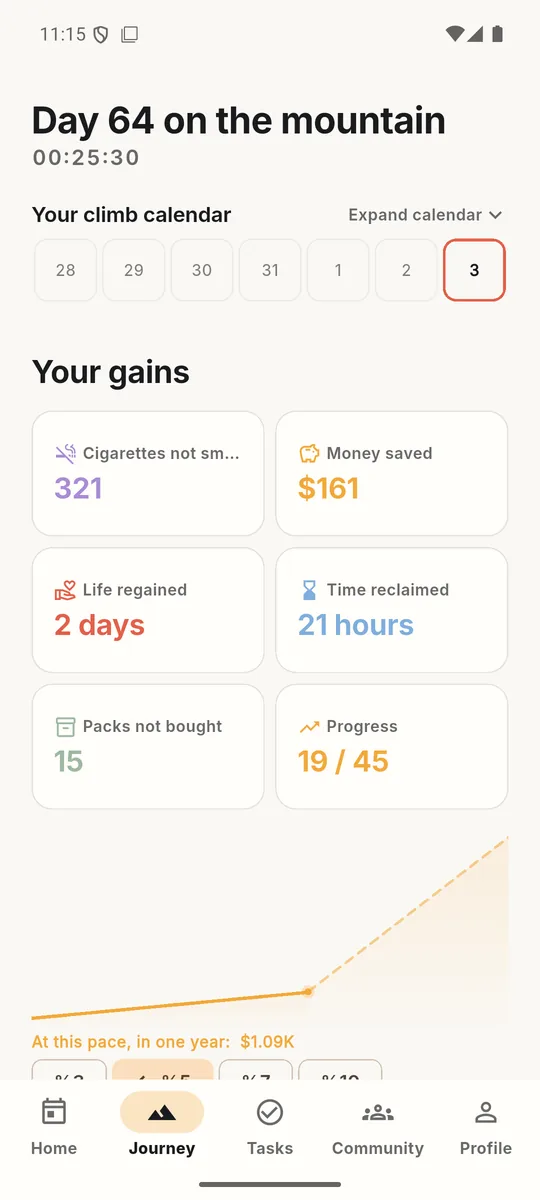
Your gains day by day: cigarettes not smoked, money saved, life reclaimed.
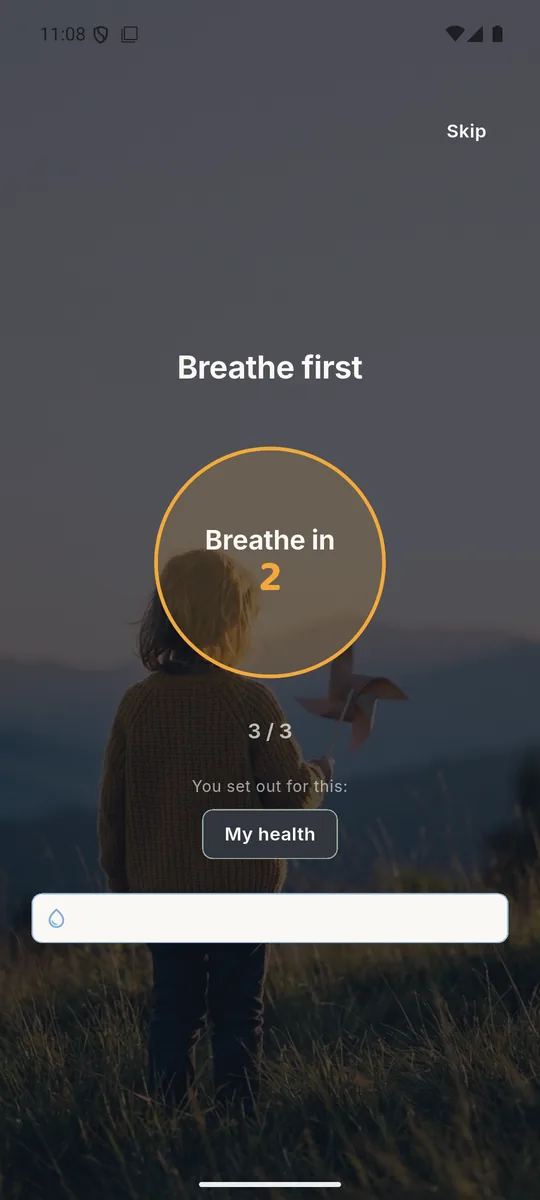
One tap when a craving hits: breathe first. A three-round guided breathing exercise.
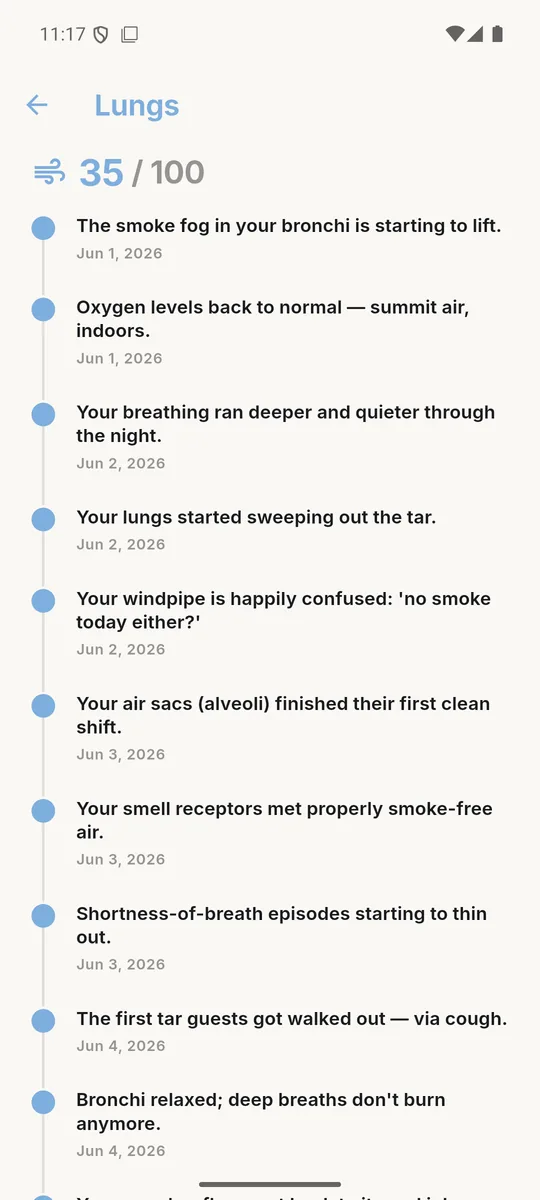
Six routes, 600 stops. Whatever is repairing in your body, you read it there.

You choose the view you are climbing — summit, forest, sea, or your own photo.
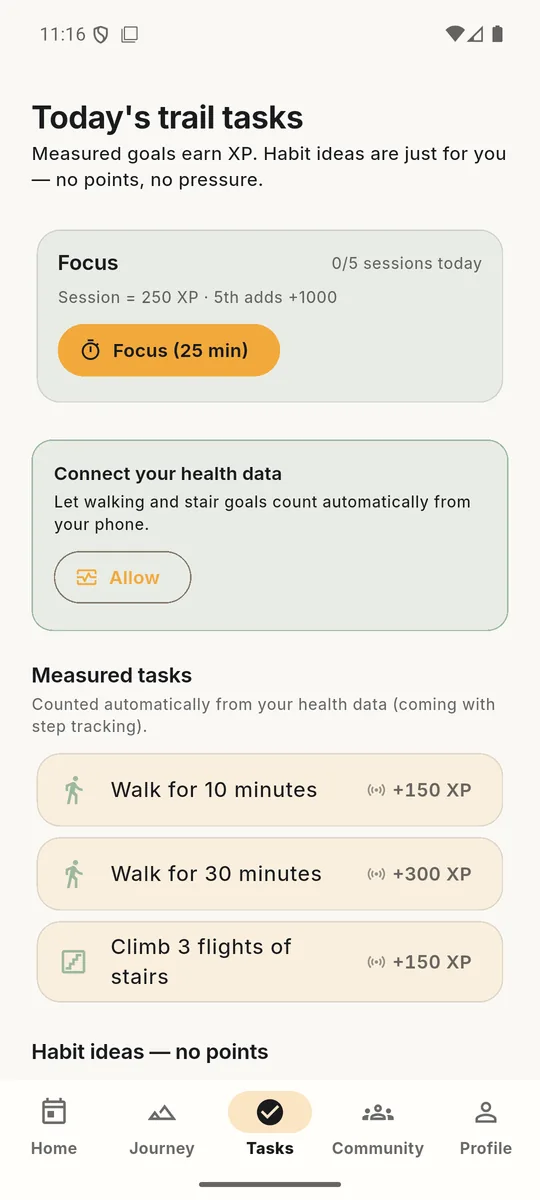
Small tasks every day. You are building a habit, not willpower.
Real screens from the app.
- Hear your own voice when a craving hits — the reason you quit, in your own words. You can add the voices of people you love, too.
- One tap for guided breathing and a distracting task — enough to fill those four minutes.
- 600 stops across six routes: read exactly what is repairing in your body today.
- Your numbers live on your device and keep counting offline — even on a plane.
- You pick the view you are climbing: summit, forest, sea, or your own photo.
- Interface, content and notifications in 14 languages.
You start free. The first day of the journey and the last are both yours.