Quit smoking cold turkey or cut down first? What the research actually shows
July 29, 2026·8 min read
Should you quit smoking all at once or by cutting down gradually? A 700-person study compared both. Here’s what worked better and why.
Most people who decide to quit end up in the same dilemma: quit in one go, or cut down slowly?
On paper, cutting down sounds nicer. Gentler, smarter, less of a shock.
The data tells a different story.
Is quitting cold turkey actually more effective than cutting down?
This isn’t just a debate over coffee; it’s been tested.
In 2016, a study in the Annals of Internal Medicine randomly assigned about 700 people to two groups. One group picked a quit date and stopped all at once. The other group gradually cut down over two weeks, then quit on a set date. Both groups got the same level of support and the same nicotine replacement treatment.
After four weeks, here’s what happened:
Quit all at once: 49% smoke‑free
Cut down first: 39% smoke‑free
At six months, the gap was still there: 22% vs 15%.
So quitting in one go clearly came out ahead of gradual reduction.
Two details matter when you look at these numbers. First, both groups received support — so the difference isn’t “help vs no help,” it’s only the method. Second, the gradual group didn’t crash and burn; 39% still quit. So this isn’t “cutting down doesn’t work.” It’s “it works, just less often.”
That extra ten percentage points means ten more people out of every hundred are still smoking a year later.
What’s going on behind these numbers?
The study tells us which method did better, not why. For the “why,” it helps to look at three mechanisms — all three run mostly outside conscious willpower.
First, a distinction that clears up a lot of confusion:
Cutting down is a behavior. Quitting is a threshold.
When you cut down, your daily pattern shifts bit by bit, but that threshold — zero cigarettes — never gets crossed. With a single‑day quit, the behavior flips in one step and the threshold is crossed on day one.
Your body’s repair timeline also starts after that threshold, at zero. It doesn’t kick in just because you’re cutting back.
So why do most people prefer to cut down?
In the same study, one of the most interesting findings was this: at the start, when people were asked which method they wanted, most picked gradual reduction.
Our gut feeling points one way; the results point the other. The reason is pretty understandable.
Cutting down softens the feeling of loss. Going from “I smoke” to “I don’t smoke at all” can look like a giant empty space. Dropping “just two a day” feels manageable.
It also makes a perfect cover for delay. You can tell yourself “I’m cutting down” and keep smoking for months while feeling like you’re “in the process.” The same trap shows up in the sentence “I really should quit someday.”
Why does cutting down get harder over time?
There are three concrete reasons:
1. The remaining cigarettes become more “precious.” If you go from 20 a day down to 5, those five cigarettes start to feel like gold. Letting go of them is often harder than letting go of the 20.
2. Your body compensates. When the number of cigarettes drops, people unconsciously inhale deeper and longer. Measurements back this up: even when the number of cigarettes per day is cut in half, levels of nicotine and carbon monoxide in the blood don’t fall by the same proportion.
3. Withdrawal drags on. With a one‑step quit, withdrawal is sharp but short: it peaks around day 2–3, and most of it eases within 2–4 weeks.
With gradual reduction, you can end up with a mild, nagging withdrawal that lasts for weeks. Not a short, steep climb — more like an endless uphill.
Is cutting down ever useful?
Writing it off completely would be unfair. In some situations it makes sense:
For someone smoking 40+ a day, jumping straight to zero can be a big shock; cutting down by half over a week and then quitting on a date can be a reasonable bridge.
For someone who has already tried quitting abruptly and found it very tough, trying a different route can be sensible.
Planned reduction with medical guidance plus medication or nicotine replacement is a different scenario again.
⚠️ The key is this: cutting down should be a bridge, not a lifestyle. A bridge needs another side — a quit date — and that date shouldn’t be more than about two weeks away. We’ve broken down how to choose that date in a separate piece.
If you’re going to build a bridge, these three rules matter:
Write the end date first.
The date comes before the cutting down, not after. Cutting down without a date isn’t a bridge, it’s a pier that goes nowhere.
Cut down by time, not by total number.
If you just say “I’ll smoke two fewer a day,” you leave it to the moment to decide which two to skip — and in the moment, you always sacrifice the easiest ones. When you lengthen the time between cigarettes, the timing makes the decision, not your current craving. We go into the method in detail in another article.
Don’t save the hardest cigarettes for last.
Most people hang on to their “first cigarette of the morning” until the very end — but that one is usually the most reinforcing. Dropping that morning cigarette from day one is the single most effective move that bridge can offer.
“I’m down to 3 a day. That’s a win… right?”
Partly. Just not as big a win as it feels — mainly because of that compensation effect above.
Also, risk doesn’t fall in a straight line with cigarette count. Even a few cigarettes a day carry more cardiovascular risk than most people expect. The idea that “three a day is basically harmless” feels reasonable, but the data doesn’t support it.
The issue is the shape of the curve: harm shoots up quickly with the first few cigarettes, then flattens. So going from 20 to 10 doesn’t cut your risk in half — it cuts it by a lot less. Going from 3 to 0, on the other hand, buys you more benefit than you’d guess.
Our intuition imagines a straight line; the real curve bends.
The “gain curve” gets steep near zero. Your body’s repair timeline starts once you hit zero, not while you’re just cutting back. Dropping the last three cigarettes is less work than dropping the first seventeen — but it brings more benefit. Reversing that order is exactly where the cost shows up.
“If I start by cutting down, can I still quit in one go later?”
Yes — and in real life, this often turns out to be the most workable path.
The order is what matters: cutting down is preparation, quitting is crossing the line.
So that reduction period exists to weaken the smoking pattern while you wait for your quit date; it’s not a substitute for the date itself. During that time, you go through your pre‑quit checklist: you untangle your triggers, clear your home, and write down your plan.
When you set it up that way, cutting down doesn’t carry the same disadvantages seen in the study, because it’s no longer “quitting by cutting down.” It becomes “getting ready to quit in one step.” It looks like a small change in wording, but on the calendar it’s a completely different setup.
How do you decide?
Ask yourself one question: am I using cutting down as a plan, or as a delay?
You know the answer. The test is simple: does your “cutting down” have an end date? If yes, it’s a plan. If not, it’s postponement.
There’s a second test, a bit harsher: when did you start cutting down? If the answer is “three months ago” and your daily number is still in the same ballpark, that reduction has turned from a method into a habit. Three months is longer than any realistic step‑down plan needs.
One more piece: whichever route you choose, getting support improves the odds, and that’s a separate decision from method. Nicotine patches, gum, or a behavioral support line help both cold‑turkey quitters and gradual reducers. “Going it alone on willpower” isn’t really a method — it’s just not using tools that are available to you.
And another: quitting in one go isn’t about being “strong‑willed.” Understanding why the first 72 hours feel so intense lets you avoid dumping those days on willpower alone — because you already know what’s coming.
The data points toward quitting all at once.
But the data doesn’t quit for you. You do.
Pick a date — within the next two weeks — and use the days until then to get ready. Your first climb starts there.
Whichever method you lean toward, plug your date into the counter on the right; it’ll show you what’s changing from day one. And if you want something in your pocket for the rough minutes, the Tar2Star app was built exactly for those moments, with breathing exercises and quick tasks to carry you through one craving at a time.
This page is a photo. The app is the film.
These numbers show today. Tar2Star shows you a new one every morning — and stays with you when a craving hits.
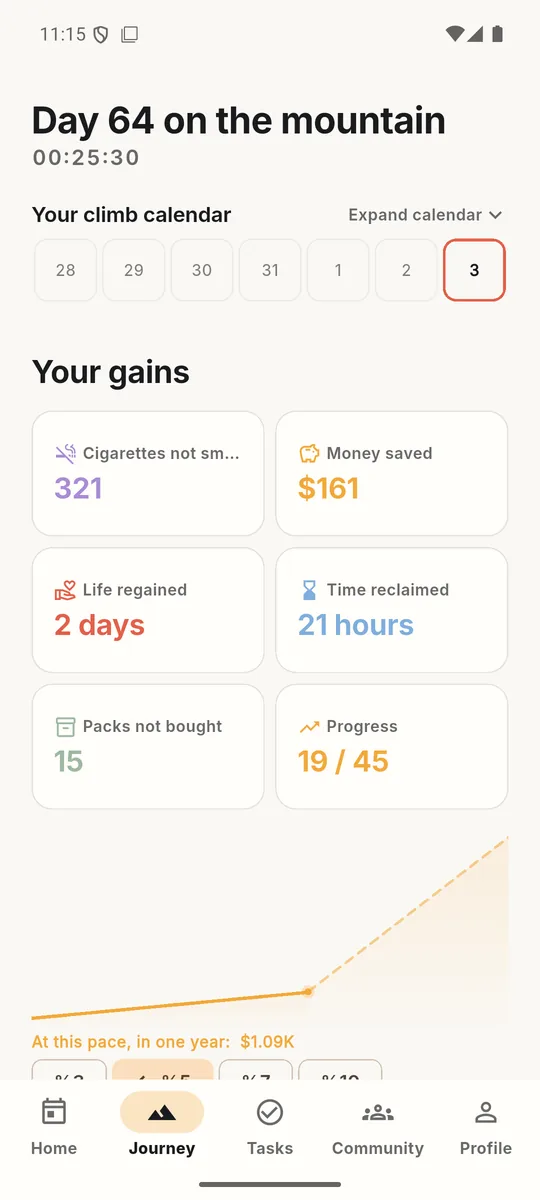
Your gains day by day: cigarettes not smoked, money saved, life reclaimed.
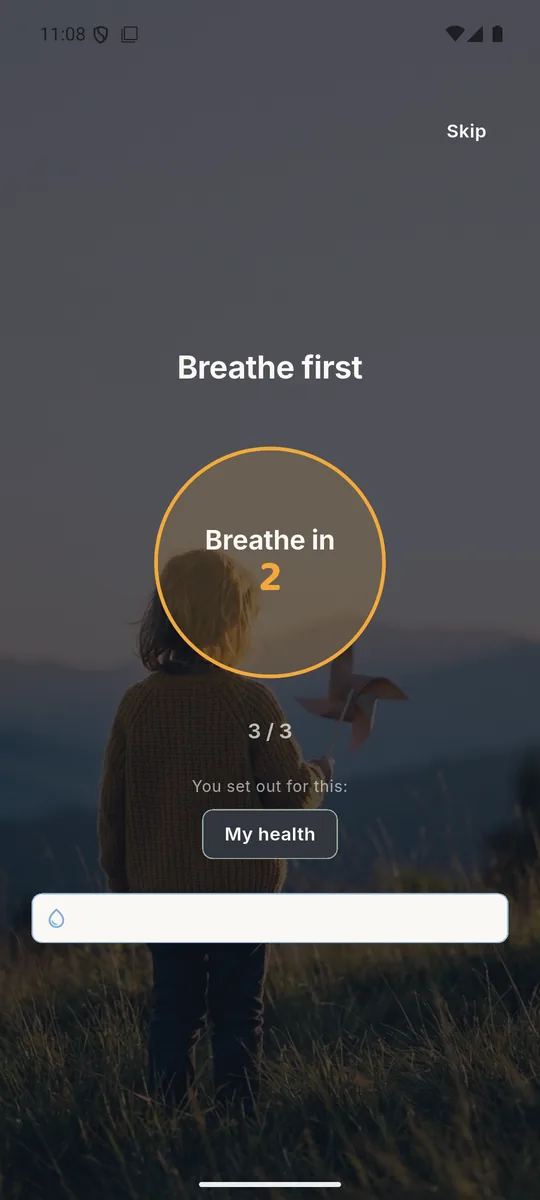
One tap when a craving hits: breathe first. A three-round guided breathing exercise.
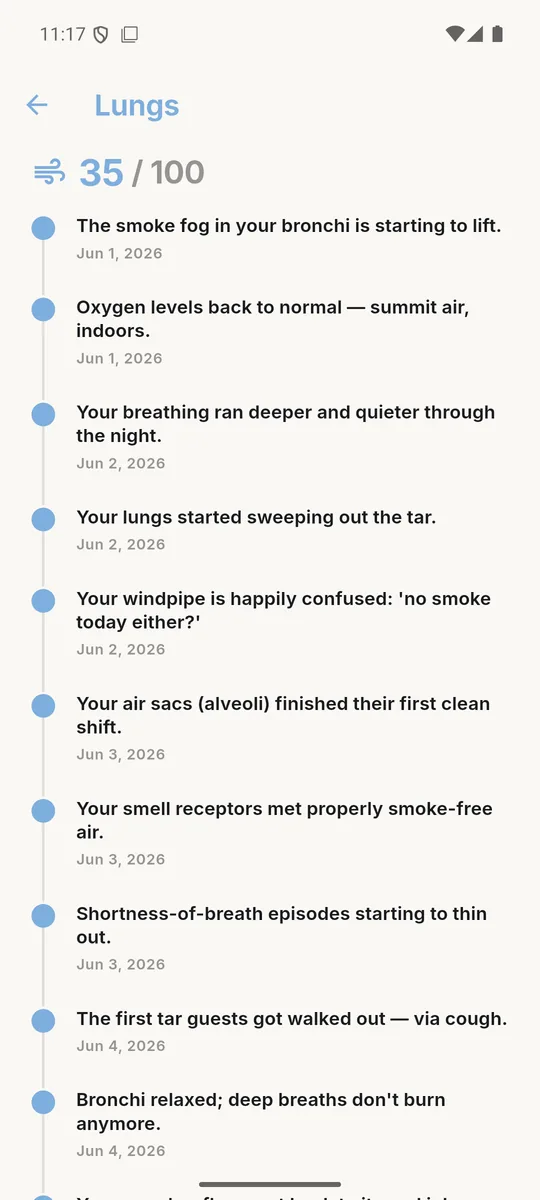
Six routes, 600 stops. Whatever is repairing in your body, you read it there.

You choose the view you are climbing — summit, forest, sea, or your own photo.
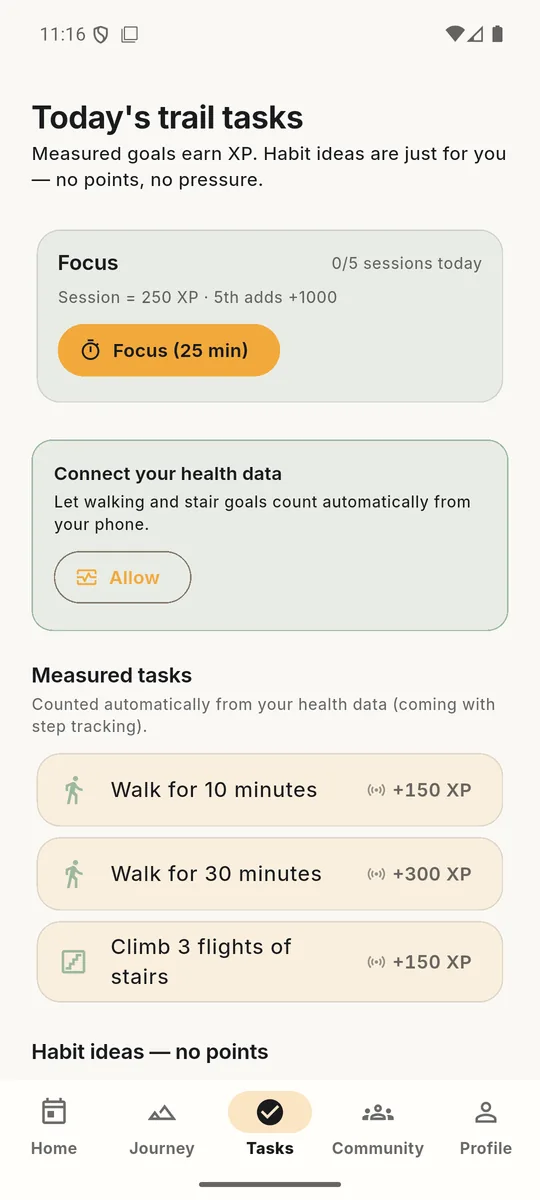
Small tasks every day. You are building a habit, not willpower.
Real screens from the app.
- Hear your own voice when a craving hits — the reason you quit, in your own words. You can add the voices of people you love, too.
- One tap for guided breathing and a distracting task — enough to fill those four minutes.
- 600 stops across six routes: read exactly what is repairing in your body today.
- Your numbers live on your device and keep counting offline — even on a plane.
- You pick the view you are climbing: summit, forest, sea, or your own photo.
- Interface, content and notifications in 14 languages.
You start free. The first day of the journey and the last are both yours.