How to find a reason to quit smoking that actually works
July 29, 2026·7 min read
“For my health” is true but often not enough to quit smoking. Here’s how to find a reason that works at 3 p.m. when the craving hits.
"I'm going to quit for my health" is what most people say.
And most of them don’t quit.
The sentence is correct. Medically flawless. And that’s exactly why it often doesn’t work.
A good reason and a useful reason are not the same thing — seeing the difference is one of the cheapest wins on this climb.
Why “I’ll quit for my health” usually isn’t enough
Everyone’s list looks the same: health, money, smell, kids.
All four are real. And all four share one flaw: they live in the future.
Health, ten years from now. Money, at the end of the year. Smell, in someone else’s nose. Kids, when they grow up one day.
The cigarette is now. In your hand. Something you can light in three minutes. That’s not a fair fight.
In this bargain, your mind keeps picking the same side. In behavioral science this is called delay discounting: the human brain systematically overvalues rewards that are close in time, compared with those that are far away. It’s not a character flaw; it’s a built‑in mechanism — and nicotine is very good at using that mechanism.
So the problem isn’t that you “lack willpower”. The problem is that you’re trying to beat a very present habit with a very distant reason.
You can test this with a quick experiment. Say your reason out loud, then ask yourself one question: will this reason pop into my head today at 3 p.m., when I’m bored and my fingers want a cigarette? If the answer is “no”, your reason isn’t wrong — it just doesn’t clock in on the right shift.
Why a good reason and a working reason are different
A good reason is the one people nod at when you say it out loud. A working reason is the one you usually don’t tell anyone.
What you say in the doctor’s office and what you tell yourself alone at midnight are not the same sentence. The first is a defense. The second is a reason. And when you’re in trouble, it’s the second one that stays in the room.
Nietzsche wrote this long before cigarettes came along:
“He who has a why to live for can bear almost any how.” (Hat man sein Warum? des Lebens, so verträgt man sich fast mit jedem Wie? — Friedrich Nietzsche, Twilight of the Idols, 1889)
Here’s the subtle part: the sentence doesn’t say “a good why”. It just says “a why”. Your why. The kind that doesn’t need anyone’s approval, doesn’t sound impressive, might even feel a bit small.
So what does that “small” reason usually look like?
The real reason you quit is usually much smaller
When people manage to stick with quitting, the story they tell afterwards is rarely just “health”. It’s usually something smaller and much more concrete:
Having to stop on the third floor of the stairs. And that one even has a calendar attached: your circulation and lung function start to improve within 2–12 weeks (WHO) — which means that third floor stops being a problem in less than a month. (We break down when your fitness starts to come back in the Body stage.)
Your kid slightly scrunching up their face when they hug you.
Spending the first fifteen minutes of the morning coughing.
Walking to the store in the rain at midnight just to buy a pack.
These look small. But they share one thing: they’re happening today. And something that happens today can actually compete with something that might happen ten years from now. That rainy walk at midnight does what no health statistic can do: it makes you stop and think in the moment.
Small reasons have a second advantage: you can check them.
You can’t verify “I’m not going to get cancer” for the next thirty years. But you can test “I don’t have to stop on the third floor anymore” three weeks from now on the stairs — and when it turns out to be true, your reason starts feeding itself.
That’s why, when you’re looking for a reason, you don’t look up, you look down. You’re not hunting for a sentence that will “change your life”. You’re looking for one that will change this week.
An exercise to find your reason: three questions
This is an exercise we genuinely encourage you to do — just reading it won’t do much.
Three questions:
What was the smallest moment of shame you had because of smoking in the last month? Not the big one — the small one. The moment nobody else noticed.
On a day without cigarettes, what would you notice the most? Your breath in the morning, the extra money, or just not having something in your hand?
*Who would you not tell if you quit?* This one tells you who the reason belongs to. If the answer is “no one”, the reason is probably really yours.
Write your answers down. On your phone, on a scrap of paper, doesn’t matter — as long as it’s somewhere you can see. Tomorrow morning, when the first craving hits, you’re going to look at it. (In the Mind stage we explain why a craving usually fades in about four minutes.)
Why writing your reason down changes so much
Because in a crisis it changes whose side your memory is on.
When a craving hits, your mind doesn’t “forget” your reason — it reframes it. “Today was already hard.” “One won’t make a difference.” “I’ll start again tomorrow.” These aren’t exactly lies; they’re negotiations. And if there’s nobody on the other side of the table, those negotiations always win.
A written sentence puts a second party at that table: you, in your own handwriting, in your own words, from two hours ago. Reading it won’t magically erase the urge — but it stops the urge from quietly winning by default.
There’s also this: a craving typically lasts three to five minutes. Reading one short sentence takes ten seconds. Even if your written reason only filled the first ten seconds of those three minutes, it would already be doing its job.
What if your reason changes over time?
It will. That’s not a problem; it’s actually a healthy sign.
In the first week, your reason is usually defensive: “I don’t want to feel this bad anymore.”
By the end of the first month, it shifts toward something you can measure: “The stairs aren’t a problem now.”
By month six, most people don’t really have an active “reason” anymore, because there’s nothing to justify — nobody wakes up thinking, “Why am I brushing my teeth today?”
So your reason isn’t fuel; it’s an anchor. You mainly need it at the start of the climb.
When is the “right time” to quit smoking?
There’s only one honest answer: there is no perfect time.
“When work calms down.” “After exams.” “Once the move is over.” “After vacation.” Everyone who waits for “the right moment” is usually still waiting. Life doesn’t produce a stress‑free window for quitting; every season comes with its own stuff. There is no calm period — there’s just stress that hasn’t started yet.
It also helps to know this: the hardest part of quitting usually lasts about 72 hours. Most of the nicotine leaves your body in that window (CDC). So the “right time” you’re imagining is really a three‑day stretch — and in the First Climb stage we walk through those days one by one.
Is there any week in your calendar that doesn’t have three days?
Quitting isn’t a single day — it’s a direction
One last thing, and it might be the most important.
If you picture quitting as “a single moment”, then missing that moment feels like the end. You smoke one cigarette and think, “It’s ruined, what’s the point.”
But quitting is a direction. Going backwards for one day doesn’t flip the direction — it just means you went backwards that day. The next morning you can face the same way again.
That’s why, on this route, there’s really no such thing as “I failed”. There’s just a path you’re still on. (In the later stages we talk about why a slip is not an ending, but data you can use.)
Have you found your reason?
Write it down and put it somewhere you’ll see it.
You’ll need it tomorrow morning — because tomorrow the **first climb** begins.
If you’re wondering why we’re on this journey at all and what we’re trying to do here, we told that story in the very first post.
There’s one more way not to lose track of your reason: put your quit date into the counter on the right and see what you gain each day. And if you want to keep the same tracking in your pocket, the Tar2Star app was built exactly for that.
This page is a photo. The app is the film.
These numbers show today. Tar2Star shows you a new one every morning — and stays with you when a craving hits.
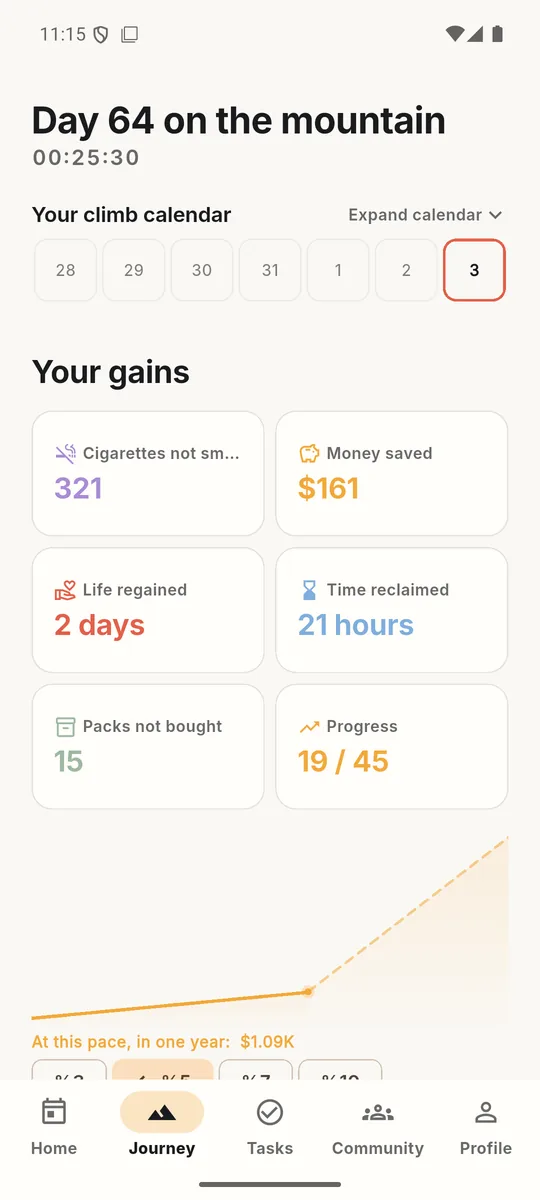
Your gains day by day: cigarettes not smoked, money saved, life reclaimed.
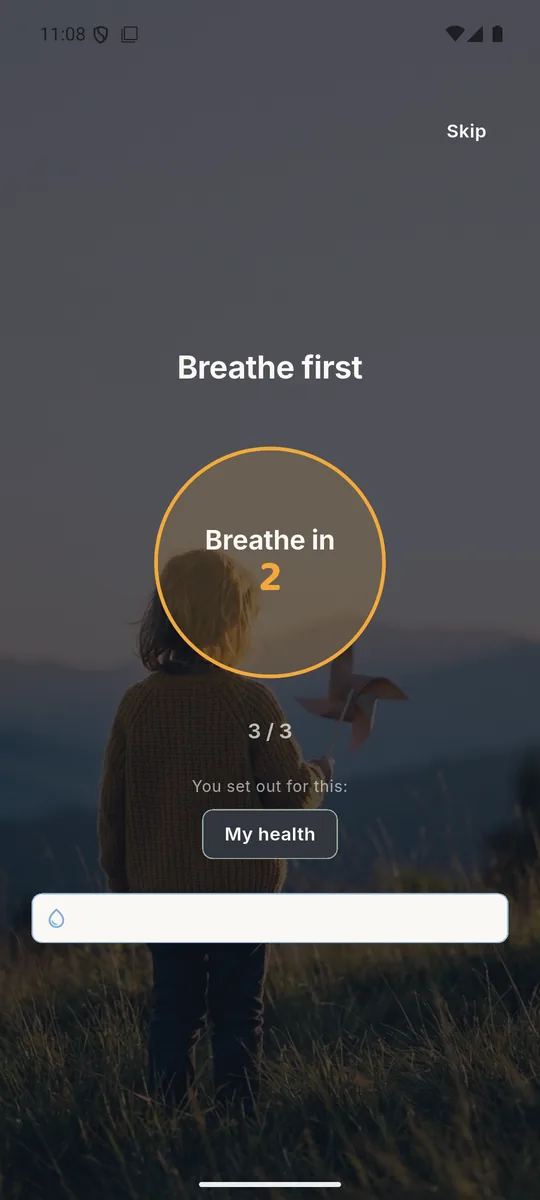
One tap when a craving hits: breathe first. A three-round guided breathing exercise.
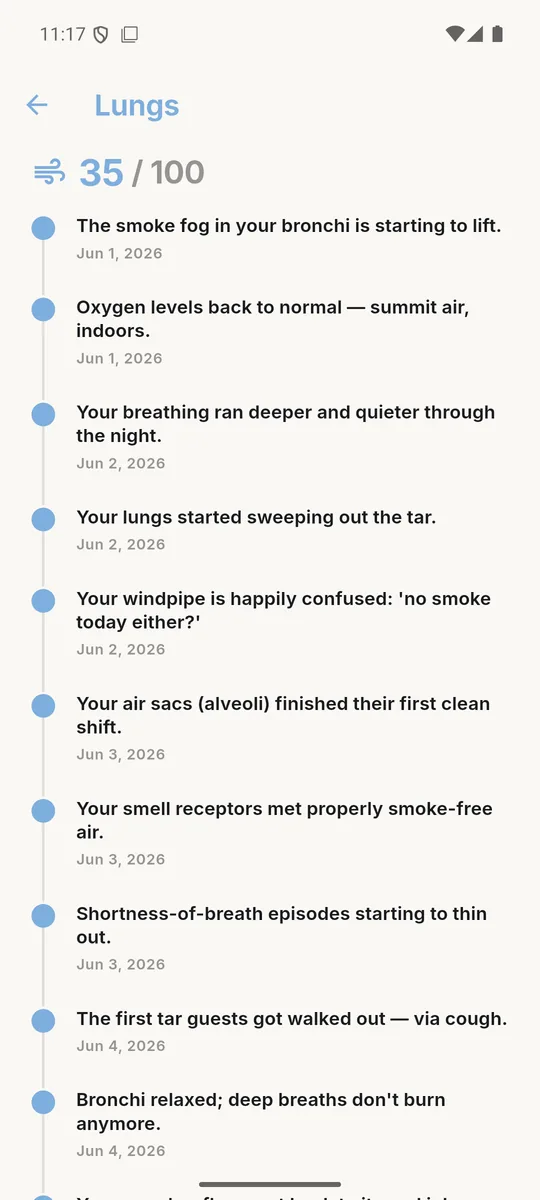
Six routes, 600 stops. Whatever is repairing in your body, you read it there.

You choose the view you are climbing — summit, forest, sea, or your own photo.
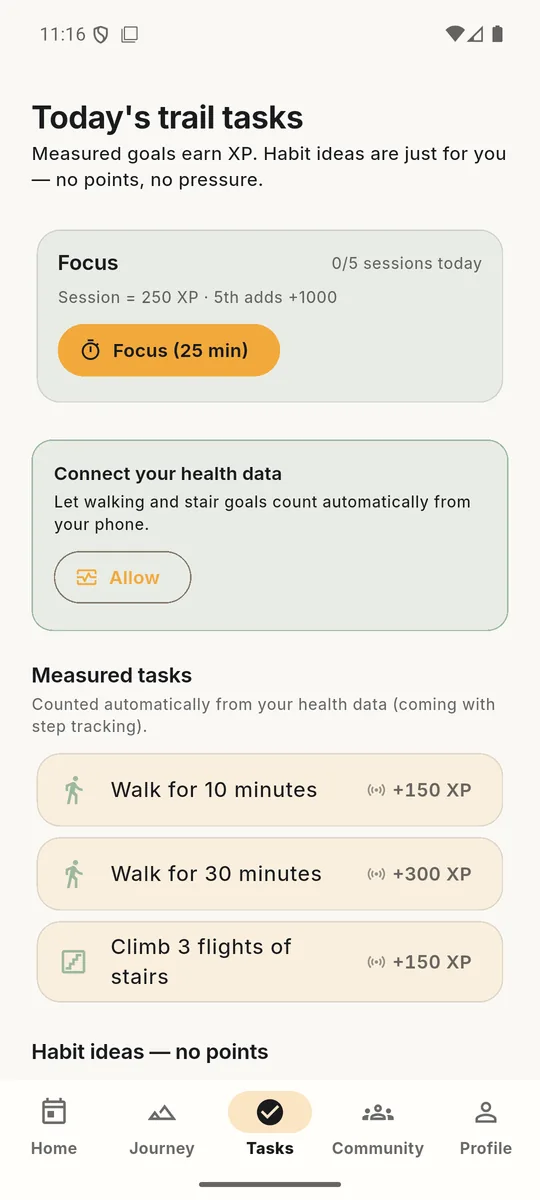
Small tasks every day. You are building a habit, not willpower.
Real screens from the app.
- Hear your own voice when a craving hits — the reason you quit, in your own words. You can add the voices of people you love, too.
- One tap for guided breathing and a distracting task — enough to fill those four minutes.
- 600 stops across six routes: read exactly what is repairing in your body today.
- Your numbers live on your device and keep counting offline — even on a plane.
- You pick the view you are climbing: summit, forest, sea, or your own photo.
- Interface, content and notifications in 14 languages.
You start free. The first day of the journey and the last are both yours.