Design a ritual for your quit day
July 30, 2026·7 min read
Don’t glorify your last cigarette; mark your first smoke‑free day. A simple 15‑minute quit‑day ritual can lock in your decision when cravings hit.
This will sound like a contradiction, so let’s clear it up right away.
You *don’t* want a big ceremony for your **last cigarette** — that only makes the cigarette special and turns it into a memory. And memories can be more convincing than nicotine.
But a small ritual for your quit day itself is different. There, what you’re highlighting isn’t the cigarette. It’s the decision.
Why a ritual works
Rituals in human life do one main job: they split time into a "before" and an "after".
Your quit day needs to do exactly that. If it doesn’t, then “I quit today” just gets lost inside a day that looks like every other day.
A useful ritual does three things:
Marks the time. There’s a clear line: before and after.
Includes a physical action. Not just a thought, but movement.
Leaves a trace. Something you can come back to later.
The third part is the one most people skip — and the one that helps the most.
Reason: memory. In week two, when the “Why did I even quit?” thought shows up, you don’t remember how you felt that day — you only feel today’s discomfort. Three lines you wrote down that morning are often the only thing that balances that uneven scale.
Ritual is not the same as celebration
This is where things get mixed up, and when they do, the ritual can backfire.
A celebration salutes a result: one week smoke‑free, one month smoke‑free. It looks back.
A ritual marks a threshold: from today on, things are different. It looks forward.
On your quit day you need the second one. The first one will have its turn later — and by then the first thing you do with the money you’ve saved becomes a very natural way to celebrate.
⚠️ The most common mix‑up is treating day one like a big victory party. Day one isn’t an achievement, it’s a starting line. If you celebrate it like a finish line, day two can feel like a drop‑off.
A three‑step design
This doesn’t have to be complicated. These three are enough:
1. A throwing‑away move. Pack, lighter, ashtrays — put them in a bag and take them out of your space. We wrote separately about why this isn’t just symbolic: the distance between you and those objects is what protects your decision.
2. A starting move. Set the date in your counter, mark your calendar, sign your agreement. The quit agreement gives you a ready‑made form for this step.
3. A record. Three lines on paper: today’s date, your reason, and how you feel in this moment. You’ll read it a week later and it will matter a lot. Your quit journal starts with that line.
Total time: about fifteen minutes.
The order isn’t random either. Throwing away comes first because it’s the hardest; if you postpone it, you’ll keep postponing it all day. Starting comes second because once the first step is done, you need to put something concrete in its place — an empty space tends to create unease. Recording is last, because there’s nothing real to write until the first two are done.
⚠️ The most common reversal: writing first, and pushing the throwing‑away part to “this evening”. If the pack is still in the house that night, the ritual doesn’t count — because the ritual’s job isn’t to make a decision, it’s to make that decision hard to take back.
When to do it
Within the first hour of your quit day. In the first‑hour plan, it already has a slot: wake up, drink water, tweak your usual breakfast routine, read your anchor sentence, start your counter.
The ritual fits inside that plan; it doesn’t need a separate day or a special time.
What not to do
There are three things to avoid. They’re very common — and they tend to backfire.
Making the last cigarette special. Keeping the butt, taking a photo, “saying goodbye”. We wrote separately about why this backfires.
A big public announcement. Posting a dramatic declaration on social media, making a show of it. Praise comes in week one, difficulty comes in week two — and when the applause is gone, if you don’t have your own reason, there’s a gap. The question of who to tell needs its own space.
Inflating the date. Waiting for a “meaningful” day like New Year’s to quit. That isn’t ritual, that’s postponing. And when that day is missed, the quit date gets pushed to the next meaningful date.
⚠️ The most common form of the “special date” trap: birthdays, New Year’s, the first of the month. They look harmless, but they’re the most respectable mask for delay.
Part two of the ritual: the end‑of‑week check‑in
This is the thing almost nobody does, but it helps.
At the end of your first week, go back to the note from your ritual. Read those three lines and add a new one underneath: what has changed in your body over this week?
That way, your reason shifts from external to internal — and the sentence you write after a week is usually tougher and more grounded than the sentence from day one.
You repeat the same check‑in once more at the end of month one. You end up with three lines: day one, week one, month one. Reading the three together is one of the clearest forms of progress — because the difference is there in your own handwriting.
Things that don’t count as a ritual
This part is for the “I already did something like that” group — when in fact, they didn’t.
Finishing the pack. Smoking the rest of what you have isn’t a ritual, it’s a form of delay. If the end time is set by the pack, the decision isn’t really yours.
Stashing the pack. Keeping a pack “just in case” in a drawer means your decision is up for negotiation every single day. We wrote separately about why throwing out ashtrays is about creating distance; the same logic applies to the pack.
Promising someone else. That’s not a ritual, it’s a promise — and it creates a decision that doesn’t fully belong to you.
The common thread: none of these mark time. A ritual works when it draws a line; if there’s no line, it’s just an intention.
With a partner or family
If you’re quitting together with someone, doing the ritual together often helps: same bag, same date, same record.
If you have kids, they can have a small role — carrying the bag to the door, for example. One caution though: don’t turn your child into a guard. Joining the ritual is support, not supervision.
⚠️ If someone in the house keeps smoking, the ritual can feel half‑done: the ashtray goes to the trash, but a new one appears the next day. In that case, limit the ritual to your own zone — your pack, your lighter, your car — and talk separately about a basic house rule. We wrote more about why smoking at home isn’t fixed by “just opening a window”.
If the ritual gets pushed
This happens a lot and it’s where many people feel their whole plan collapse.
You wake up, the day hits harder than expected, the ritual doesn’t happen, and by evening the thought appears: “Didn’t work today. I’ll start next Monday.” Then a week goes, then two.
The way out is to shrink the ritual: do only the first step. Throw the pack away. The rest can happen that evening, or the next day. The ritual is there to help you — when it turns into a condition, it becomes a fresh excuse to postpone.
⚠️ The key test: the ritual doesn’t pick the date; the date picks the ritual. If that order flips, the ritual has stopped being a helper and turned into an obstacle.
Skip the ceremony for your last cigarette; put it into the first hour of your quit day instead.
Today’s only task: add these three steps (throw away, start, record) into tomorrow morning’s plan.
If you want to set up the second step now, enter your date in the counter on the right — on ritual morning you’ll only need to hit “start”. For tough minutes and craving spikes, the Tar2Star app is built exactly for those moments.
This page is a photo. The app is the film.
These numbers show today. Tar2Star shows you a new one every morning — and stays with you when a craving hits.
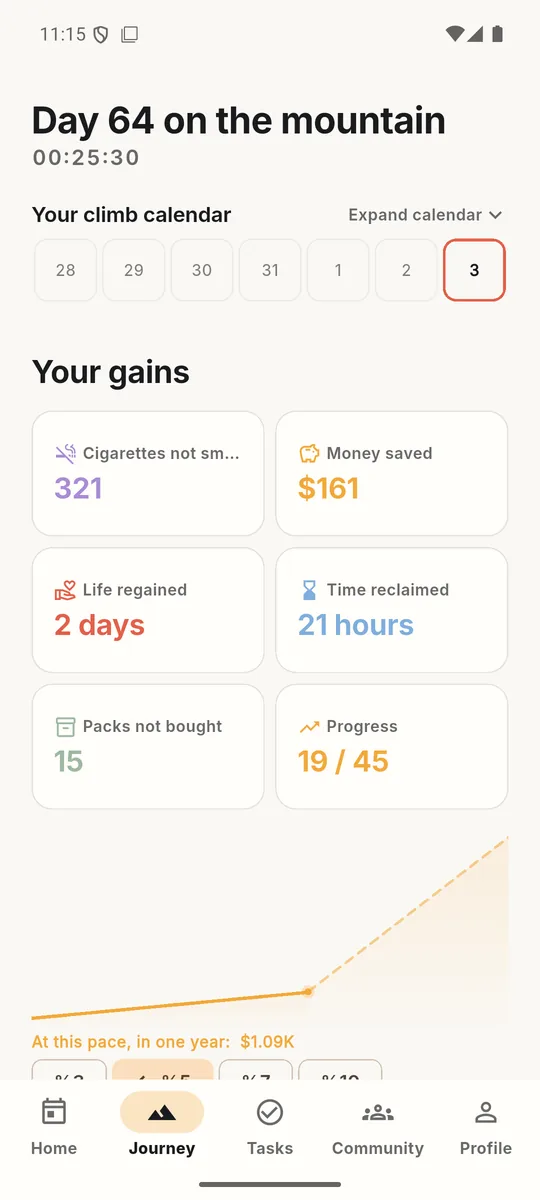
Your gains day by day: cigarettes not smoked, money saved, life reclaimed.
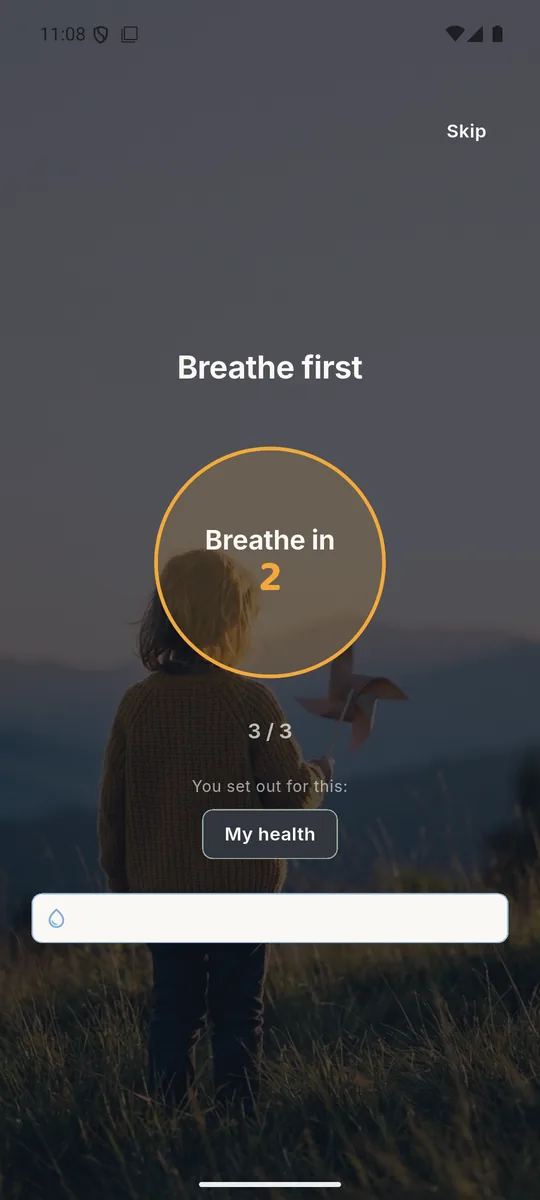
One tap when a craving hits: breathe first. A three-round guided breathing exercise.
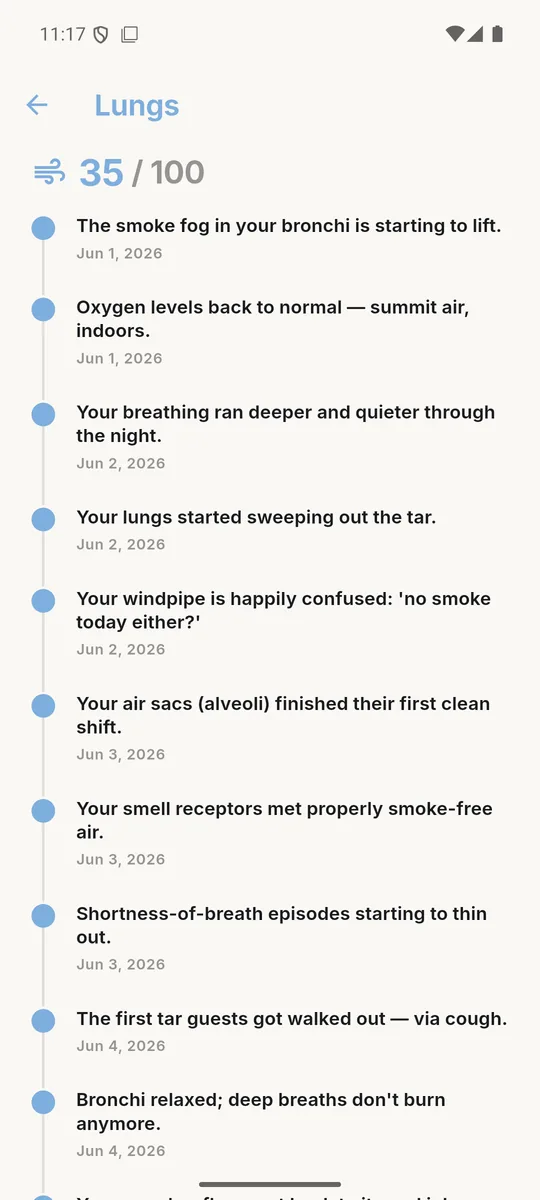
Six routes, 600 stops. Whatever is repairing in your body, you read it there.

You choose the view you are climbing — summit, forest, sea, or your own photo.
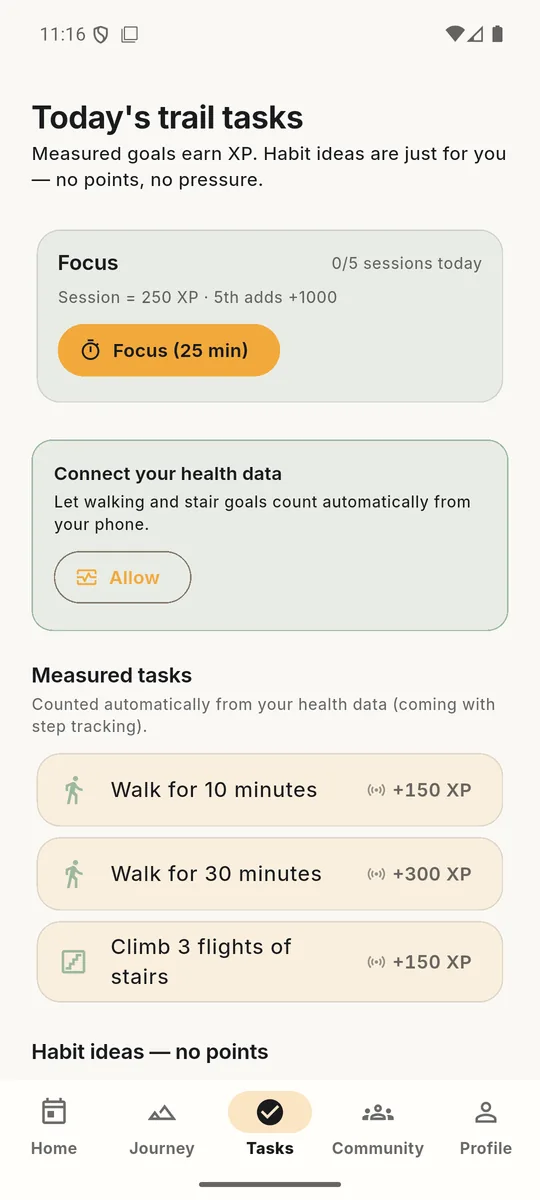
Small tasks every day. You are building a habit, not willpower.
Real screens from the app.
- Hear your own voice when a craving hits — the reason you quit, in your own words. You can add the voices of people you love, too.
- One tap for guided breathing and a distracting task — enough to fill those four minutes.
- 600 stops across six routes: read exactly what is repairing in your body today.
- Your numbers live on your device and keep counting offline — even on a plane.
- You pick the view you are climbing: summit, forest, sea, or your own photo.
- Interface, content and notifications in 14 languages.
You start free. The first day of the journey and the last are both yours.