Smoking and your heart: the first wins after you quit
July 30, 2026·7 min read
When you quit smoking, your heart improves before your lungs do. See what changes after 20 minutes, 12 hours, weeks and years — and what you can feel.
Quitting shows up in your heart before it shows up in your lungs.
It feels counterintuitive, because smoke goes into your lungs. But what pushes on your heart isn’t the smoke sitting there — it’s what that smoke puts into your blood, and blood clears fast.
How does smoking affect the heart?
Four mechanisms — all measurable:
1. Less oxygen gets delivered. Carbon monoxide binds to hemoglobin more easily than oxygen does. Your blood still circulates, but it carries less oxygen. The heart is doing the same job on worse fuel.
2. Heart rate and blood pressure go up. Nicotine boosts adrenaline release; heart rate and blood pressure rise. The effect of a single cigarette can be measured within minutes.
3. The inner lining of blood vessels gets damaged. The inner layer (endothelium) normally helps blood flow smoothly. Smoking injures this surface and sets the stage for plaque buildup.
4. Blood clots more easily. Platelets become stickier. Most heart attacks and strokes start with a clot forming on top of an already narrowed vessel.
Put these four together and it’s clear why even low daily intake carries risk — in the “3 cigarettes a day” article we looked at why the risk curve is steepest close to zero.
What’s striking about all four: none of them actually happens inside the lungs. Smoke enters through the lungs, but the real action starts after it hits the bloodstream — and blood goes everywhere. That’s why smoking sits not only on lung disease lists, but right at the top of heart and blood vessel disease lists, too.
One cigarette: what you can measure in the heart
“Bad for you” is vague. It helps to see numbers.
After a single cigarette, nicotine reaches the bloodstream within minutes; heart rate climbs and blood pressure rises. This effect lasts about 20–30 minutes, then drifts down. For someone smoking twenty a day, that means the heart is running at higher revs for most of the waking day.
⚠️ The sneaky part is how normal it feels: when that level stays high all the time, it becomes your “baseline.” For many people who quit, part of the early “feeling calmer” is not just their mood — it’s their pulse.
When do things start to improve after quitting?
On the heart side, the timeline is one of the fastest in the body:
20 minutes: Heart rate and blood pressure start to drop.
12 hours: Carbon monoxide levels in the blood fall back to normal — oxygen-carrying capacity returns.
2 weeks – 3 months: Circulation improves; walking distance and stairs get noticeably easier.
1 year: The risk of coronary heart disease is reported to be clearly lower than if you had kept smoking — commonly quoted estimates put it at about half.
5–15 years: Stroke risk is reported to approach that of someone who never smoked.
This timeline is based on summaries from the World Health Organization and the CDC. We’ve put the full, hour‑by‑hour picture in a separate piece: what happens in your body the moment you quit.
Why the heart improves before the lungs
Because the damage looks different in each.
Most of the heart‑side changes are functional — what’s in your blood, how tight or relaxed your vessels are, how easily blood clots. Remove the trigger, and these can move back toward normal fairly quickly.
Some of the lung damage is structural — like destruction of the tiny air sacs. Structural damage doesn’t reverse; quitting mainly slows how fast it progresses.
We walk through this difference in more detail in “Does the damage ever reverse?”. The short version: the heart recovers, the lungs stop getting worse.
After a heart attack
In people who have already had a heart attack, quitting is counted among the most effective interventions available — on a level comparable with some medications.
The reason ties back to mechanism number four: most repeat events start with a clot, and smoking directly increases the blood’s tendency to clot.
⚠️ If you’re on heart medication, tell your doctor you’re quitting: smoking changes how some drugs act in the body and your dose may need adjusting. We cover this in more detail in the article on quitting at 60.
“Will my blood pressure spike when I quit?”
This comes up a lot, because the first days can feel tense and restless.
During withdrawal, short‑term swings can happen, but the overall direction is down: the constant nicotine‑driven stimulation stops. Each withdrawal symptom has a lifespan, and this phase is measured in weeks.
Weight gain worries sit in the same frame: for heart and blood vessels, the benefit of quitting is considered clearly larger than the impact of any weight gain over the first few months.
“I quit and now my heart is pounding” — is that normal?
Many people notice palpitations in the first days. It’s unnerving — and for some, it’s enough to pull them back to smoking.
The mechanism here points the other way: years of nicotine jolts with every cigarette suddenly stop, and your body wobbles a bit while it finds a new balance. There’s also a hidden player: caffeine. Smoking speeds up how fast your body clears caffeine. When you quit, the same coffee hits harder, and what you feel is “my heart is racing.”
⚠️ The practical takeaway is simple: cut your coffee/tea intake in half for the first two weeks. That one change can ease a chunk of the early restlessness and palpitations.
⚠️ Separate from that: chest pain, pain spreading into the arm or jaw, shortness of breath, or feeling like you might pass out are not withdrawal symptoms. If those show up, you don’t wait them out — you get emergency care.
When to start exercising
The answer is “today,” and not for motivational posters — for physiology.
In the first weeks, walking does two jobs at once: it cuts through urge waves (on average they last about four minutes, and a walk simply fills those four minutes) and it helps circulation improve faster.
The dose is modest: 20–30 minutes of brisk walking a day. No gym, no program, no equipment — just swapping a cigarette break for a walking break uses roughly the same slice of your day.
Women and birth control pills
This is important and rarely spelled out.
Smoking while taking a combined birth control pill needs its own risk discussion around clot‑related events — and that risk rises with age. That’s why guidelines treat this combination separately above certain ages.
⚠️ The one thing you shouldn’t do here is decide based on what you read online. Ask your clinician directly: “I smoke and I’m on this pill — is it appropriate for me?” The answer depends on your age, your overall picture, and the specific product you use.
You can track your pulse yourself
This is the most hands‑on part of the article, because heart‑side changes are measurable — and the measurement is free.
The day before your quit date, write down your resting pulse: one minute, in the morning, before you get out of bed. Then repeat the same measurement on day 3 after quitting, at week 2, and at one month.
For most people the number goes down — and that’s not a promise, it’s your own data. Having a number you measured yourself is one of the cheapest tools for shifting your reason from “out there” to “in here”.
You can do the same thing with stairs: today, note which floor you need to pause on. Check again three weeks later.
The first thing you actually feel
For a lot of people who quit, the first noticeable change isn’t breathing — it’s stamina: stairs, hills, carrying bags.
The reason is everything you’ve just read: your blood carries more oxygen and your heart works less hard to move it. That’s the kind of change that shows up in everyday life within two to three weeks.
There’s a rough order to what changes, and knowing it helps: first pulse (days), then stamina (weeks), then cough easing up (months). So if the first thing you notice isn’t about your lungs directly, that’s not a failure — that’s the timeline. The hour‑by‑hour breakdown is in a separate article.
The heart is the organ that answers quitting the fastest: changes start at 20 minutes, can be measured by 12 hours, and are felt within weeks.
The only decision for today is to pick a date. The first gains show up the same day.
If you want to see the hours ticking by from that date, and what’s changing as they pass, use the counter on the right. For tools built for those “crisis minutes,” the Tar2Star app is designed exactly for that window.
This page is a photo. The app is the film.
These numbers show today. Tar2Star shows you a new one every morning — and stays with you when a craving hits.
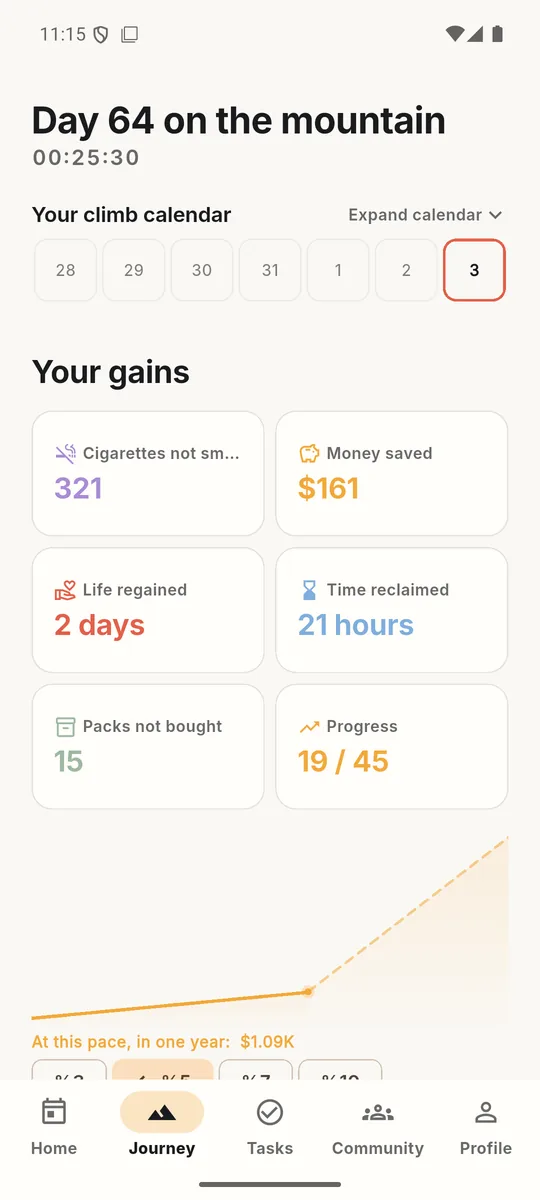
Your gains day by day: cigarettes not smoked, money saved, life reclaimed.
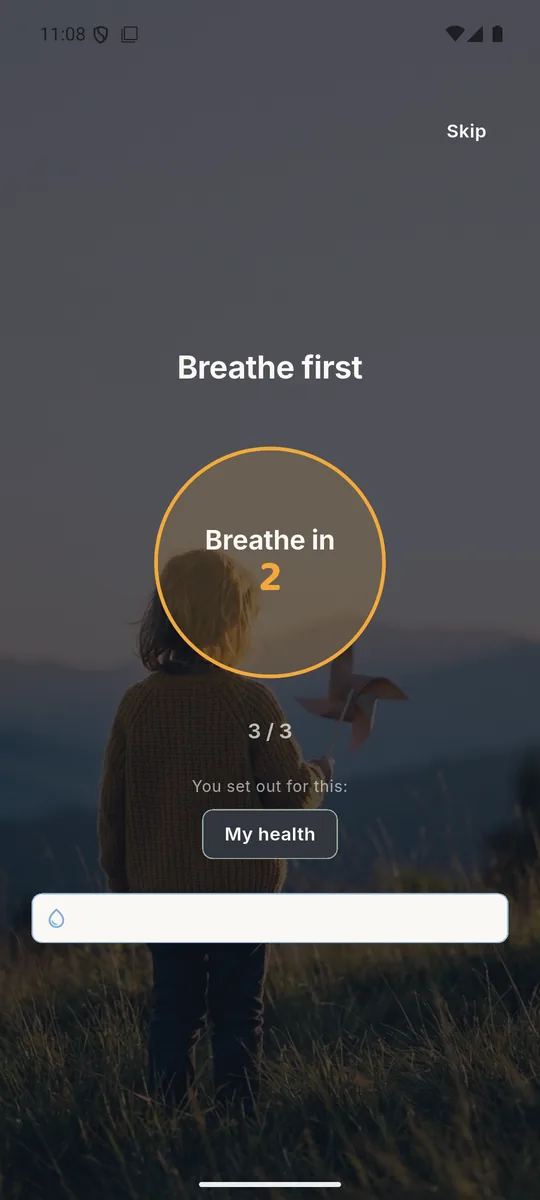
One tap when a craving hits: breathe first. A three-round guided breathing exercise.
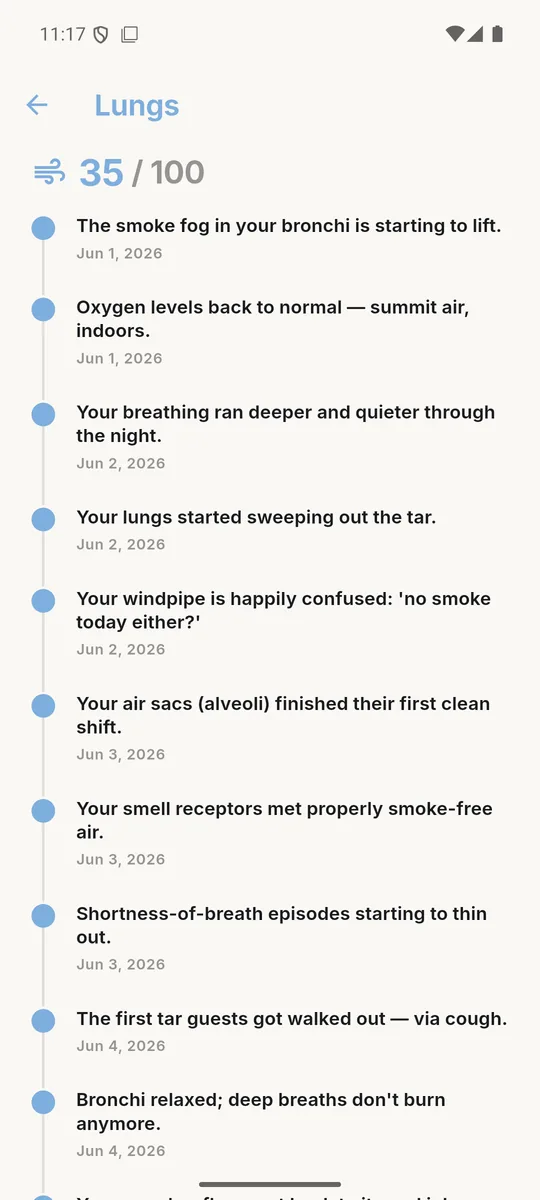
Six routes, 600 stops. Whatever is repairing in your body, you read it there.

You choose the view you are climbing — summit, forest, sea, or your own photo.
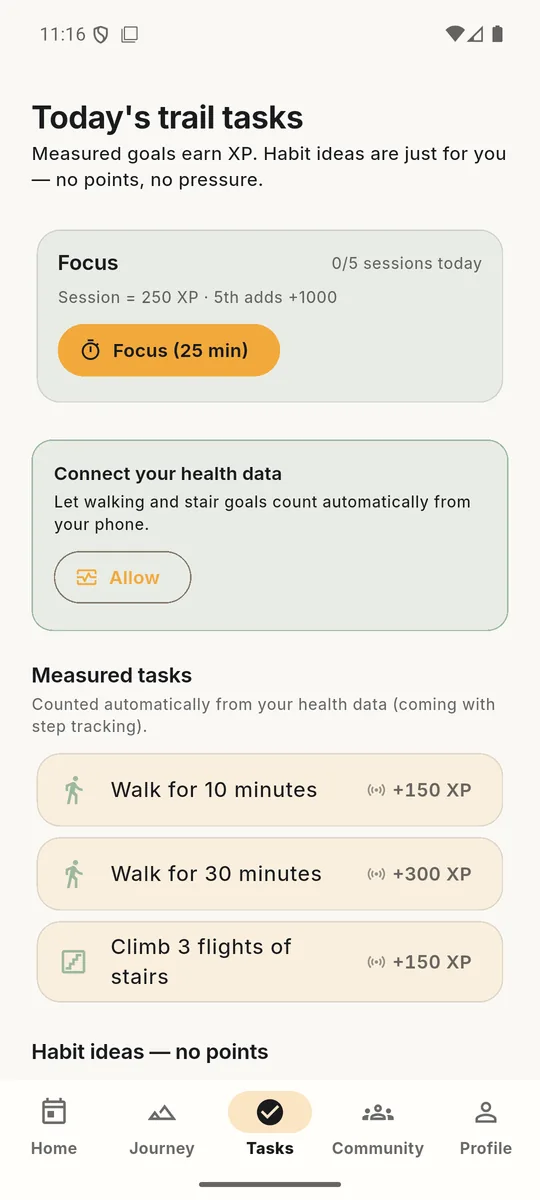
Small tasks every day. You are building a habit, not willpower.
Real screens from the app.
- Hear your own voice when a craving hits — the reason you quit, in your own words. You can add the voices of people you love, too.
- One tap for guided breathing and a distracting task — enough to fill those four minutes.
- 600 stops across six routes: read exactly what is repairing in your body today.
- Your numbers live on your device and keep counting offline — even on a plane.
- You pick the view you are climbing: summit, forest, sea, or your own photo.
- Interface, content and notifications in 14 languages.
You start free. The first day of the journey and the last are both yours.