Are You Actually Ready to Quit Smoking? A Brutally Honest Checklist
July 29, 2026·8 min read
“Ready” isn’t a feeling, it’s a plan. Use this 8‑point checklist to see how prepared you really are to quit smoking—and what to fix today.
"Are you ready?"
If you’ve been answering that with "not really" for years, there is something wrong with the question itself.
Because that question is about a feeling. Quitting doesn’t start with a feeling. It starts with eight concrete steps. The list below is exactly those eight — and you can probably knock out three of them tonight.
This article sits next to two others on the same road: is the reason you say you’re quitting really your reason? and the gap between “I should quit” and “I’m quitting”. Think of this one as part three: the list you put on the table after you’ve made the decision.
Is “feeling ready” the same as “being ready”?
No. And the gap between those two explains pretty much your entire waiting period.
Feeling ready is an emotional state: I’m motivated, I’m determined, this time will be different. It shows up in the morning, disappears by evening. Nobody can schedule that feeling on a calendar.
Being ready is a level of preparation: Do you know what you’re doing? What’s your plan for the first big craving? Is there a pack in the house? Who have you told?
You wait for the first one. You build the second.
Most people who quit did not wake up on quit day feeling ready. They just woke up prepared. We wrote separately about why waiting for the “right time” never ends; this article is the practical side of that question.
As long as you put “feeling ready” before “getting ready”, you never start. The Roman poet Horace nailed this in a letter two thousand years ago, in four words:
"The one who has begun has half done." (Dimidium facti qui coepit habet. — Horace, Epistles I.2, around 20 BCE)
This isn’t a motivational poster, it’s an observation. The feeling of being ready usually shows up after you’ve started — and most often within the first 48 hours.
The honest checklist: eight questions
Don’t just skim these in your head. Actually answer them. On paper, in your notes app, wherever — but write them down. An answer you don’t write down changes by tomorrow. (Most of these points have their own deep‑dive articles; if you get stuck, tap the link and then come back to your list.)
Can you say your reason in one sentence? Not "for my health" but something concrete from your own life. Getting winded on the stairs, your kid wrinkling their nose, that morning cough.
Do you have an actual date? A specific day on the calendar. "Soon" is not a date — how to pick a quit date is a topic on its own.
Do you know how many cigarettes you smoke a day? Not a guess — a number. Count for one full day; the number in your head is usually lower than the real one.
Have you worked out what that costs you per year? Daily pack price × 365. The total is usually bigger than you expect — and for this to help, it needs to be.
Can you name your three toughest moments? Morning coffee, driving, after work, drinking, long phone calls. Everyone’s top three is different.
Do you have a plan for those three moments? "I’ll power through" is not a plan. "Today I’ll drink my coffee at the table instead of on the balcony" is a plan. The thing that makes a plan powerful is this: a craving wave averages about four minutes, so your plan doesn’t have to cover a lifetime — just those four minutes.
Do you still have packs, lighters, ashtrays at home or in the car? If you do, this isn’t a checklist item, it’s a task — here’s a practical room‑by‑room guide to clearing them out.
If the first week gets rough, who will you tell? One person is enough. Having nobody is the most common missing piece.
How many boxes did you tick?
There’s a trap here, so let’s call it out early: this list is not an entrance exam.
Someone who ticks eight out of eight might quit tomorrow. Someone who ticks three out of eight might also quit tomorrow — they’ll just quit with a five‑item to‑do list.
An unticked item doesn’t say "you’re not ready". It says "there’s something to do this evening". You can easily handle item 7 today and item 6 tomorrow; neither takes more than an hour.
The most useful way to use the list is this: pick the two easiest items and do them today. Number 7 (clearing your space) takes about half an hour and you see the impact instantly; number 2 (writing down a date) takes about two minutes. Once you’ve ticked two items, the list stops being theoretical. It becomes something you’re actively working on — and it’s much harder to walk away from something you’ve started than to postpone something you haven’t touched.
If you care about the order, use this simple rule: environment first, then plan, then date. A quit date chosen while there’s still a pack in the kitchen has to defend itself.
If you don’t feel like doing the math for item 4, plug your daily cigarette count and pack price into the calculator on the right: it shows your yearly spend and what that adds up to over ten years. The vaguest item on the list becomes very concrete in two minutes.
⚠️ It’s very easy to turn this checklist into another reason to postpone: "I’m not ready yet, I should sort all this out first." Your whole prep phase shouldn’t last longer than two weeks. Anything beyond that isn’t preparation, it’s a very polite delay.
How strong is your nicotine dependence? One‑question test
You don’t need a long questionnaire. On the most widely used dependence scale (Fagerström), one question carries more weight than the others:
How soon after waking up do you smoke your first cigarette?
Within 5 minutes — high dependence
6–30 minutes — medium‑high
31–60 minutes — medium
After 60 minutes — low
Your answer shows how quickly your body reacts when nicotine levels drop. You can go all night without smoking, but if you reach for the pack the second your eyes open, part of what’s waking you up is withdrawal — there’s a separate article with the full list of withdrawal symptoms and how long they last.
Why it matters: with high dependence, going on willpower alone is much harder. Support like nicotine patches, gum, and similar aids or behavioral support lines can raise your chances in a meaningful way. That’s not a sign of weakness; it’s choosing the right tools for the job.
With low dependence, the main work is usually around habit: untangling the moments that have smoking attached to them matters more than the nicotine itself.
This difference also changes how you use the checklist. With high dependence, the weight is on item 6 (craving plan) and choosing your supports; those first three days are mostly physical, and getting through them without a plan is tough. With low dependence, the weight shifts to items 5 and 7: understanding which moments are tied to cigarettes and cleaning up your environment often does most of the heavy lifting.
So the same eight items don’t have to come in the same order for everyone. Your answer to the one‑question test tells you which items deserve more of your attention.
"I don’t feel ready at all"
People say this a lot — and they’re usually being honest. Nobody likes starting something they don’t feel ready for.
But quitting isn’t a one‑shot exam. Most people who don’t smoke today did not succeed on the first try; research estimates the average number of attempts somewhere between 6 and 30. So "I tried before and it didn’t work" isn’t a failure report. It’s just you lining up with the statistics.
Which means today’s attempt does not have to be perfect. It just needs to be prepared enough.
So when should you actually wait?
An honest list should include honest exceptions. Waiting a few weeks can make sense if:
You’re right in the middle of a major shock like moving house, losing your job, or losing someone close.
You’re currently in treatment for another addiction — in that case, ask your clinician about timing.
Almost everything else (a busy week, a tough project, a packed calendar) is normal life. Normal life doesn’t stop for quitting; quitting happens inside it.
⚠️ Pregnancy or an upcoming surgery are not reasons to wait. They’re reasons to start now. Talk to your doctor in both cases.
Read through the eight items one more time. Take the ones you haven’t ticked and spread them across the days of this week.
Then pick a date — here’s the article on how to choose one — and see what happens in your body hour by hour after you quit.
If you enter your date into the counter on the right, you can track what you’re gaining from today onward. And if you want to keep the same checklist, your craving plan, and the counter in your pocket, the Tar2Star app was built exactly for that.
This page is a photo. The app is the film.
These numbers show today. Tar2Star shows you a new one every morning — and stays with you when a craving hits.
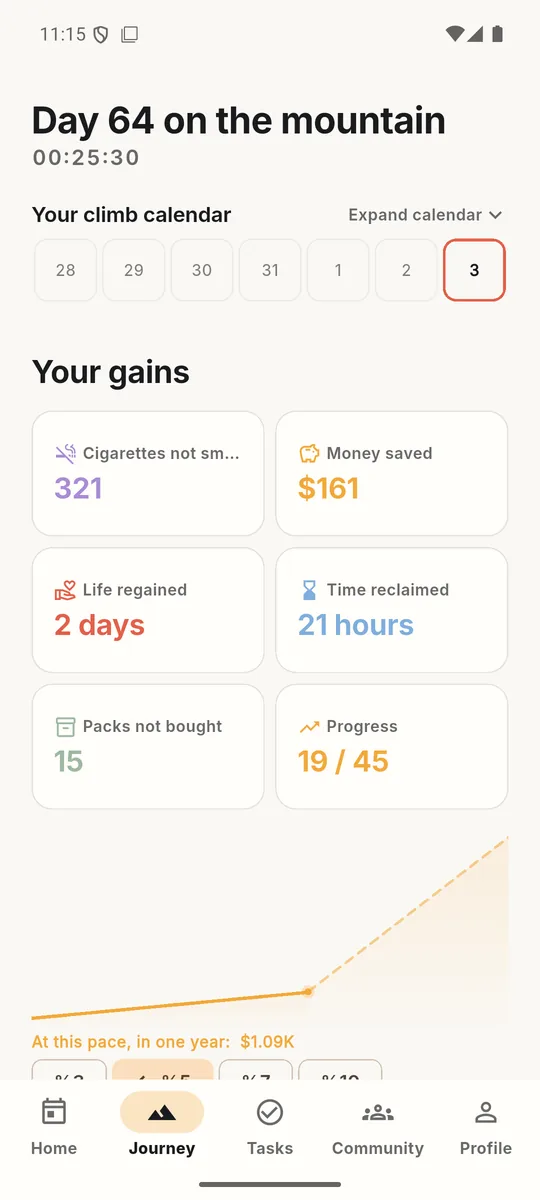
Your gains day by day: cigarettes not smoked, money saved, life reclaimed.
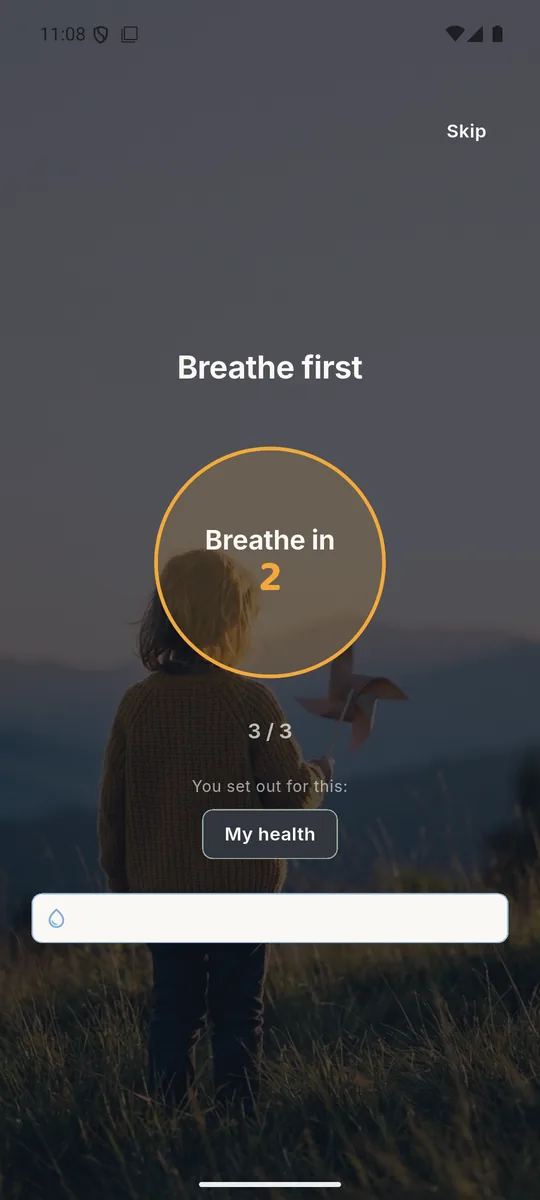
One tap when a craving hits: breathe first. A three-round guided breathing exercise.
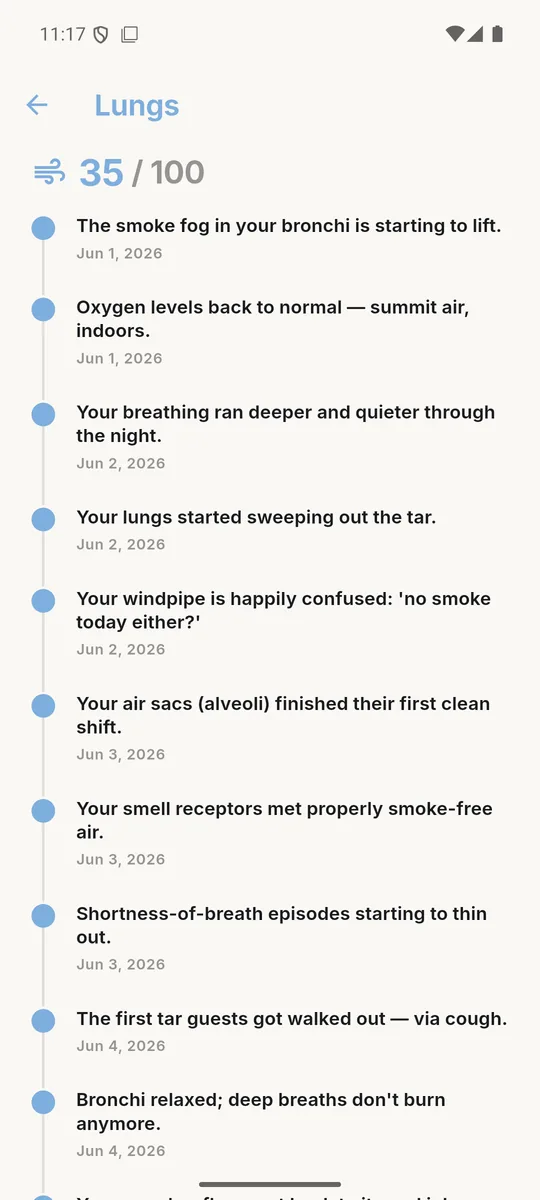
Six routes, 600 stops. Whatever is repairing in your body, you read it there.

You choose the view you are climbing — summit, forest, sea, or your own photo.
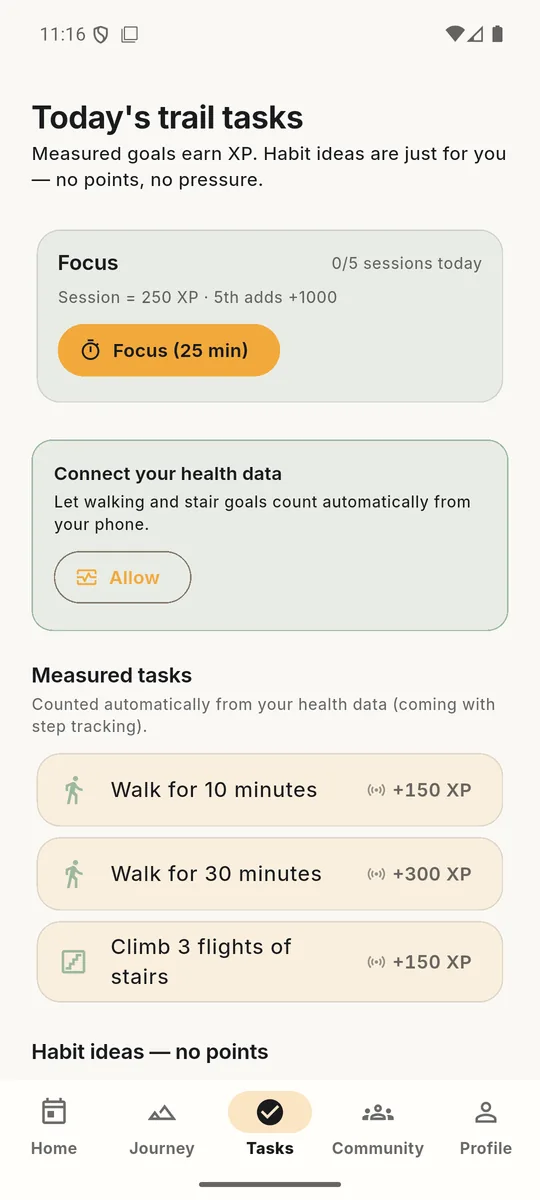
Small tasks every day. You are building a habit, not willpower.
Real screens from the app.
- Hear your own voice when a craving hits — the reason you quit, in your own words. You can add the voices of people you love, too.
- One tap for guided breathing and a distracting task — enough to fill those four minutes.
- 600 stops across six routes: read exactly what is repairing in your body today.
- Your numbers live on your device and keep counting offline — even on a plane.
- You pick the view you are climbing: summit, forest, sea, or your own photo.
- Interface, content and notifications in 14 languages.
You start free. The first day of the journey and the last are both yours.