What happens to your “smoke break” friendships when you quit?
July 29, 2026·7 min read
Worried you’ll lose your smoke-break friends if you quit? Here’s what actually changes in the first weeks and months – and what usually stays.
There’s a worry most people don’t say out loud: “If I quit, I’ll lose those conversations.”
It’s not a silly thought. For a lot of people, the smoke break is the most honest five minutes of the day — that’s why quitting at work can feel so hard. When you decide to quit, you rarely think about this part. Then around week three, the loss shows up.
So let’s talk about it upfront.
Are you losing friends, or just a setting?
Making this distinction makes everything easier.
“Smoking friendships” usually sit in three layers:
Real friendship. The cigarette was just an excuse to meet. This bond survives without smoking — maybe a bit awkward at first, but it survives.
Setting-based friendship. People you always see on the same balcony or outside the same door, but rarely anywhere else. Once cigarettes are gone, contact drops. That’s a loss, but not necessarily the loss of a close friendship.
Ritual partnership. Less about talking, more about doing the same thing at the same time. When it stops, nobody really misses it; a week later even you barely notice.
Most people throw all three into one basket and think, “My social life is going to disappear.” In reality, only the second layer is at any real risk.
There’s a quick test to see which layer you’re in: In the last six months, have you met this person anywhere that didn’t involve smoking? If the answer is yes, that’s layer one — and there’s not much to worry about. If the answer is no, that’s layer two — and the real question becomes, “Am I going to suggest a non-smoking way to meet?”
Cervantes wrapped these three layers into one sentence four hundred years ago:
“Tell me who you walk with, and I’ll tell you who you are.” (Dime con quién andas, decirte he quién eres. — Cervantes, Don Quijote, 1615)
The part that matters for this topic: the people around you influence you, but you also influence them. The person who quits often becomes the first concrete example in the group — and that happens without you giving a single speech.
The toughest stretch: three weeks of weirdness
Let’s be honest — it will feel weird for a bit.
When you stop going out for smoke breaks, the person still going out can sometimes take it personally. (What to say to whom is a whole separate article.) Some friends read it as, “They don’t hang out with us anymore.” Others feel uneasy having you there while they smoke: your presence reflects their own indecision back at them.
All three reactions tend to be temporary. But for them to pass, there’s one thing you need to do: don’t vanish from the social space.
The easiest mistake is to avoid the whole group just so you never have to turn down a cigarette. That feels simpler in the short term, but it’s expensive in the long term — because three weeks later, the “price” of quitting looks like social isolation, and that price quietly invites you to undo your decision.
What do you say? Two sentences are enough
You don’t need a long explanation, a medical lecture, or a list of reasons.
“I quit. I’ll still come out with you, just don’t offer me one.”
Why this works is simple: it directs the “no” at the cigarette, not the person. We wrote out a full script elsewhere.
⚠️ One warning: don’t try to talk anyone into quitting. “You should quit too” turns a friendship into an interrogation and usually backfires. You’re there as an example, not a preacher.
Except for the first few days
There is one exception to the “don’t withdraw from the group” idea: the first three to four days.
In those days, your defenses are at their weakest and the smell is at its strongest as a trigger. Skipping the smoking area in the very beginning isn’t running away; it’s respecting what the first 72 hours are actually like.
The rough order usually looks like this: stay away the first days → go back to the setting after week two → by week three, the awkwardness is mostly gone.
Drinking and smoking: a special case
This is the riskiest part of most people’s social life, and it deserves to be treated that way.
Alcohol does two things: it lowers your decision threshold, and it’s one of the strongest “paired” habits with cigarettes. Many people light their “first one back” as “just one” at a table with drinks.
In practice:
Keep the first two to three weeks alcohol-free. If there’s one tip that helps the most, it’s this one.
If you do go out: leave early, keep something in your hand (a glass, some snacks), and have at least one person there who knows what you’re doing.
⚠️ The sentence “One won’t hurt” doesn’t get solved at the table — that single cigarette is exactly what resets the reward loop.
What takes its place?
No one really talks about this part, but there is a gain on the other side.
When smoke breaks are gone, you suddenly free up 30–40 minutes a day. Those slots turn into walks, coffee breaks (indoors, sitting), short conversations — and those conversations can absolutely happen without a cloud of smoke.
There’s another shift: by the end of the first month, some people find themselves supporting someone else through their own quitting process. Having a concrete reason helps here too.
That extra half hour isn’t meant to stay as empty time. If you don’t choose what fills it, the phone usually does — and a scroll break doesn’t give you what a smoke break used to give: a change of place and a bit of human contact. The time passes, but your daily rhythm doesn’t really reset.
When someone in your home or at your table still smokes
This is the hardest version, because here you don’t get to choose the environment.
Three things tend to help — and none of them require asking the other person to quit:
1. Step away from the moment, not the person. When they go out for a cigarette, you stay where you are; when they come back, the conversation continues. You’re stepping away from those five minutes, not from the relationship.
2. Suggest a different shared moment. The smoke break used to be your “meeting point.” Replacing it with a walk, a coffee, or a lunch date fills that space. The suggestion has to come from you — the other person can’t guess what you’d prefer instead.
3. Let your decision be visible but quiet. Don’t hide it, don’t turn it into an announcement. Your counter can sit on your phone; you don’t have to show it to anyone, but you’re also not pretending nothing changed.
⚠️ The most common trap is waiting for the other person to quit first. Tying your own decision to someone else’s decision is handing over control — and that control doesn’t magically come back.
What does it look like after three months?
This is usually the most reassuring part — and it tends to be something people only hear at the end.
By month three, three things have usually shifted. You aren’t struggling in those settings anymore; for many people, even the smell has gone from tempting to unpleasant. They have adjusted; the automatic “Want one?” has faded, and you’ve settled into your new role as “the friend who doesn’t smoke.” And the relationship has shown which layer it lived in — the ones that stay are real, the ones that vanish were built around cigarettes.
What surprises people most: by month three, a lot of quitters realize they haven’t actually lost anyone. What they’ve lost is one format of spending time together — and formats can be changed.
Not all your friendships are built on cigarettes. The ones that are aren’t your fault.
One thing to try this week: join a break without lighting up, just once. Once you’ve seen that it can work, the rest starts getting easier.
If you want to keep track of your days without telling anyone, you can plug your quit date into the counter on the right. And if you want something in your pocket for the tough moments, the Tar2Star app was built for exactly those minutes.
This page is a photo. The app is the film.
These numbers show today. Tar2Star shows you a new one every morning — and stays with you when a craving hits.
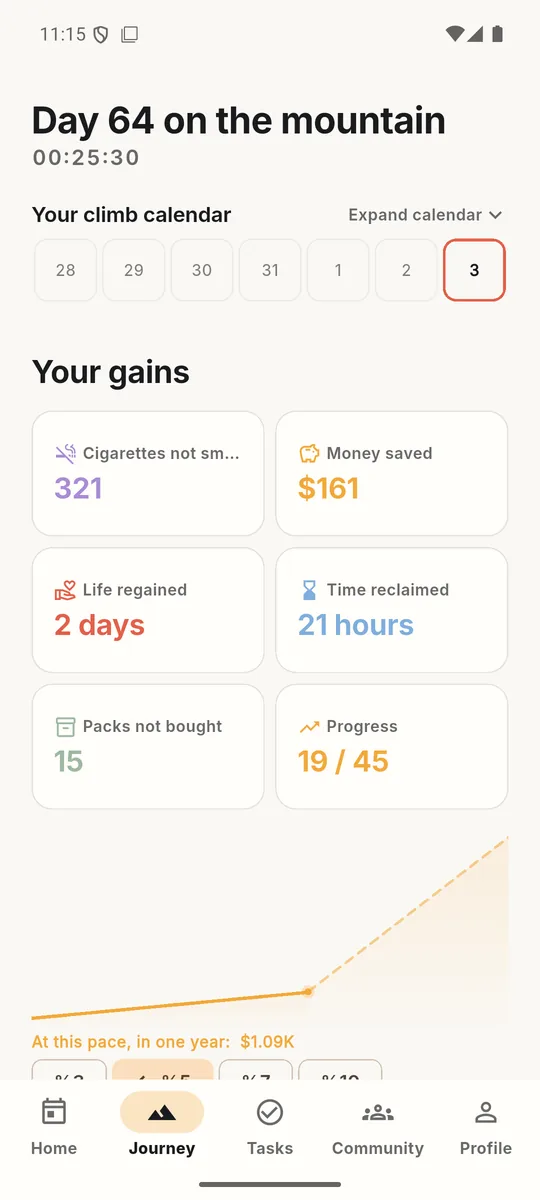
Your gains day by day: cigarettes not smoked, money saved, life reclaimed.
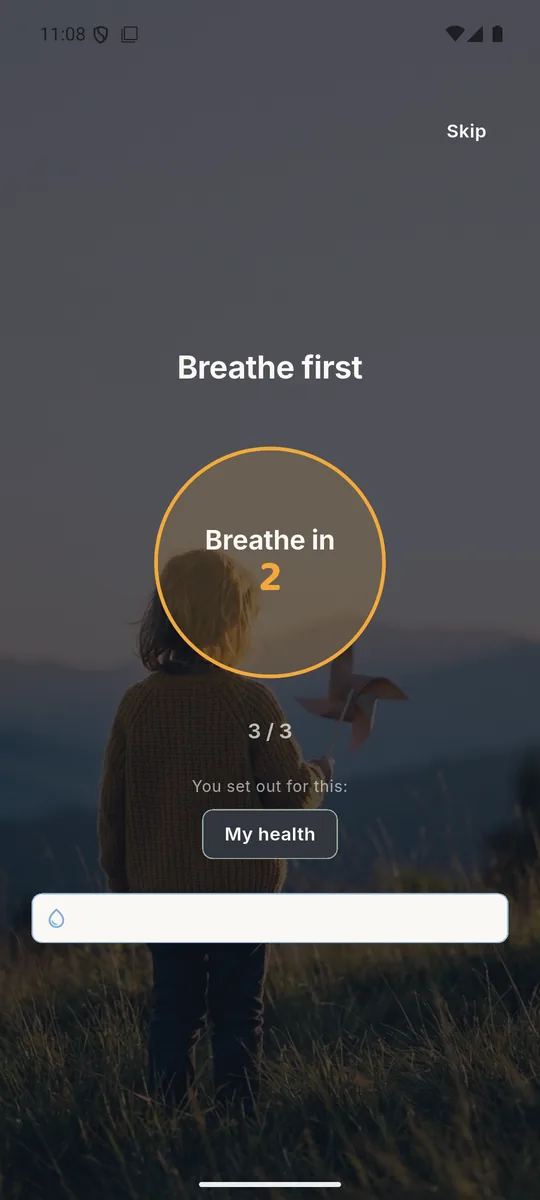
One tap when a craving hits: breathe first. A three-round guided breathing exercise.
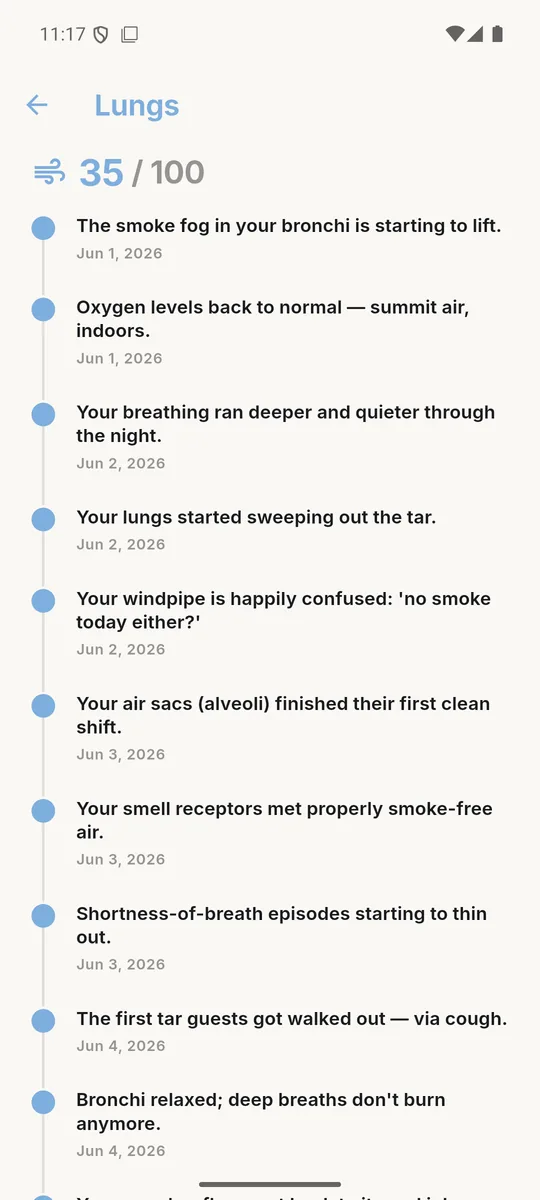
Six routes, 600 stops. Whatever is repairing in your body, you read it there.

You choose the view you are climbing — summit, forest, sea, or your own photo.
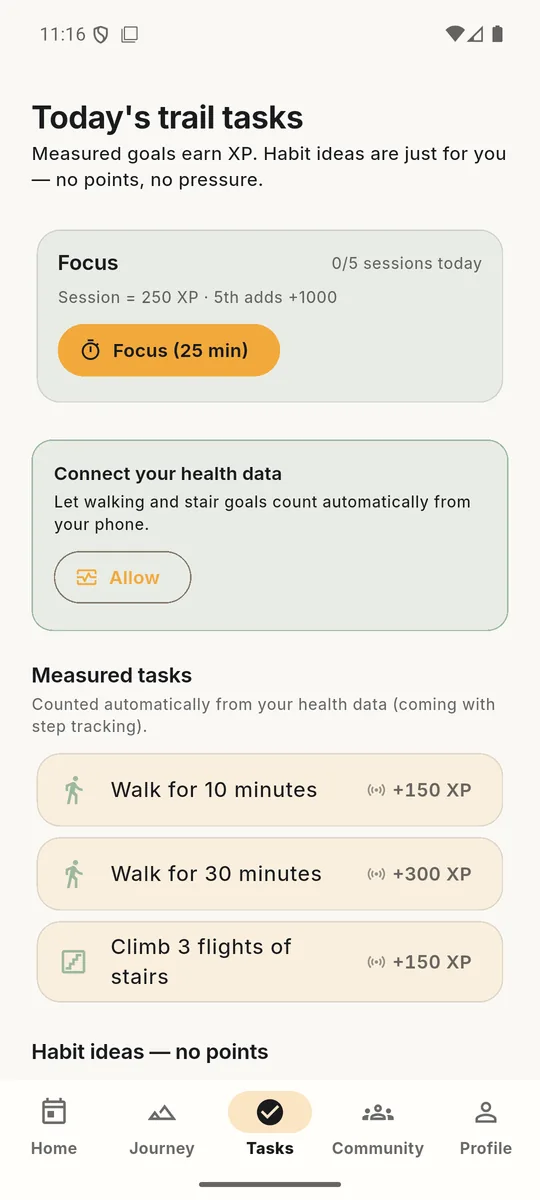
Small tasks every day. You are building a habit, not willpower.
Real screens from the app.
- Hear your own voice when a craving hits — the reason you quit, in your own words. You can add the voices of people you love, too.
- One tap for guided breathing and a distracting task — enough to fill those four minutes.
- 600 stops across six routes: read exactly what is repairing in your body today.
- Your numbers live on your device and keep counting offline — even on a plane.
- You pick the view you are climbing: summit, forest, sea, or your own photo.
- Interface, content and notifications in 14 languages.
You start free. The first day of the journey and the last are both yours.