What’s the real first step to quit smoking? (Hint: it’s not the trash can)
July 29, 2026·7 min read
Throwing the pack away feels dramatic, but it’s not the first step. Here’s the simple one-day exercise that actually starts your quit attempt.
Most “quit stories” start the same way: the pack gets crushed, tossed in the trash, lid slams shut.
It’s a satisfying scene. But it’s not the first step — and starting there is one of the most common reasons people are back at the store on day three.
Why throwing the pack away isn’t step one
Because tossing the pack is a final step — the easiest, latest part of preparation. It takes five seconds and can be reversed in fifteen minutes.
The real issue isn’t where the pack sits. It’s what your hand is trying to solve every time it reaches for a cigarette — twenty times a day. If you don’t know that, the pack you threw away shows up again at the nearest corner store the first time the day gets rough.
So what is the real first step?
Write down every cigarette you smoke for one day.
Don’t quit. Don’t cut down. Just write.
It sounds almost too simple. There’s a reason for that: most cigarettes are smoked on autopilot, not by decision. You’re not consciously choosing; your coffee, your phone, your car, your break are.
You can’t change an automatic behavior you can’t see. Writing makes it visible.
That’s why this sits at step one in almost every structured quit program. It’s called self‑monitoring, and its only job is to turn “awareness” into something you can measure.
The smallness of the step isn’t a flaw. It’s the whole design.
“A journey of a thousand miles begins with the single step beneath your feet.” (千里之行,始於足下 — Lao Tzu, Tao Te Ching, Chapter 64)
We usually quote the “single step” part, but the important word here is “beneath.” The beginning isn’t some heroic move in the distance; it’s the thing you can do standing exactly where you are.
Today you have a pen and a scrap of paper. Step one is that close.
How to keep a smoking log
One day is enough; two days is even better.
Use whatever is right in front of you: a small piece of paper taped to the pack, or a note on your phone.
Before each cigarette, jot down three things:
Time. (e.g. 8:15 a.m.)
Where / what you’re doing. (kitchen, with coffee)
Need level from 1–3. 1 = my hand just went for it, 3 = I really wanted this one.
That’s it. No commentary, no beating yourself up, no trying to cut back. Today’s job is to measure.
⚠️ Writing it down before you light up matters. If you write afterward, you log what you remember. If you write first, you slip a two‑second pause into that automatic chain. That tiny pause is where the log does its real work.
What does a filled‑in log look like?
Here’s half a day for someone who smokes about a pack a day:
7:40 a.m. — kitchen, with coffee — need 3
8:15 a.m. — car, in traffic — need 2
9:50 a.m. — outside office, with coworker — need 1
11:20 a.m. — outside office, alone — need 1
12:35 p.m. — after lunch — need 3
2:10 p.m. — after phone call — need 2
3:30 p.m. — outside office, with coworker — need 1
Seven cigarettes: two of them rated 3, three of them rated 1.
This simple list already says something important: this person’s main challenge isn’t “nicotine in general.” It’s the three cigarettes outside the office — the place and the social routine.
That’s where most of their craving plan will need to live.
Also notice: 9:50, 11:20, and 3:30 are the same place, same rating. Repeated lines are the log’s best gift to you, because whatever repeats can be planned for.
After one day, what will you have?
Three things — and together they shape the rest of your prep:
1. The real number. Most people underestimate how many they smoke. “About half a pack” often turns out to be 14.
2. The chains. Your 3‑point cigarettes tend to cluster: morning coffee, after work, evening calls. Those are your high‑risk moments — you’ll make a plan for each one.
3. The “easy” ones. If your 1‑point cigarettes are half your total — and they often are — that’s good news. Many of those are more about habit than chemistry. Habits are usually easier to unhook than nicotine itself.
This third piece changes the math for a lot of people. “I’m quitting 20 cigarettes a day” sounds like 20 separate battles.
The log usually shows something different: the real fight is over 4–5 cigarettes, and the rest just follow along behind them.
Not a 20‑front war — a 5‑front one. Still tough, but suddenly something you can actually design a plan around.
⚠️ You may feel “caught” or exposed as you fill in the log. It’s uncomfortable. That’s normal.
Remember: the log’s job is not to shame you, it’s to map the territory.
If the number is high, that isn’t bad news; it’s just news. And it’s the only kind of data you can act on.
Three practical rules for logging
1. Paper beats phone. Open your phone and three notifications hit you before your notes app does. You went in to write a line and came out scrolling the news.
A little paper taped to the pack sits right beside your cigarettes — exactly where you need it, exactly when you need it.
2. An imperfect day is still data. If you forget to log one afternoon, don’t throw the whole day out. Just add a line: “2–6 p.m. not logged.”
A patchy log is far more useful than no log.
3. Do it two days in a row. One day can give you the wrong picture. If Monday is packed with meetings, it doesn’t really show your normal pattern.
One workday plus one weekend day usually reveals the real design of your smoking.
“This is a waste of time, I just want to quit tomorrow”
Then quit tomorrow. The log doesn’t delay quitting.
You can keep logging right up to the morning of your quit date. You can even do it on your quit day — the only difference is that on that day, you’re logging the craving, not the cigarette: the time, the place, and how long it lasted.
That second version can be even more valuable. Reading that a craving usually peaks and fades in about four minutes is one thing. Seeing it on your own paper is another. Your own data is what convinces your own brain.
Here’s how it plays out:
Day one, cravings are scary because you don’t know how long they’ll last. After three days of notes, your page says “4 min,” “3 min,” “6 min.”
On day four, when a wave hits, you’re not facing a mystery anymore — you’re facing something with a measured duration. Once that uncertainty shrinks, the craving itself starts to shrink too.
What happens after the first step?
The sequence looks like this, and each stage uses the one before it:
Log — what, when, how strong.
[Reason](/tr/sigarayi-birakma-sebebi-uc-soru) — a three‑question exercise that gives you one anchor sentence.
[Date](/tr/sigara-birakma-tarihi-nasil-secilir) — circle a day on the calendar, at most two weeks away.
Plan — decide what you’ll do for each of those 3‑point moments from your log.
Clean‑up — pack, lighters, ashtrays. This is where throwing the pack away actually belongs: step five.
⚠️ Don’t turn this sequence into a never‑ending “prep marathon.” The whole thing shouldn’t take more than a week. There is no perfect time, and “getting ready” can quietly turn into one of the nicest forms of procrastination.
The only task for today
Grab a piece of paper, tape it to your pack, and write down the time of your first cigarette.
That’s how small the first step of your quit journey is. But every step that comes after — your reason, your date, your plan — is built on those lines of ink.
Log one day, see your real number. Then pick your date and check what will start happening in your body hour by hour after you quit.
If you’d rather keep it in your pocket than on paper, you can track the same log — and your high‑risk moments plan — inside the Tar2Star app.
This page is a photo. The app is the film.
These numbers show today. Tar2Star shows you a new one every morning — and stays with you when a craving hits.
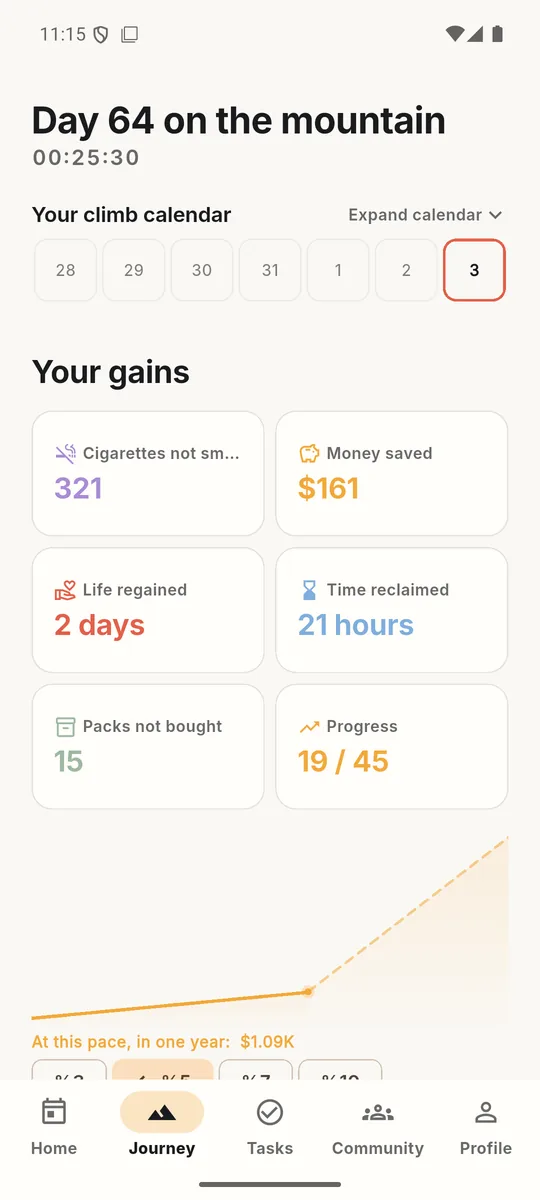
Your gains day by day: cigarettes not smoked, money saved, life reclaimed.
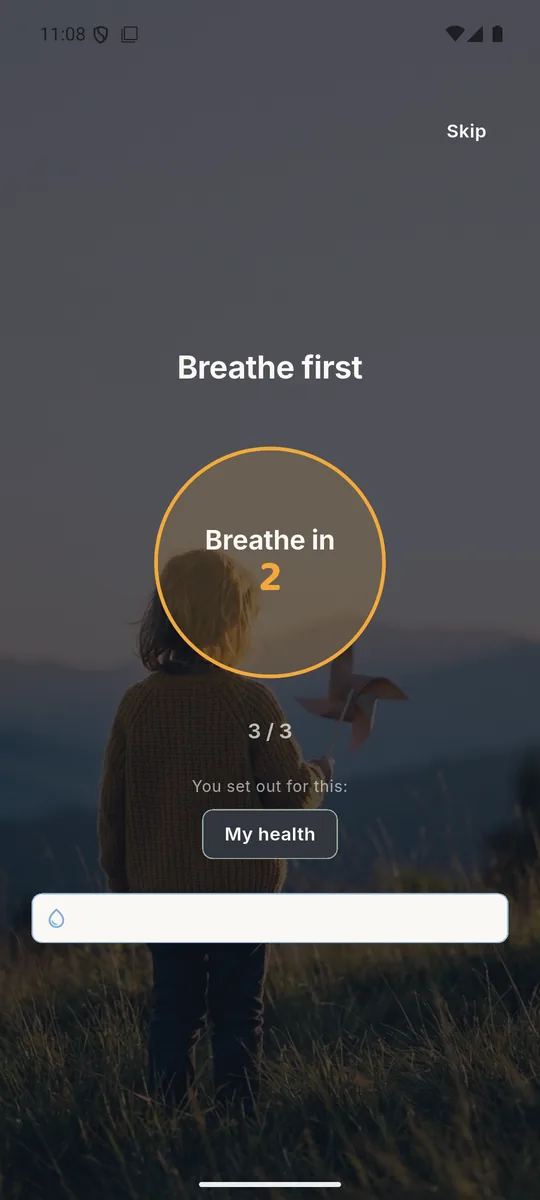
One tap when a craving hits: breathe first. A three-round guided breathing exercise.
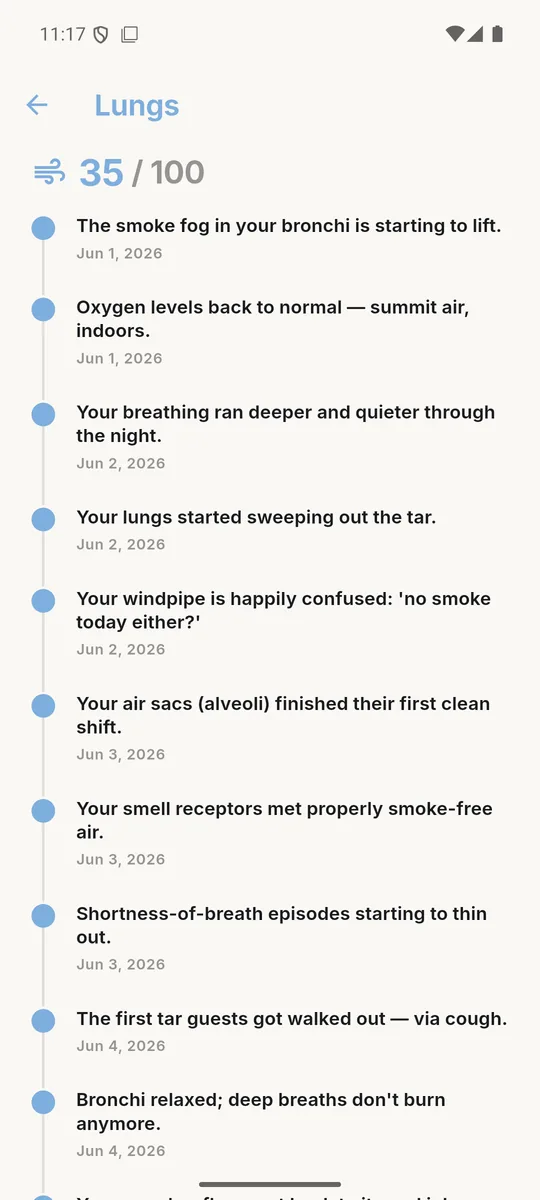
Six routes, 600 stops. Whatever is repairing in your body, you read it there.

You choose the view you are climbing — summit, forest, sea, or your own photo.
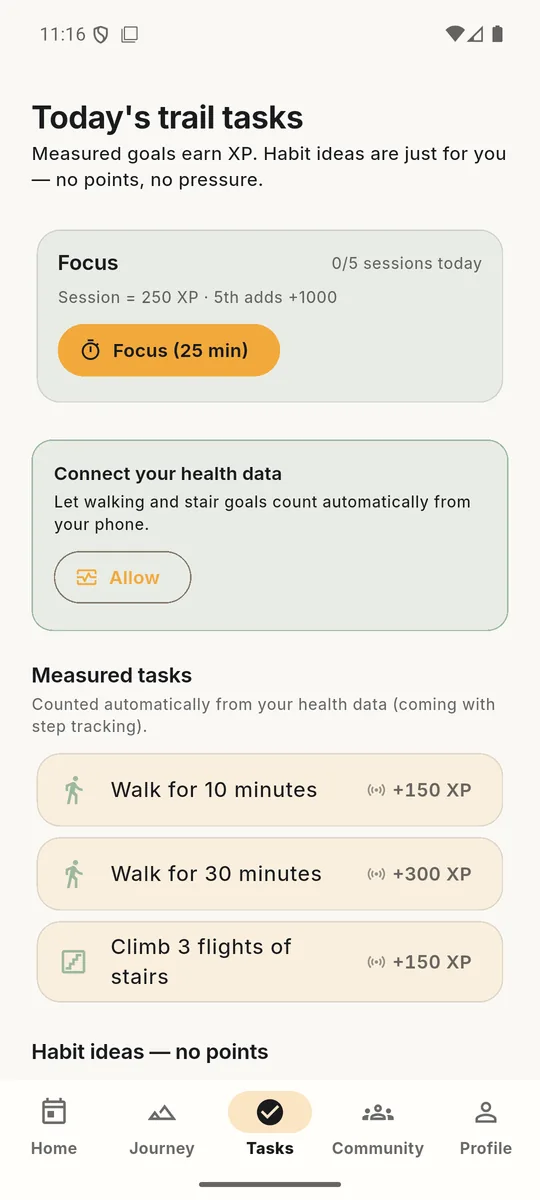
Small tasks every day. You are building a habit, not willpower.
Real screens from the app.
- Hear your own voice when a craving hits — the reason you quit, in your own words. You can add the voices of people you love, too.
- One tap for guided breathing and a distracting task — enough to fill those four minutes.
- 600 stops across six routes: read exactly what is repairing in your body today.
- Your numbers live on your device and keep counting offline — even on a plane.
- You pick the view you are climbing: summit, forest, sea, or your own photo.
- Interface, content and notifications in 14 languages.
You start free. The first day of the journey and the last are both yours.