Quit‑smoking journal: why it works and how to keep one in 2 lines a day
July 30, 2026·6 min read
A quit‑smoking journal isn’t homework; it’s a tool. See why it works, how to do it in 2 lines a day, and what to write on good days, bad days and slips.
The first step was a one‑day log — writing down every cigarette you smoked.
Once you quit, the journal doesn’t end. It just switches from cigarettes to cravings.
This piece is about that second part.
Why a quit‑smoking journal actually works
Three reasons:
1. Cravings become measurable. “I want one all the time” usually shrinks to three or four waves a day once you start tracking. Numbers correct what the feeling exaggerates.
2. Progress becomes visible. Day 1: five waves. Day 10: two waves. While you’re in it, that drop is easy to miss; on paper, it’s obvious.
3. Writing makes it easier not to act. Jotting down a craving puts two seconds between you and the cigarette — and those two seconds turn the start of a four‑minute craving wave into a conscious moment.
How to keep a quit journal: 2 lines a day
Complicated journals die on Day 2. So we keep it to the minimum.
One line for every craving wave: `time · where/what you were doing · intensity 1–3`
Example: `2:20 pm · after a meeting · 2`
One line at the end of the day: `how many waves · which one was the hardest · one note for tomorrow`
Total time: about a minute a day.
⚠️ Skip the “pouring my heart out” trap. “I felt awful” is useless a week later; “after meetings” becomes gold when you see it three times in seven days — that’s a pattern.
⚠️ Second trap: writing after the wave is over. When you log inside the wave, the act of writing already breaks it up. Written later, it’s just data; written in the moment, it’s both data and tool.
What kind of quit journal does not work?
Knowing what fails is often more useful than hearing what’s ideal — most people quit the journal on Day 2, for one of these three reasons.
The long‑form journal. Paragraphs, emotions, self‑criticism. Takes five minutes, gets dropped on Day 5. The standard is one line — like the quit agreement, it works because it’s short enough to survive.
The scorecard journal. “Today was 8/10.” Grading yourself slowly turns into an exam, and a rough day starts to feel like “bad student” territory.
The bad‑days‑only journal. If you only write on hard days, the record becomes one‑sided, and when you look back it all looks bad. Yet most of the evidence is hiding in the ordinary days.
The common mistake: treating the journal as an evaluation tool. Its job is to measure, not to judge.
How long should you keep it?
First two weeks: non‑negotiable. Up to Week 4: still useful.
Here’s why: in the first two weeks, your triggers show up and most withdrawal symptoms happen. In Weeks 3–4, the waves get rarer and the journal naturally feels less necessary.
Months later, there’s really one good reason to bring the journal back: you notice the number of cravings creeping up again. Two days of tracking usually reveal what changed.
Three things your journal will show you
After a week, you read back through and usually see:
A trigger list. The three most common situations. These are what update item three in your quit agreement — the three risky moments you thought you had, and the three that actually show up, are often different.
A time pattern. Most waves cluster around certain hours: afternoon crash, getting off work, after dinner. You can plan for those slots in advance — the first‑24‑hours emergency plan is already built around the same blocks.
An intensity curve. Early on, level‑3 waves dominate. By Week 2, most have dropped to level 1. That’s the most concrete proof of progress you’ll get.
Paper or phone?
Both work; the only real rule is it must be within reach.
Paper advantage: handwriting takes a bit more effort, so it stretches out that gap between urge and action.
Phone advantage: it’s always on you, and the history doesn’t get lost.
The counter on the right is already tracking days and money saved; the journal just sits next to it — one shows gains, the other shows patterns.
⚠️ If you go with your phone, one rule: don’t keep the journal inside a social media app. A note in your notes app takes a minute. A “story” post grows an audience, and pretty soon you’re writing what looks good, not what actually happened.
The single most valuable line in your journal
Somewhere in that first week, there’s usually one line that quietly does more for you than the rest: a wave that passed without you acting on it.
You write: “3:40 pm · leaving work · 3” — and then… nothing. No follow‑up.
That line proves one thing: a level‑3 wave came and went. You did nothing, and it still passed.
That proof is your strongest card in the next wave. Because in the middle of a craving, your brain loves this sentence: “This one won’t pass.” If there are six lines on paper that prove it wrong, the argument ends quickly.
⚠️ That’s why passed waves need to be written down too, not just the tough ones. A bad‑moments‑only log erases half your evidence.
If you smoke one, what do you write?
This is usually the most valuable moment in the whole journal — and also the point where most people stop using it.
What to write: the time, the place, and the exact sentence that showed up in your head. Especially the sentence — because it’ll be back next time.
A slip and a full relapse are not the same thing; writing down a slip makes it harder for it to quietly grow into a full return. What’s on paper asks to be explained.
If you stop journaling
It’s okay; there’s nothing to feel guilty about.
The journal is a tool, not a duty. Two weeks of notes do far more than none at all: your main triggers are already on the page.
⚠️ One exception: if you skip two days in a row, it’s usually not because the journal got boring — it’s because those two days were rough. The first thing to get dropped is the thing that would record what you’d rather not see.
In that moment, you don’t have to “go back to journaling.” Just write one single line: “I skipped two days, here’s why.”
Day 7: a 10‑minute read‑through
The real value of the journal shows up when you read it, not when you write it — and this step is almost always skipped.
At the end of Week 1, sit down and read all seven days from start to finish. With three questions in mind:
Which situation repeated the most? That becomes the new number‑one item in your quit agreement.
Which way is the wave count going? Compare the average of the first three days to the last three.
When did the strongest waves hit? There’s usually one time of day that stands out — you can build a plan just for that slot.
This review takes about ten minutes and has a surprising effect for many people: there were fewer waves than they remember. A week that “felt like constant craving” shows up on paper as three waves a day. Memory gets corrected here — and that correction sets the tone for Week 2.
Before you quit, you log cigarettes. After you quit, you log cravings. Two lines a day.
Today’s only step: open a note on your phone, call it “journal,” write your first line.
If you also want to track days and money saved, add your quit date to the counter on the right. And if you want both in one place, the Tar2Star app was built exactly for that.
This page is a photo. The app is the film.
These numbers show today. Tar2Star shows you a new one every morning — and stays with you when a craving hits.
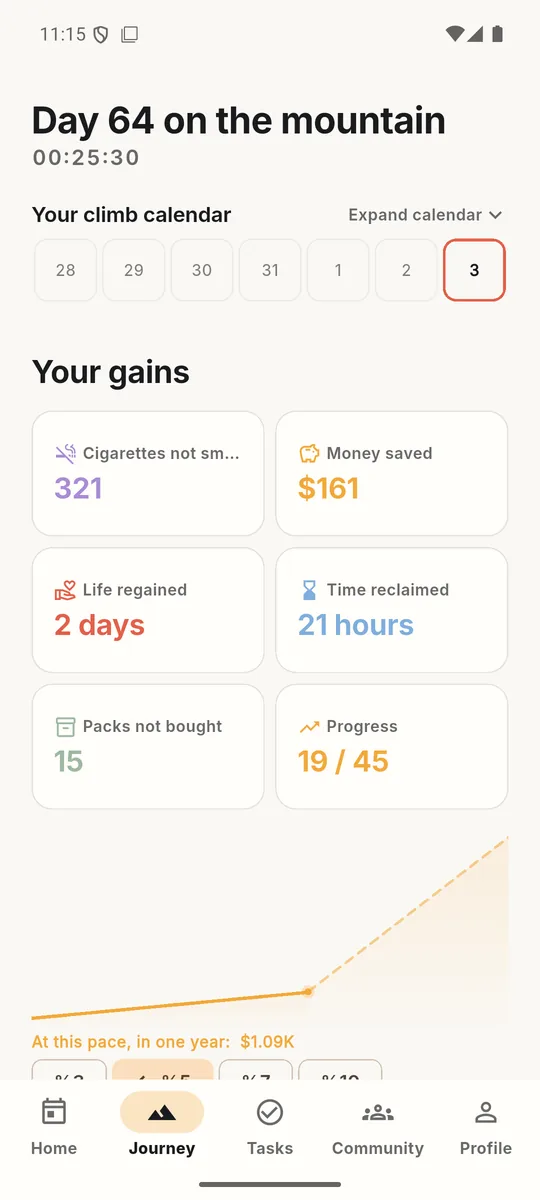
Your gains day by day: cigarettes not smoked, money saved, life reclaimed.
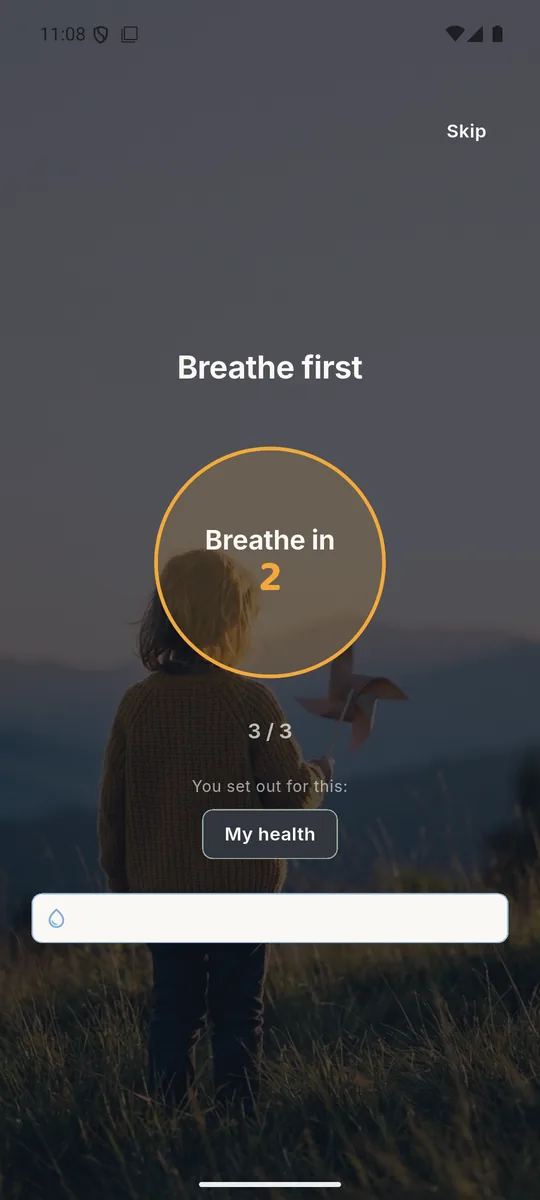
One tap when a craving hits: breathe first. A three-round guided breathing exercise.
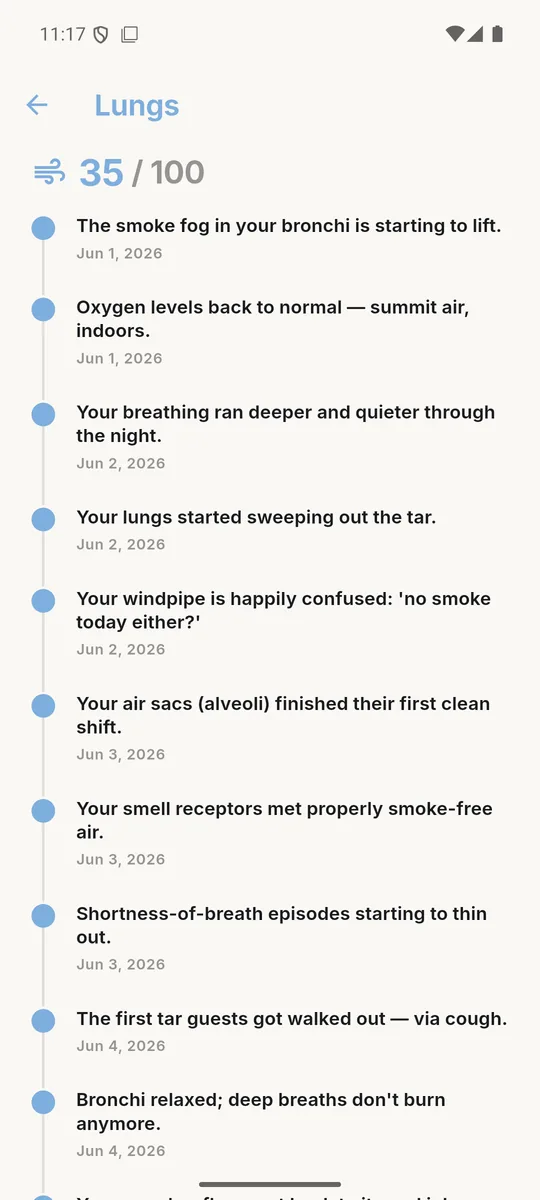
Six routes, 600 stops. Whatever is repairing in your body, you read it there.

You choose the view you are climbing — summit, forest, sea, or your own photo.
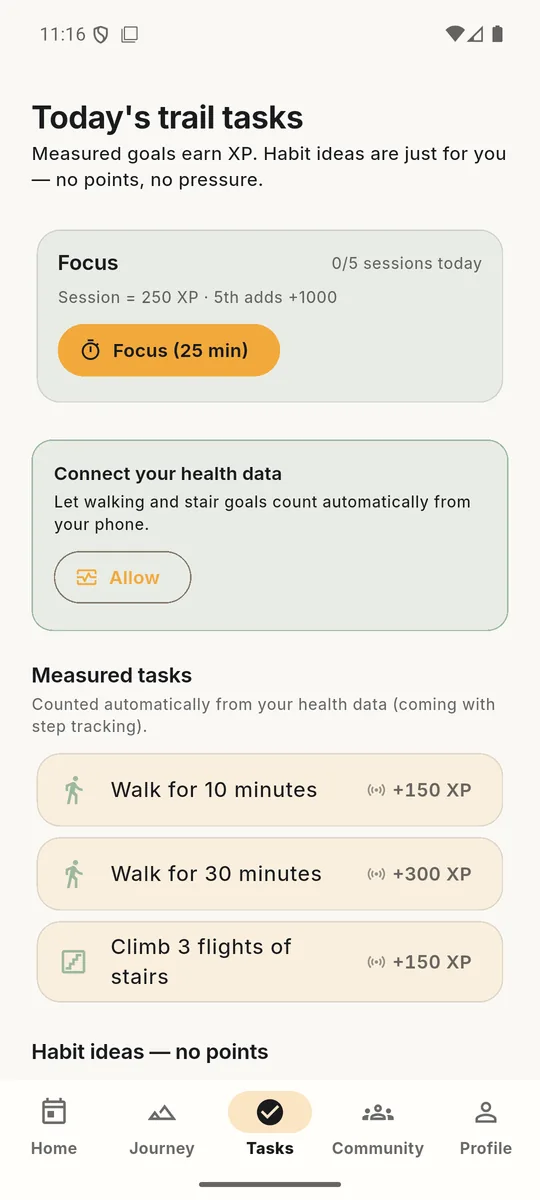
Small tasks every day. You are building a habit, not willpower.
Real screens from the app.
- Hear your own voice when a craving hits — the reason you quit, in your own words. You can add the voices of people you love, too.
- One tap for guided breathing and a distracting task — enough to fill those four minutes.
- 600 stops across six routes: read exactly what is repairing in your body today.
- Your numbers live on your device and keep counting offline — even on a plane.
- You pick the view you are climbing: summit, forest, sea, or your own photo.
- Interface, content and notifications in 14 languages.
You start free. The first day of the journey and the last are both yours.