Find Your Reason to Quit Smoking: A 10‑Minute, 3‑Question Exercise
July 29, 2026·7 min read
“Quit for your health” sounds right but rarely works in a craving. These 3 questions help you find a real, usable reason to quit smoking in 10 minutes.
“Find your reason to quit.”
People repeat that line all the time. Hardly anyone explains how to find it.
This exercise does. Three questions, ten minutes, one sheet of paper.
All three questions have something in common: none of them ask, “Why do you want to quit?” You already have an answer to that – and exactly that answer keeps failing you in the hard moments.
Why borrowed reasons don’t work
“Because of my health.” Almost everyone can say that. It’s true. And in the middle of a craving it does… pretty much nothing.
Simple reason: that sentence is about the future and abstract. A cigarette is right now and very concrete – in your hand, in your mouth in fifteen seconds.
When an abstract reason and a concrete urge collide, the concrete one wins.
We explained why the “right reasons” often aren’t enough in another article; here, we focus on what to use instead.
A reason that actually helps has three features: it’s from your own life, it happened this week, and you can say it in one sentence.
Rainer Maria Rilke wrote something to a young poet that fits the spirit of this exercise:
“Try to love the questions themselves. Do not now seek the answers, which cannot be given you because you would not be able to live them.” (Versuchen Sie, die Fragen selbst liebzuhaben. Suchen Sie jetzt nicht nach Antworten. — Rainer Maria Rilke, Letters to a Young Poet, 1903)
Same idea here: no one can hand you your reason. A reason given to you is on loan – and in a crisis, loans get called in. The three questions below don’t tell you what your reason is; they pull up what’s already there.
Question 1: What did smoking cost you today?
Yesterday or today. Not last year, not “someday”.
Your answer will be small. That’s the point: a conversation you cut short, stepping outside into the rain, your kid saying “you smell”, hearing your own breathing on the stairs, driving around late because the store was closed and you needed a pack.
They look trivial. But in a craving, your brain doesn’t serve you “heart attack risk up by X%”. It serves you the memory of standing in front of that closed shop last night.
⚠️ When you write, skip the adjectives. Not “I felt terrible”, but “At 11:10 p.m. I went out in the rain.” Adjectives fade. Scenes don’t.
Question 2: On a scale of 0–10, how important is this to you – and why not lower?
This one has two parts, and the second part is the useful one.
First, give it a number. Say you pick 6.
Now the real question: Why 6 and not 3?
When you ask, “Why not 10?”, people get defensive and start producing excuses. When you ask, “Why not lower?”, they start listing their own reasons – and what you say in your own words carries more weight than anything someone else tells you.
This question is widely used in behavior change conversations. Its goal isn’t to convince you; it’s to bring out what’s already there.
Write your answer down. The two or three points you list are your real reasons.
Question 3: What would you, one year smoke‑free, say to you today?
This question flips time around.
From today’s angle, quitting feels like a loss: you’re giving up the habit, the break, that first drag. From a year in the future, the same thing looks like a list of gains.
The you one year from now will already know: the first 72 hours are behind you, cravings come in waves that last minutes, the money has started to pile up.
Ask that person a question and write the answer in their voice: “Looking back, what are you most glad about?”
Why this works is simple: right now, the loss is visible because it happens today; the gains haven’t happened yet. When you move the camera one year forward, the balance evens out – same decision, but now you can see both sides.
When you write the answer, don’t be afraid of detail. Not “I’m healthier now”, but “I don’t wake up coughing”, “my shirts don’t smell”, “I’m not walking to the corner store at midnight anymore”. A one‑year‑from‑now you doesn’t talk in vague terms – they’ve actually lived it.
What do you do with your answers?
Put all three answers in one place. Then pick two of them and build this sentence:
“I’m quitting because ___ is happening and because I want ___.”
This is your anchor sentence. Keep it short; an anchor you can’t remember is just a paragraph.
Then put it where you’ll see it: phone lock screen, fridge door, car glove box. In a craving, you’re not going to sit there and think it all through – you’re going to read. A craving is a terrible time for deep thinking.
Why reading is enough: a craving wave is measured in minutes, not hours. Reading that sentence takes about ten seconds. If all your anchor does is occupy the first ten seconds of that wave, it has done its job. Time can take care of the rest.
One more thing people skip: reading your anchor out loud is not the same as reading it silently. Silent reading stays “just a thought”. When you say it, you hear your own voice saying your own decision. If you’re in the car, that’s an especially good place to do it.
The 3 most common mistakes when doing this exercise
These three alone can cut the quality of your answers in half.
1. Answering in your head. “I already know, I don’t need to write it down” is the classic. But the answer in your head isn’t stable; it’s one thing in the morning, something else completely in a craving. The only advantage of the written version is exactly this: tomorrow, the same words are still there.
2. Trying to look good. No one else is going to read this paper. If “To set a good example for my kid” sounds right but the real reason is “I scared myself with how hard I coughed this morning”, write down the second one. That’s the one that will show up next to you in a craving.
3. Hunting for a “big” reason. Your reason doesn’t have to be a grand life‑changing statement; it only has to be strong enough to get you through this week. No one writes a manifesto titled “I’m done walking to the store in the rain at 11 p.m.” – and yet, that exact sentence is what stops people at 11 p.m.
Weak answer vs. strong answer
Seeing the difference is the fastest way to learn it:
“For my health.” → Weak. Whose health, when, what happened?
“Last Tuesday I had to stop on the stairs to catch my breath while my son waited behind me.” → Strong. There’s a scene.
“It’s a waste of money.” → Weak. How much?
“About 30 packs a month; in two years that’s a car down payment.” → Strong. There are numbers.
“My partner wants me to.” → Weak, but keep it. It can be a starting reason, but on its own it won’t be enough; you’ll need to put your own sentence next to it.
When should you repeat this exercise?
Do it again at the end of your first week.
Your list of reasons will shift. Some of the pre‑quit reasons stop making sense once you’ve quit; new ones appear (“my breathing is better, I don’t want to lose that”). That’s a good sign: future‑tense reasons are turning into past‑tense evidence.
Something else happens too: one of your original reasons turns out to be wrong. People start with “I’m quitting for my partner” and two weeks later realize, “Actually I was doing it so I don’t wake up coughing.” That’s not inconsistency; the first answer was just the most visible reason, not the strongest. On the second round, the visible one moves back and the strong one steps forward.
⚠️ One warning: “finding your reason” shouldn’t become a new way to delay your quit date. The exercise takes ten minutes. Do it today, and still pick your date today.
Grab a sheet of paper, write down the three questions, give yourself ten minutes. Then run the rest of your prep through the 8‑point checklist.
If you want to add a number to your reason afterward, set your date in the counter on the right. And if you’d like to keep your anchor sentence and craving plan in your pocket, the Tar2Star app was built exactly for that.
This page is a photo. The app is the film.
These numbers show today. Tar2Star shows you a new one every morning — and stays with you when a craving hits.
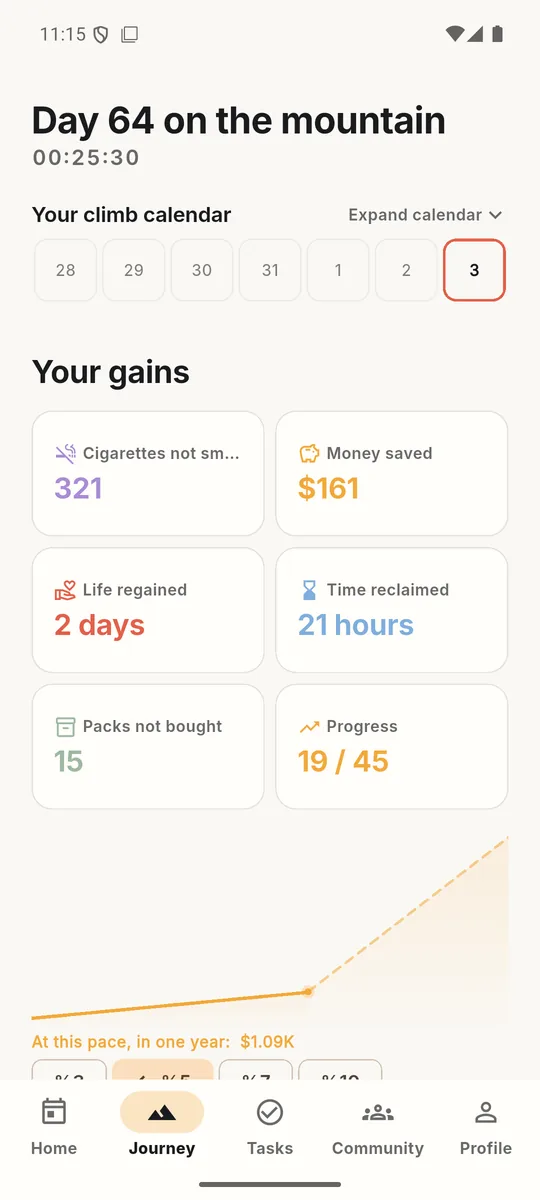
Your gains day by day: cigarettes not smoked, money saved, life reclaimed.
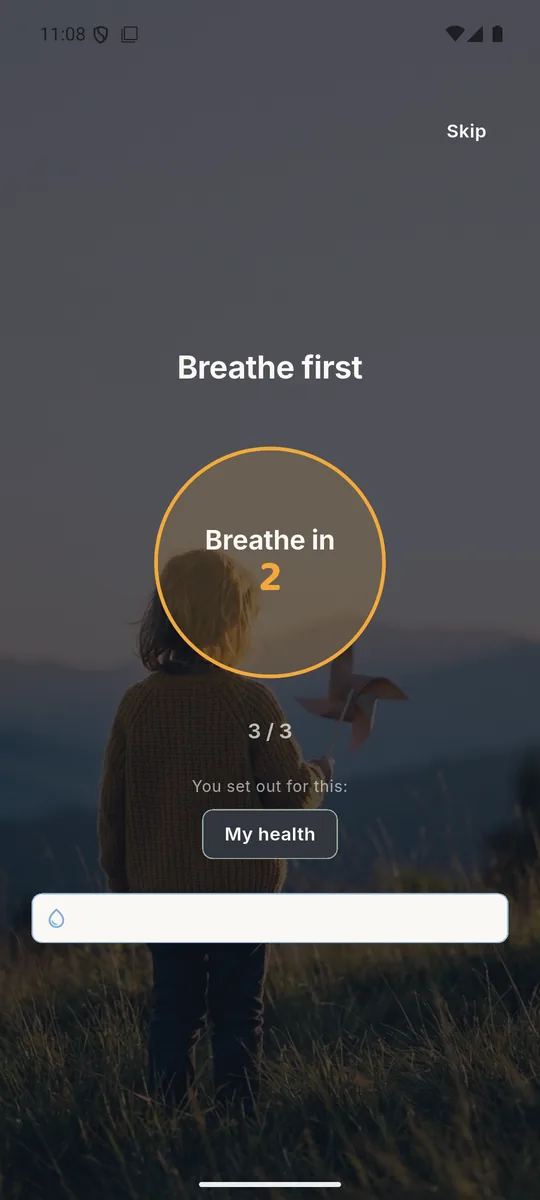
One tap when a craving hits: breathe first. A three-round guided breathing exercise.
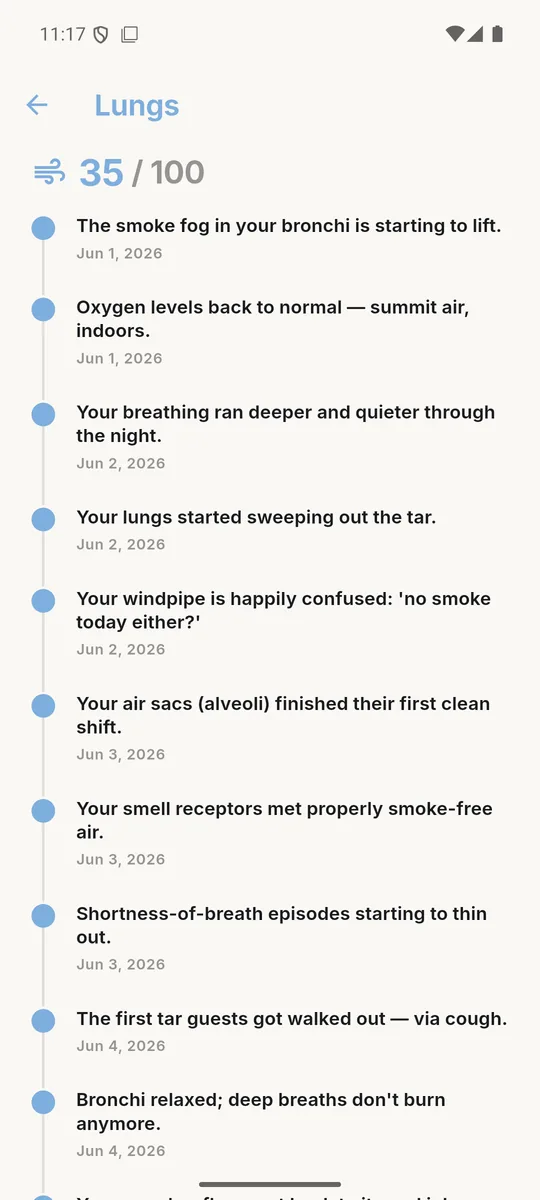
Six routes, 600 stops. Whatever is repairing in your body, you read it there.

You choose the view you are climbing — summit, forest, sea, or your own photo.
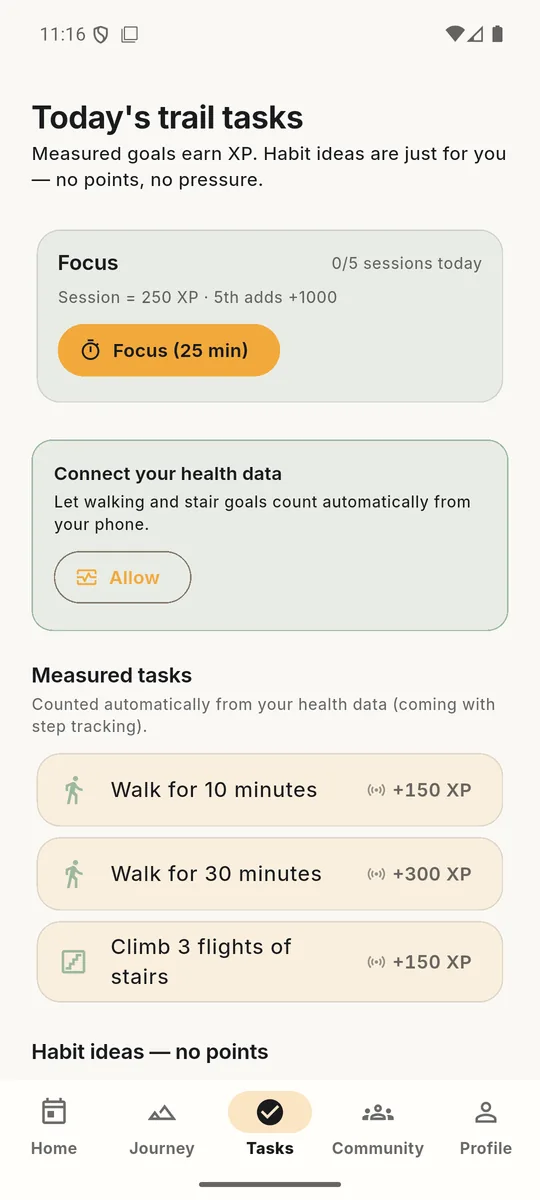
Small tasks every day. You are building a habit, not willpower.
Real screens from the app.
- Hear your own voice when a craving hits — the reason you quit, in your own words. You can add the voices of people you love, too.
- One tap for guided breathing and a distracting task — enough to fill those four minutes.
- 600 stops across six routes: read exactly what is repairing in your body today.
- Your numbers live on your device and keep counting offline — even on a plane.
- You pick the view you are climbing: summit, forest, sea, or your own photo.
- Interface, content and notifications in 14 languages.
You start free. The first day of the journey and the last are both yours.