Gum, toothpicks, water: do these small quit tools actually work?
July 30, 2026·6 min read
Chewing gum won’t cure an addiction — it fills the four minutes a craving lasts. What small tools actually solve, what they don’t, and when to use which.
“Chewing gum won’t make you quit smoking.”
True. But that sentence misunderstands what gum is even for.
These small tools aren’t here to “fix addiction.” Their job is much narrower and much more concrete: to get you through four minutes.
What they solve — and what they don’t
Separating these two makes everything clearer.
What they don’t solve: Physical dependence. A piece of gum doesn’t replace the drop in blood nicotine. With a high level of dependence, what you need is nicotine support or behavioral support, not just gum.
What they do solve: The behavior itself. Smoking is built out of three physical actions — picking up, bringing to your mouth, inhaling. One cigarette is on average 10–12 puffs; for someone who smokes a pack a day that’s around 200 repetitions a day, and over 70,000 a year. A move you repeat that often becomes automatic, and it keeps running even when nicotine isn’t there.
Small tools aim directly at those automatic moves.
Why four minutes?
Because a craving wave usually lasts three to five minutes. We broke down how that wave works in a separate article.
That makes the job measurable: a tool has exactly one task — to keep your hands and mouth busy for four minutes. Anything that does that helps; anything that doesn’t, doesn’t.
So the question isn’t “does gum work,” it’s “does this fill my four minutes?”
Which tool, when?
Each one shines in a different situation:
Water — at your desk, in the car, basically anywhere. The least noticeable. It also changes the taste in your mouth. Drinking a glass slowly takes 1–2 minutes, so about half a wave.
Gum — in social settings, meetings, while walking. The easiest to carry. ⚠️ Go for sugar‑free: forty pieces of sugary gum in a day is a serious sugar load, and in the first weeks your appetite is already up.
Toothpicks / cinnamon sticks — if you miss the feeling of a stick in your mouth. They mimic the physical shape of a cigarette more than anything else, which helps some people and triggers others. You only find out by trying.
Sunflower seeds / nuts — long drives, TV time, evenings. They keep both your hands and mouth busy for a long stretch. ⚠️ The calories are real; you don’t want to go on autopilot with them.
Stress ball / pen / paperclip — when it’s mainly your hands that need something to do. For desk jobs this is often the most practical.
Cold water / splashing your face — for intense waves, when the rest isn’t cutting it. It gives your body a quick jolt and snaps your attention away for a moment. Easy to do at home or work, and you don’t have to carry anything.
Brushing your teeth — the single most effective move after meals. It kills the taste and breaks the ritual.
⚠️ One selection rule: it has to be within reach. Gum in the kitchen or a stress ball in a drawer doesn’t help. If you have to get up and go fetch it when a wave hits, the tool is already late. That’s why the carry‑with‑you list is written as something you scatter around your day.
Tool or avoidance?
This matters, because the same object can do two different jobs — and only one of them works.
Using it as a tool: the wave hits, you take the gum, four minutes pass, you spit it out. Job done.
Using it as avoidance: you chew gum all day just so there’s always something in your mouth and a wave never shows up. That doesn’t erase the wave; it only postpones it.
The test is simple: do you use the tool when the wave comes, or do you use it so the wave never comes? If it’s the second, the dial has slipped. Most people only notice this in the first month — when they finally stop the gum and the craving is still sitting there.
⚠️ In the first week you don’t need to police this too hard. The goal in week one isn’t to “learn it right,” it’s to get through it.
Breathing exercise: the least known, closest at hand
This one sits in a special place on the list because it copies smoking’s third action: a deep breath.
For many people, part of what they call “smoking calms me down” is simply taking slow, deep breaths. Smoking forces you — without noticing — into a kind of breathing exercise.
Here’s the practical version: breathe in for four seconds, hold for four, breathe out for six. One round is 14 seconds; four rounds are about one minute. That already covers a quarter of your four minutes, and you can do it with completely empty hands.
When these tools don’t work
It’s worth being honest: there are three situations where these tools usually aren’t enough.
High dependence. If your first cigarette comes within five minutes of waking up, doing this on gum alone gets hard. The kind of support you need there is different — this is something to talk through with your doctor.
Drinking. When you’ve been drinking, your “decision threshold” drops and the tool doesn’t really stand a chance. The solution isn’t a different tool; it’s keeping the first weeks alcohol‑free.
A really bad day. When the emotional load is heavy, keeping your mouth busy isn’t enough. What helps there is a plan you wrote ahead of time and reaching out to a person.
“Isn’t this all just placebo?”
Partly — and that’s not a flaw.
A tool doesn’t have to solve dependence chemically to be useful. It only has to cover four minutes, because once the wave passes, so does the urge.
So even if part of the effect is placebo, it’s still doing something you can measure: during those minutes, you’re not smoking. And every cigarette you don’t smoke weakens the chain one more time.
There’s also the numbers side. In the first week you usually get three to four waves a day — roughly 25 waves in a week. Each about four minutes. Total: around 100 minutes a week. The only job these tools have is to cover those 100 minutes — which is a much smaller, much more doable job than “solving addiction.”
How do you know a tool is working?
The measure isn’t emotional, it’s numeric — and you can see it when you look at your quit journal.
If a tool is helping, what changes is not the intensity but the length of the wave: a “3 out of 10” craving still feels like a 3, but it ends faster. Someone who expects that doesn’t get disappointed.
⚠️ The unhelpful expectation is: “If I chew gum, I won’t want a cigarette.” You will. The job of the tool isn’t to erase the urge, it’s to help you get over the top of it. When the expectation is wrong, the tool looks useless and you drop it.
By the end of the first week you can usually see which tool works at which time of day. For most people, mornings and evenings need different tools — and that matching is more valuable than the list itself.
Gum doesn’t “cure” dependence; it fills four minutes. That’s its entire job — and that job is real.
The only thing to do today: pick three tools (make water one of them) and put them where you can actually reach them.
If you want something to literally count those minutes, the counter on the right tracks days, and the app holds the breathing exercise and short distraction tasks — the Tar2Star app is built exactly for those moments.
This page is a photo. The app is the film.
These numbers show today. Tar2Star shows you a new one every morning — and stays with you when a craving hits.
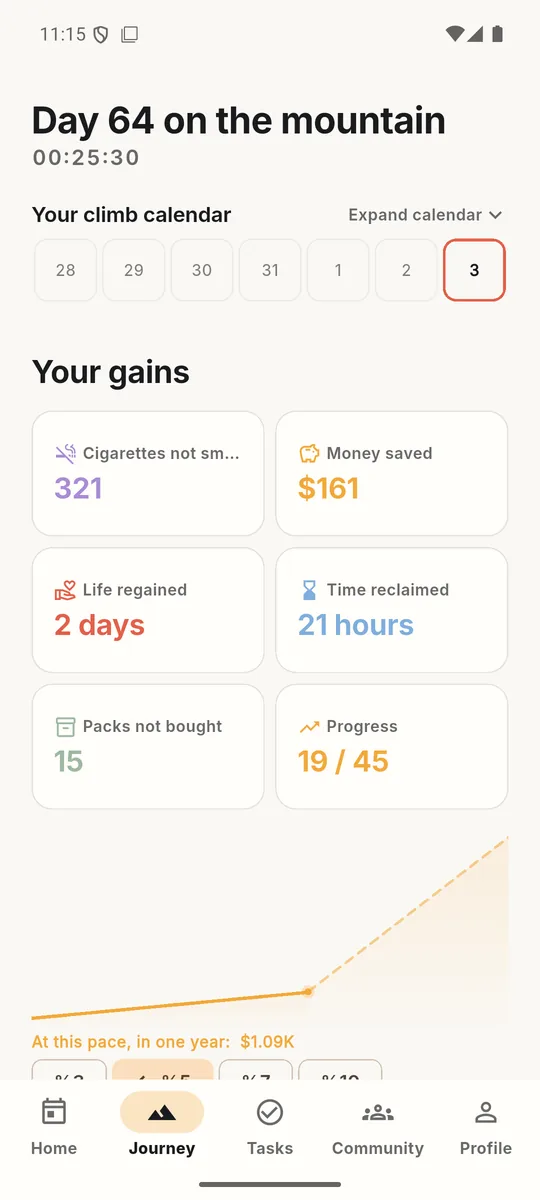
Your gains day by day: cigarettes not smoked, money saved, life reclaimed.
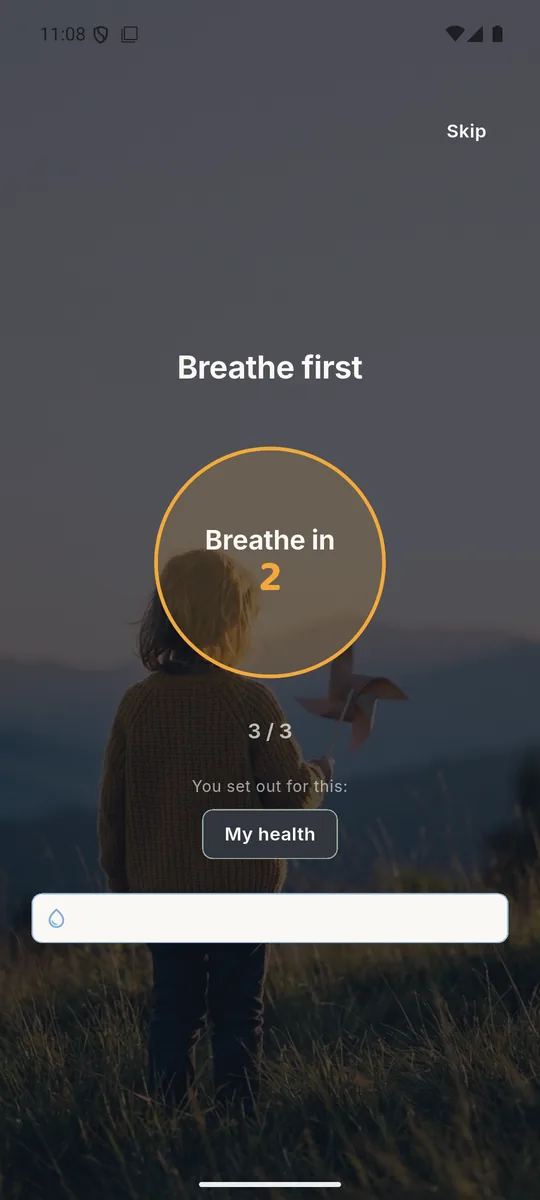
One tap when a craving hits: breathe first. A three-round guided breathing exercise.
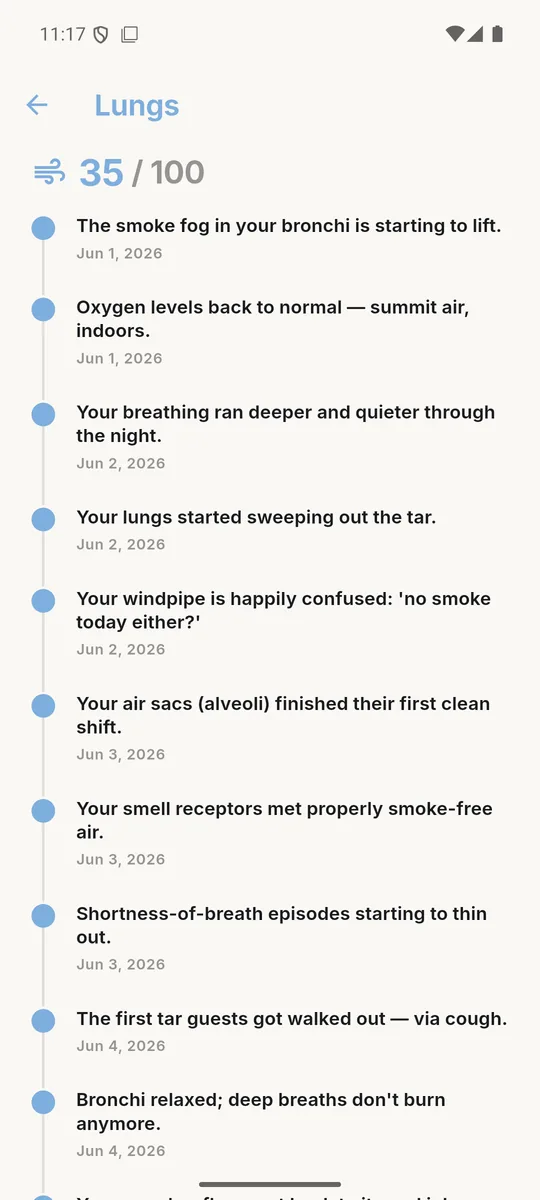
Six routes, 600 stops. Whatever is repairing in your body, you read it there.
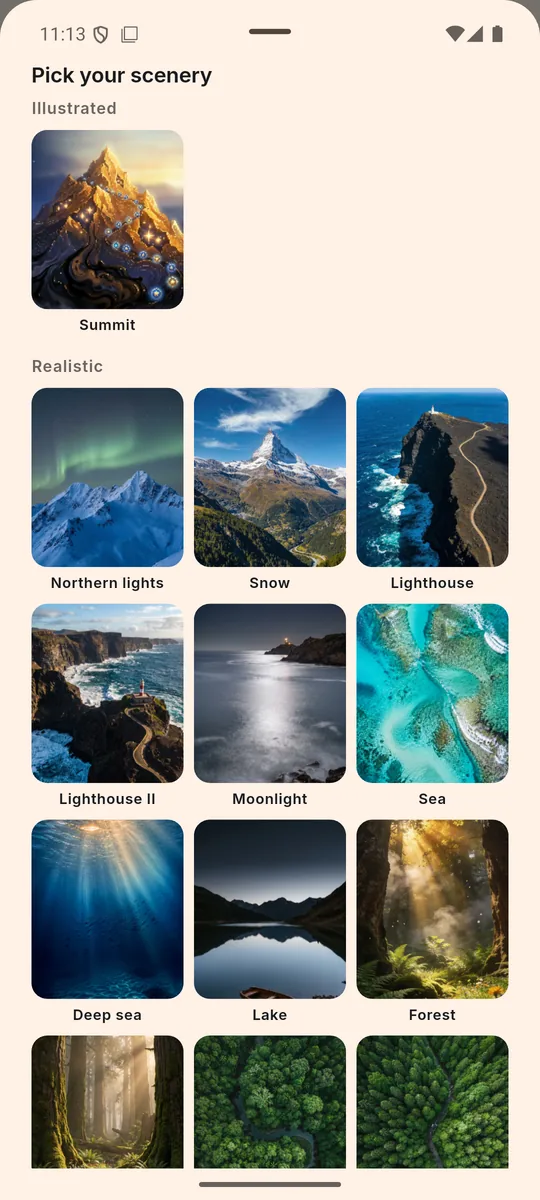
You choose the view you are climbing — summit, forest, sea, or your own photo.
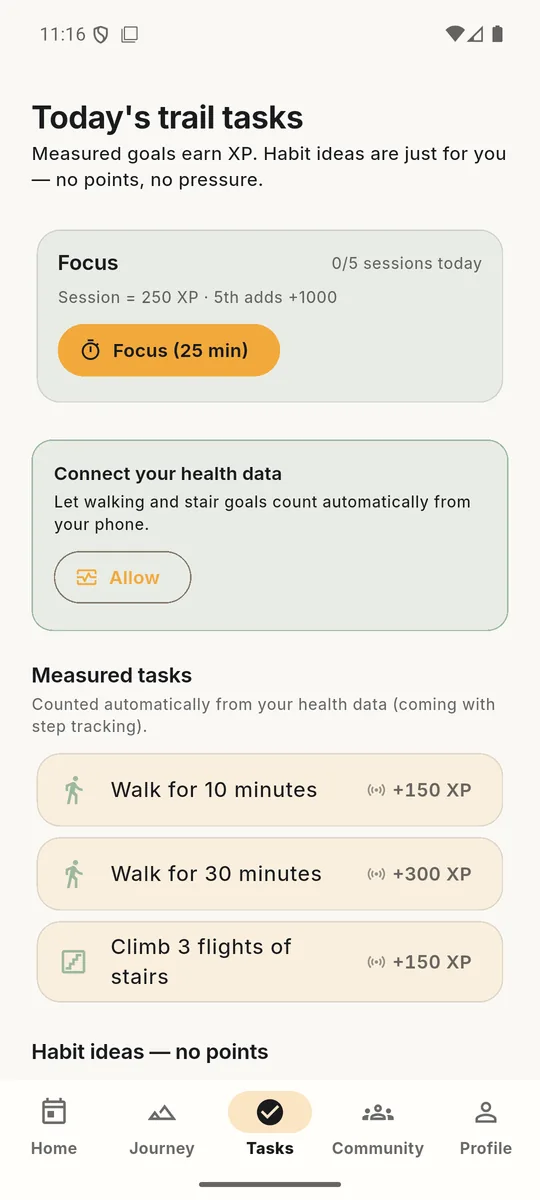
Small tasks every day. You are building a habit, not willpower.
Real screens from the app.
- Hear your own voice when a craving hits — the reason you quit, in your own words. You can add the voices of people you love, too.
- One tap for guided breathing and a distracting task — enough to fill those four minutes.
- 600 stops across six routes: read exactly what is repairing in your body today.
- Your numbers live on your device and keep counting offline — even on a plane.
- You pick the view you are climbing: summit, forest, sea, or your own photo.
- Interface, content and notifications in 14 languages.
You start free. The first day of the journey and the last are both yours.