How much money will you actually save when you quit smoking? Do the math first
July 30, 2026·7 min read
Work out how much smoking really costs you: per day, per year, per decade. Money, time, hidden extras, and the “past total” nobody wants to see.
Most smokers know what they spend on cigarettes in a month. Far fewer know the yearly total. Almost nobody sits down and works out ten years.
And the bigger the number gets, the more convincing it becomes — which is why this is a calculation to do before you quit.
The simple math
Three multiplications:
Daily: pack price × packs per day Yearly: daily × 365 Ten‑year: yearly × 10
For someone who smokes a pack a day, the yearly total in most countries is in the range of a vacation or a major home appliance. Over ten years, you’re in “car down payment” territory.
The cigarette side of the math is just as big — and just as striking as the money: a pack a day means 7,300 cigarettes and 365 packs a year. Ten years is 73,000 cigarettes. That number doesn’t care about currency — it’s the same wherever you live.
⚠️ Do the calculation with your real number. Most people underestimate how many they smoke in a day; when you write it down for one full day, the total usually goes up.
The time cost: the third multiplication almost no one does
People sometimes crunch the money. Almost nobody crunches the time — even though it’s just as concrete.
Formula: about 5 minutes per cigarette × your daily number.
10 cigarettes a day → 50 minutes a day → around 304 hours a year
15 cigarettes a day → 75 minutes a day → around 456 hours a year
20 cigarettes a day → 100 minutes a day → around 608 hours a year, roughly 38 full days awake
That includes walking out to the balcony, stepping outside, waiting for a smoke break. So this is actually a modest estimate.
⚠️ There’s one way time beats money: you can earn money back; you don’t get time back. For someone who feels “I can afford it,” this second number is usually a lot more uncomfortable.
What the math misses: opportunity cost
So far we’ve pretended the money you spend on cigarettes just sits in a box under your bed.
In real life, money you don’t smoke could be sitting somewhere earning interest or growth. Which means the real loss is bigger than the amount you hand over at the register.
The flip side is the motivating part: if you quit and actually put that money aside every month, after ten years you end up with noticeably more than the raw total.
The calculator on the right runs this both ways: what your past spending would be worth today, and the ten‑year curve of what you’ll build if you stop.
Three rules for writing your numbers down
1. Write down your assumptions. Note which pack price you used and what return or interest rate you assumed. Numbers that hide their assumptions feel sketchy; that’s why the calculator shows the assumptions under every figure.
2. Don’t get carried away with inflation. Pack prices will go up — that’s true. But stacking guess on top of guess makes the result feel unrealistic. Using today’s price is already persuasive enough.
3. Don’t count “just the cigarettes.” There’s a whole support cast: lighters, gum, breath mints, extra mouth care, extra coffees, time lost being late. These might not make it into the spreadsheet, but they’re exactly why the final total feels “too low.”
The invisible extras
That third rule deserves its own list, because for most smokers these extras add up to a non‑trivial slice of the yearly total.
Lighters. They get lost, borrowed, replaced. Almost no one tracks them.
Gum, mints, breath products. Everything bought to cover the smell.
Dental cleaning. Needed more often because of cigarette stains.
Dry cleaning and home “de‑odorizing” products. Clothes, curtains, car.
Car value loss. A smoked‑in car sells for less; deep‑cleaning the interior is another line item.
Insurance and health premiums. In some countries, smokers pay more.
⚠️ None of these is huge on its own, which is exactly why they’re ignored. But they’re regular, and they all shrink on their own once you stop smoking.
Turn the number into something real
A raw amount of money quickly turns abstract. What it stands for doesn’t.
Translate your yearly total into a sentence: how many months of rent, how many full tanks of gas, how many months of groceries, how many years of gym membership. Whatever feels real to you.
This “translation” works in any country, any currency, and it takes the argument out of the number: “this much money a year” is debatable; “three months of rent a year” isn’t.
What to actually do with that money is a separate topic — and that same translation is the first step in choosing a target.
Why you should write the number down in advance
Because when you’re having a hard moment, you won’t be doing math.
On a rough evening in week two, your brain will tell you: “What’s one pack?” In that moment, the thing that answers back is not a vague awareness — it’s a number you’ve already written down.
This is the money section of your quit contract. And it’s the easiest way to apply the rule that your reason to quit needs to be concrete — because money is a clean, countable thing.
“Money isn’t an issue for me”
For some people that’s genuinely true, and in that case money won’t be the lever that works. That’s fine — there are plenty of other items in the reasons list.
Two notes, though:
Do the math anyway. Just because it’s “not a problem” doesn’t mean it isn’t worth knowing. Most people rethink the “no big deal” line once they see the total.
Think about what it represents. Money by itself is abstract; what it turns into is not. That’s what we dig into next.
If you “don’t smoke that much”
If you’re on three cigarettes a day or “only when I’m out”, your number will be smaller — and for this group, money is usually the weakest reason.
Still, do the math: even seven cigarettes a week adds up to around 360 a year, and that total surprises most people.
⚠️ Light smokers have their own special blind spot: packs go stale before they’re finished, which means you pay for more cigarettes than you actually smoke. For you, it’s more accurate to calculate based on packs bought, not cigarettes smoked.
The past total: the toughest number
So far everything has been about the future. There’s also a backward‑looking calculation — and for most people it’s the one that hits hardest.
Formula: yearly total × how many years you’ve been smoking.
For someone who’s been on a pack a day for ten years, that’s a hidden slice of ten years of income. And if that money had just sat somewhere, today it would be worth even more — that’s the opportunity cost the calculator on the right also shows.
⚠️ One thing this number is not for: beating yourself up. The only job of the “past total” is to show the scale. Guilt is fuel, not a brake, in this area — and it doesn’t make today’s decision easier; it makes it harder.
The right reading is this: the past is closed, but the same outflow is still happening. What you stop today is the next ten years of the same number.
For most people, the yearly cost of smoking is higher than they think.
The one thing to do today: run those three multiplications and save the number on your phone. Two minutes.
If you want to see the opportunity cost as well, plug your pack price and daily number into the calculator on the right — it shows both the “past” and “future” side of the same story. And if you want to carry that calculation in your pocket, the Tar2Star app was built exactly for that.
This page is a photo. The app is the film.
These numbers show today. Tar2Star shows you a new one every morning — and stays with you when a craving hits.
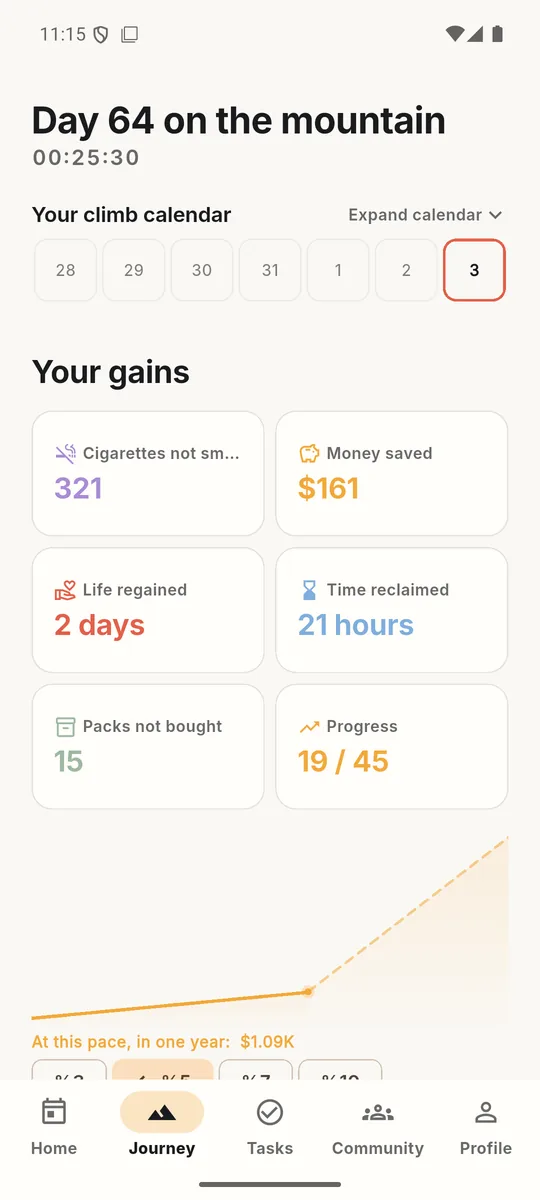
Your gains day by day: cigarettes not smoked, money saved, life reclaimed.
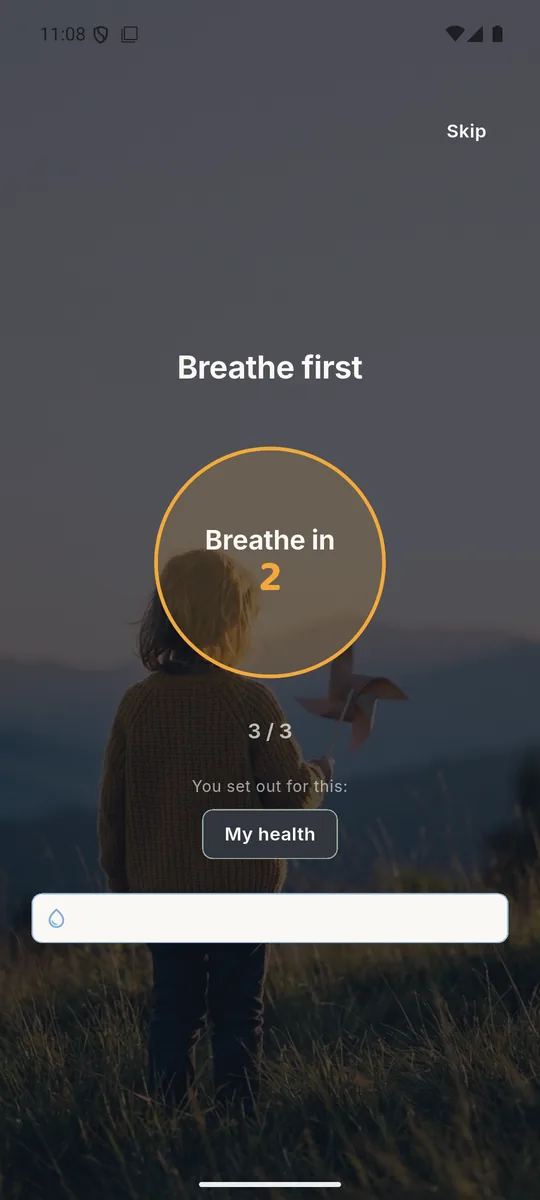
One tap when a craving hits: breathe first. A three-round guided breathing exercise.
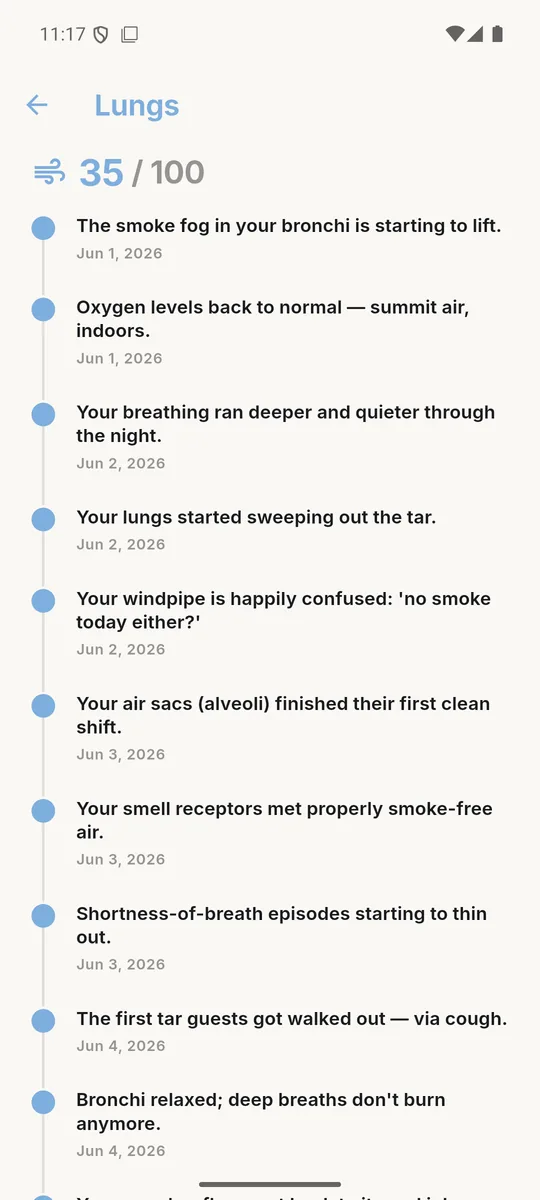
Six routes, 600 stops. Whatever is repairing in your body, you read it there.

You choose the view you are climbing — summit, forest, sea, or your own photo.
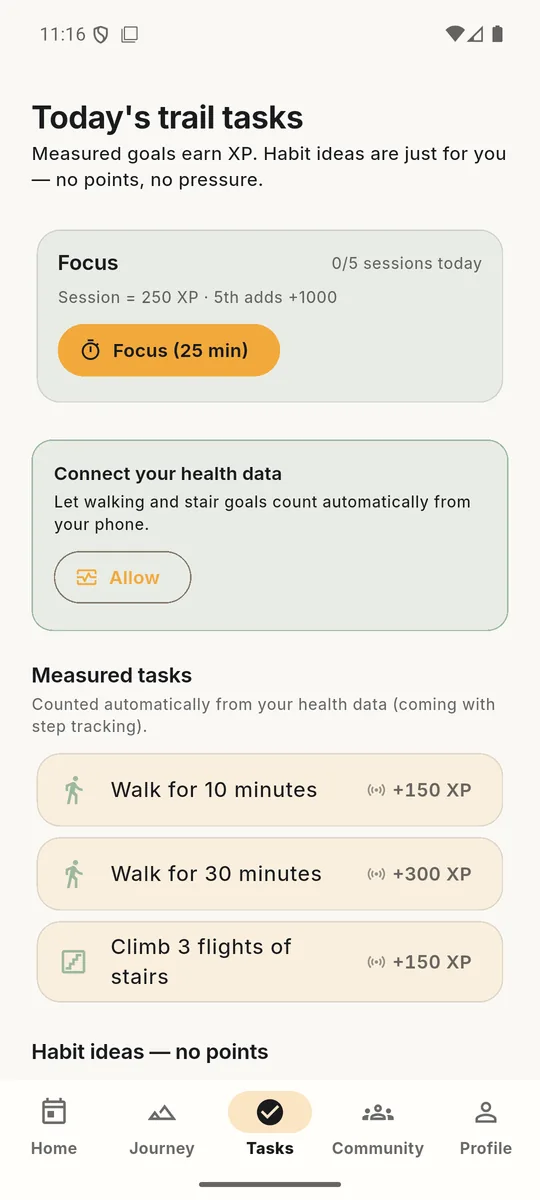
Small tasks every day. You are building a habit, not willpower.
Real screens from the app.
- Hear your own voice when a craving hits — the reason you quit, in your own words. You can add the voices of people you love, too.
- One tap for guided breathing and a distracting task — enough to fill those four minutes.
- 600 stops across six routes: read exactly what is repairing in your body today.
- Your numbers live on your device and keep counting offline — even on a plane.
- You pick the view you are climbing: summit, forest, sea, or your own photo.
- Interface, content and notifications in 14 languages.
You start free. The first day of the journey and the last are both yours.