Your First 24 Hours Smoke‑Free: Hour‑by‑Hour Survival Plan
July 30, 2026·7 min read
Quit day feels endless, but real cravings total 15–25 minutes. Here’s a simple 6‑block plan to get through your first 24 hours smoke‑free.
The hard part of the first 24 hours isn’t spread out, it’s clumped together. Cravings pile up at certain times of day.
This guide flags those times in advance. The goal isn’t to “tough it out” but to have a ready response for each block.
Why plan it hour by hour?
Because when a craving hits, you can’t think straight enough to plan.
When the wave of wanting a cigarette shows up, your brain looks for the easiest fix — and the usual fix is right there. Having a written response lets you follow a plan instead of trying to invent one in the middle of a craving.
We covered the first hour of quit day separately; this guide is for the rest of the day.
By the numbers, a typical first day looks like this: if you usually smoke twenty cigarettes a day, there are about twenty triggering moments — but not all of them become full‑on crises. Most were just automatic moves, and once the object disappears, many of those moves drop away on their own. For most people, the number of real waves is between three and six — and each one lasts about four minutes.
So the total “hard time” on day one is around 15–25 minutes. Not the whole twenty‑four hours. Knowing this shrinks the size of the day in your head.
06:00–09:00 — Morning block
Why it’s hard: You haven’t smoked all night, so nicotine in your blood is at its lowest. The morning cigarette is usually the most automatic one of the day.
Plan: Get out of bed right away. Drink water. Change your breakfast setup (coffee becomes tea, or drink your coffee in a different room). Read your anchor sentence. Start your counter. Walk for fifteen minutes.
Shape of the craving: Sharp but short. Usually a single wave.
09:00–12:00 — First work block
Why it’s hard: Start of the workday and the first break. The break itself is a trigger — your “smoke break” was doing three jobs: pausing, changing location, and social contact.
Plan: Don’t cancel the break — change what you do in it. Stairs, water, window. For the first few days, skip the smoking area.
Shape of the craving: Comes often, intensity medium.
12:00–15:00 — Lunch and slump
Why it’s hard: After‑meal smoking is one of the strongest pairings. On top of that, there’s a natural dip in energy after lunch, and cigarettes were your go‑to answer for that dip.
Plan: Stand up as soon as you finish eating — sitting at the table kicks off the old chain. Take a short walk, brush your teeth, chew gum. Use water and movement to deal with the energy drop.
Shape of the craving: One of the toughest blocks of the day.
15:00–18:00 — Heading home
Why it’s hard: You finish a chunk of work and your brain expects a reward. Driving often falls into this block — cigarettes in the car are among the most automatic.
Plan: Make sure the lighter is out of the car. Start your trip with different music or a podcast. If possible, walk a couple of stops. When you get home, immediately change your clothes, shower, or wash your face — fill that transition moment with a new ritual.
Shape of the craving: Strong, because your reward expectation is at its peak.
18:00–22:00 — Evening
Why it’s hard: Wind‑down time. Alcohol risk lives here too. And as the day ends, the line shows up: “I did great, I deserve one.”
Plan: No alcohol on day one — that single rule takes care of half of this block. Keep your hands busy. Check your counter. Message someone.
⚠️ “I deserve one” is the most dangerous moment of day one, because it doesn’t feel like a crisis — it feels like a treat. A single cigarette doesn’t close the loop; it builds a new one.
22:00–00:00 — Before bed
Why it’s hard: A cigarette before sleep is a ritual. And in the first days, falling asleep can be trickier.
Plan: Go to bed early. Put screens away. Keep anything related to smoking out of the bedroom. Write a couple of lines in your quit journal.
Shape of the craving: Gentle but drawn out.
Why split the day into six blocks?
The reason isn’t random: nicotine levels in your blood rise and fall during the day, and these blocks sit on top of those waves.
There’s a second reason, and in practice it matters more: twenty‑four hours is too big to carry as a single goal. If you say “I won’t smoke at all today” at seven in the morning, you’re staring at seventeen hours ahead, and that distance is tiring just to look at.
Block thinking shrinks the target: you’re not carrying the whole day, just three hours. When those three hours are done, the next block starts, and at no point are you staring at a seventeen‑hour stretch.
⚠️ The same logic helps on days two and three — in fact, it’s even more useful on day two, when the day‑one excitement has faded but withdrawal is still peaking.
Emergency kit
Pack it somewhere you can grab easily and keep it with you:
Gum or sugar‑free mints
Water
Something to keep your hands busy (pen, paperclip, stress ball)
A card with your anchor sentence written on it
The number of the person you’ll contact if it gets rough
We put a full list of useful things to carry in a separate guide.
Three things not to do today
Half of a plan is what you will do; the other half is what you won’t — and that second half rarely gets written down.
Don’t start a diet. Stacking two hard things on the same day makes both harder. Worrying about weight is real, but it can wait; for the first week, there’s just one job.
Don’t schedule a difficult conversation for today. That postponed argument, that raise meeting, that big confrontation. Anything that will add extra stress — if it can be moved, move it.
No alcohol. This is the one strict rule for day one. Alcohol softens your decision and directly triggers one of the strongest smoking links.
⚠️ There’s a fourth item that depends on you: being alone or not being alone today. For many people, not staying alone helps. For some, the opposite is true. Your past attempts usually tell you which one you are.
If the plan goes off track
The first day rarely unfolds exactly like it’s written — and that’s not a sign of failure.
If you miss the plan in one block, the move is not to restart the whole day. You simply step into the next block. The six blocks are independent; losing one doesn’t knock the rest down.
⚠️ The risky sentence here is: “I already messed up the plan.” That line turns the loss of a single block into the loss of the whole day and leaves your evening block uncovered — even though evening is the part of the day that needs planning the most.
Weekday or weekend?
This question shapes what your first 24 hours look like, and there isn’t one right answer — but there is a way to choose.
On a weekday, the blocks are already built in: work, break, commute, evening. The structure is there, so it’s easier to attach a plan to it. The hard part is social: the break area, smoking buddies, work stress.
On a weekend, stress is lower but structure is missing. Empty hours need to be filled, and empty time is one of the trickiest triggers in the first days. On top of that, alcohol risk is usually higher on weekends.
A simple rule of thumb: if most of your chains are tied to work, starting on a weekend helps; if they’re tied to home, a weekday start has the edge. We’ve covered how to pick a quit date in more detail elsewhere.
At the end of the day
Look at your counter: one full day. Write two lines in your journal: how many waves showed up, and which one was the hardest.
All you need to know about tomorrow: day two brings a different kind of difficulty — the day‑one excitement fades while withdrawal peaks. Knowing this keeps tomorrow from catching you off guard.
Your first 24 hours are split into six blocks, and each block has its own response.
Today’s only task: copy these six blocks onto a sheet of paper and write one specific thing you’ll do next to each.
If you want your counter ready to go on quit‑morning, set your date in the counter on the right. And if you want your craving tools in your pocket, the Tar2Star app was built exactly for these hours.
This page is a photo. The app is the film.
These numbers show today. Tar2Star shows you a new one every morning — and stays with you when a craving hits.
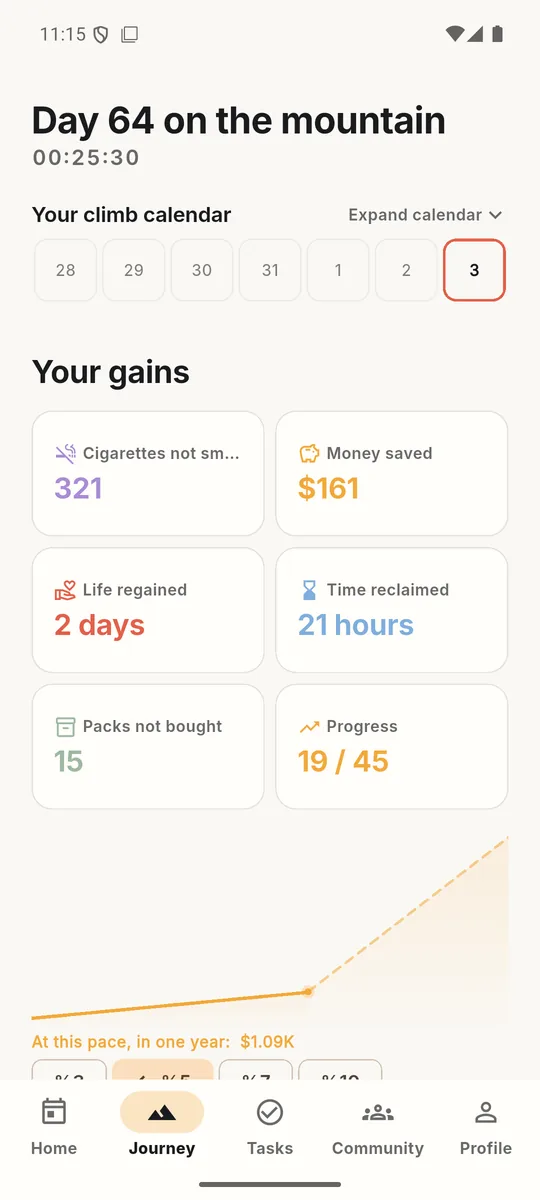
Your gains day by day: cigarettes not smoked, money saved, life reclaimed.
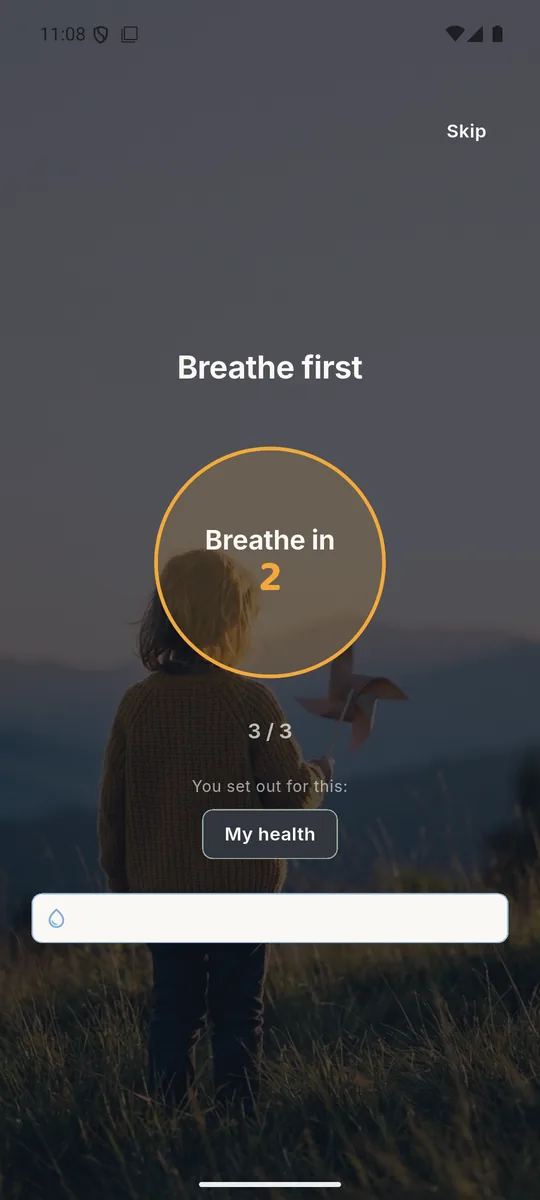
One tap when a craving hits: breathe first. A three-round guided breathing exercise.
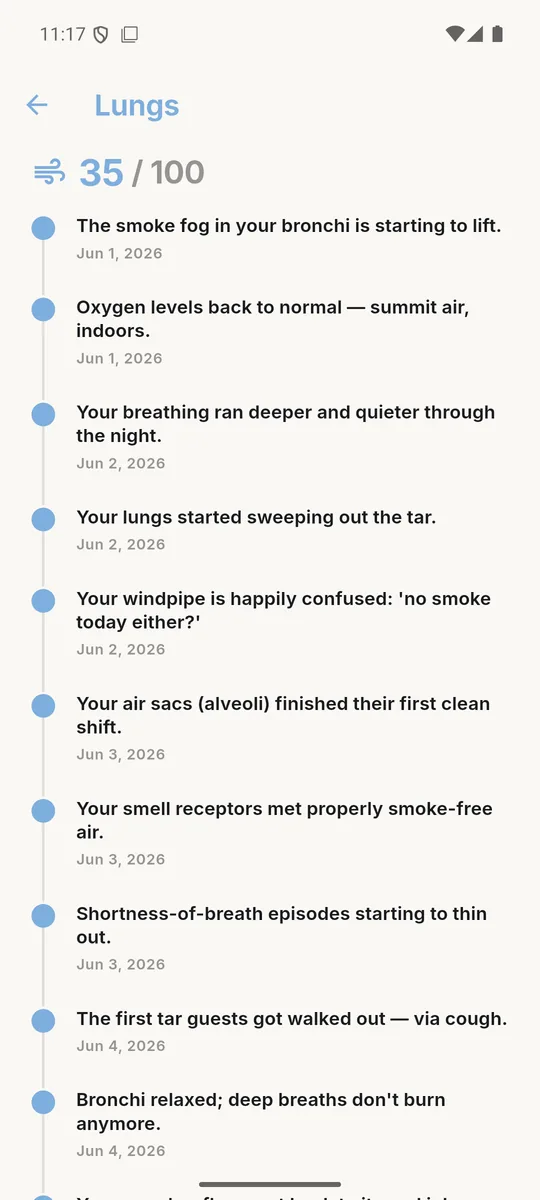
Six routes, 600 stops. Whatever is repairing in your body, you read it there.

You choose the view you are climbing — summit, forest, sea, or your own photo.
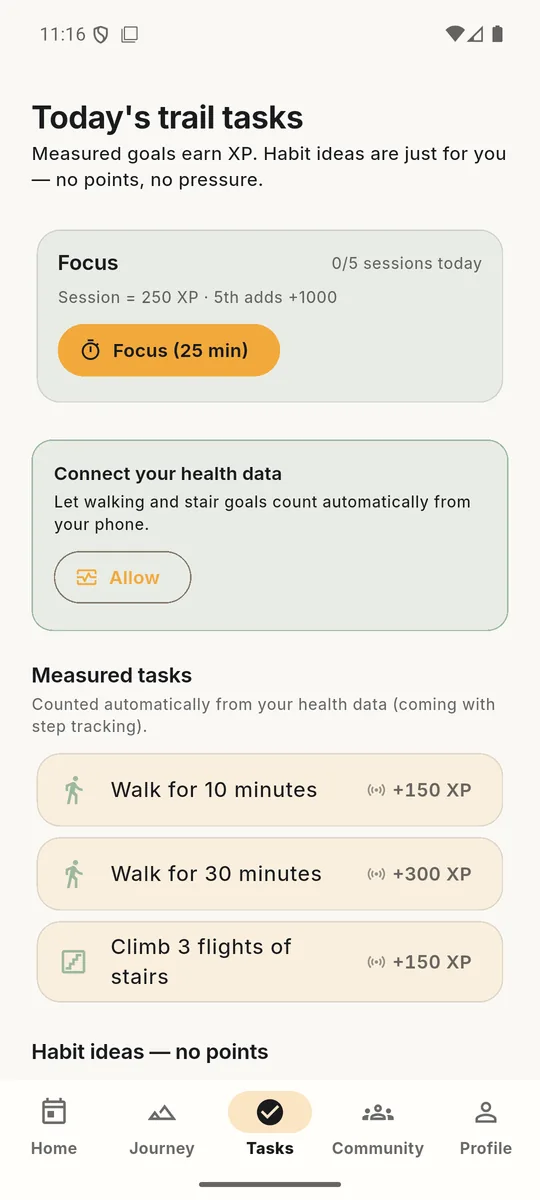
Small tasks every day. You are building a habit, not willpower.
Real screens from the app.
- Hear your own voice when a craving hits — the reason you quit, in your own words. You can add the voices of people you love, too.
- One tap for guided breathing and a distracting task — enough to fill those four minutes.
- 600 stops across six routes: read exactly what is repairing in your body today.
- Your numbers live on your device and keep counting offline — even on a plane.
- You pick the view you are climbing: summit, forest, sea, or your own photo.
- Interface, content and notifications in 14 languages.
You start free. The first day of the journey and the last are both yours.